

Series 37: Forever Peace or Forever Wars
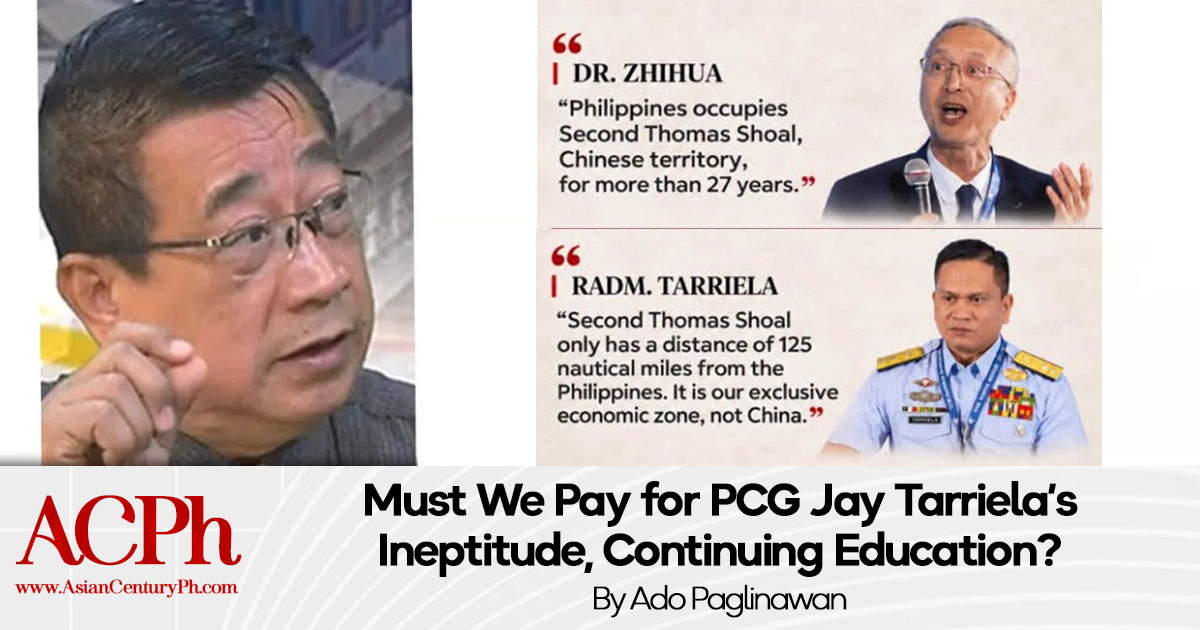
Philippine Coast Guard (PCG) spokesperson Jay Tristan rejected a Chinese scholar’s claim that Ayungin (Second Thomas) Shoal is Chinese territory, awkwardly stressing that the disputed feature lies within the Philippines’ exclusive economic zone (EEZ).
Why was it awkward? First, the exchange took place among a learned public – representatives from ASEAN member states and China across different levels. Leaders, foreign ministers, senior officials, academe and technical working groups, who were looking for common ground and solutions to problems.
Instead Tarriela in his usual broken English, gave them a monologue of encounters between Chinese and Philippine ships engaged in conflict, depicting China as an aggressor.
Dr. Zheng Zhihua of Shanghai Jiao Tong University challenged Tarriela’s tall stories explaining that Beijing was merely defending its territory, when using water cannons against Philippine vessels in the South China Sea.
It must be clarified here, for the umpteenth time, that the use of water cannon is an internationally accepted norm in law enforcement. The same goes for lasers, sonars and other Non-Lethal Weapons (NLWs).
Second, his rebuttal using sovereign rights to EEZ against Zheng’s assertion of Chinese sovereignty, was asymmetrical. These are apples and oranges, and when recklessly used by Tarriela, turn to sour grapes.
“I would just like to correct you in saying that China does not have any territorial jurisdiction whatsoever in Second Thomas Shoal,” the PCG spokesman said.
How did he support this statement?
“The last time I checked, Second Thomas Shoal only has a distance of 125 nautical miles from the Philippines. And it is our exclusive economic zone, not China’s.”
Then he introduced yet another misplaced citation of international law: the United Nations Convention on the Law of the Sea (UNCLOS), provides for an EEZ extending up to 200 nautical miles from a country’s baselines.
Sovereignty
Let us go back to basics here, lest we be misled by glib tongues.
In sovereignty, a state holds supreme lawmaking, regulatory, and enforcement power within its boundaries without external interference.
This involves ownership of the land and what is under the land, its internal waters such as bays, rivers, and ports; and territorial sea extending 12 nautical miles from its coastal baseline, for what is under the seabed, the seabed, the water column and the surface of the water, and the aerospace over land and water.
To preserve its territorial integrity foreign states cannot enter, occupy, or exercise legal authority on land territory without consent. Foreign vessels have specific transit and innocent passage rights in designated sea areas, whereas land borders are strictly closed to unauthorized entry.
Governments manage land use and natural resources under national law, alongside indigenous land rights, public trusts, and access to resources within its boundaries.
Sovereign Rights
Under the United Nations Convention of the Law of the Sea (UNCLOS), sovereign rights are specific, functional entitlements a coastal state holds over natural resources in certain waters beyond its territorial sea.
They apply primarily to the Exclusive Economic Zone (EEZ) up to 200 nautical miles and the continental shelf which can extend beyond the EEZ under specific geological conditions subject to validation by the United Nations Commission on the Limits of the Continental Shelf.
They only grant exclusive rights to explore, exploit, conserve, and manage living and non-living natural resources in the waters, seabed, and subsoil. They cover activities such as fishing, oil and gas extraction, seabed mining, and generating energy from water, currents, and winds.
Other countries retain freedoms in the EEZ, including navigation, overflight, and laying submarine cables and pipelines, provided they show due regard for the coastal state’s rights.
Tarriela’s brain fog
When Tarriela, however, talks about EEZs, it is evident that he has only read Article 55 that defines the EEZ as an area beyond and adjacent to the territorial sea, governed by the specific legal regime of Part V regarding coastal state rights/jurisdiction and other states’ rights/freedoms.
But he either has not read or disregards Article 74 that provides, that delimitation of the EEZ between states with opposite or adjacent coasts shall be effected by agreement, on the basis of international law in the event of a dispute.
When Tarriela talks about ECS, he may only be aware of Article 76 that defines it and how it sets outer limits, but glosses over Article 83 that governs how overlapping continental shelves between states with opposite or adjacent coasts are delimited.
Clarification number one: Sovereign right is not sovereignty. A coastal state does not own the EEZ or continental shelf outright; they do not become part of its territory.
Clarification number two: Having a right is distinct from the exercise of that right.
UNCLOS may automatically award rights or entitlements but the convention also provides for rules how such entitlement when disputed, is to be first delimited between or among the actors.
In emphasis, a formally disputed entitlement cannot be enforced unilaterally.
This is explicitly explained in Article 59 of UNCLOS.
“Basis for the resolution of conflicts regarding the attribution of rights and jurisdiction in the exclusive economic zone. In cases where … a conflict arises between the interests of the coastal State and any other State or States, the conflict should be resolved on the basis of equity and in the light of all the relevant circumstances, taking into account the respective importance of the interests involved to the parties as well as to the international community as a whole.
Disputes have to process under Article 38 of the Statute of the International Court of Justice in order to achieve an equitable solution before any enforcement is executed.
Transparency or nominalateralism?
President Ferdinand Marcos Jr., launched in early 2023 a strategy that relies on recording and publishing Chinese Coast Guard challenges in the South China Sea that has courted several issues with its execution:
- Wrong premise. Philippine government presence is always challenged in the South China Seas because of its presence at the wrong place at the wrong time and for the wrong reasons.
- Unilateralism. Almost always, Philippine exercise of “jurisdiction” shows onerous enforcement of “entitlement” over disputed areas or illegal delimitation in disrespect of the rights of another coastal state.
- Escalation Over Deterrence. Observers note that publicizing every encounter has not deterred China’s what it calls “gray-zone” tactics. Instead, critics argue it has provoked Beijing into more aggressive physical blockades, water cannon attacks, and swarming maneuvers.
- Inconsistent Messaging. Government officials have struggled to define the policy’s exact scope; often videos and photos shown by the Philippine government to assert violation of international law, conflicts with basic rules of International Collision Regulations (COLREGS).
- Diplomatic Isolation in ASEAN. Neighboring Southeast Asian claimants like Vietnam, Malaysia, and Indonesia largely favor quiet diplomacy. Manila’s public approach has failed to win unified regional backing, leaving the Philippines exposed to direct friction with Beijing.
- Nominalateralism. Transparency is transparency. But when twisted to trick international relations to endeavors that yield diminishing marginal returns, or to fish for false starts to suit the interests of a third country engendering reputational cost to China, it ceases to be a tool for accountability and instead becomes an instrument of provocation—eroding the quiet diplomatic channels necessary for de-escalation and locking all parties into rigid, public posturing.
Transparency degrades into performative statecraft that sacrifices genuine bilateral problem-solving on the altar of geopolitical theater, leaving the region to bear the strategic risks while external powers reap the benefits. It becomes weaponized opacity—a selective curation of facts designed not to illuminate the truth, but to manufacture confrontation and foreclose the very compromises that durable peace requires.
SeaLight
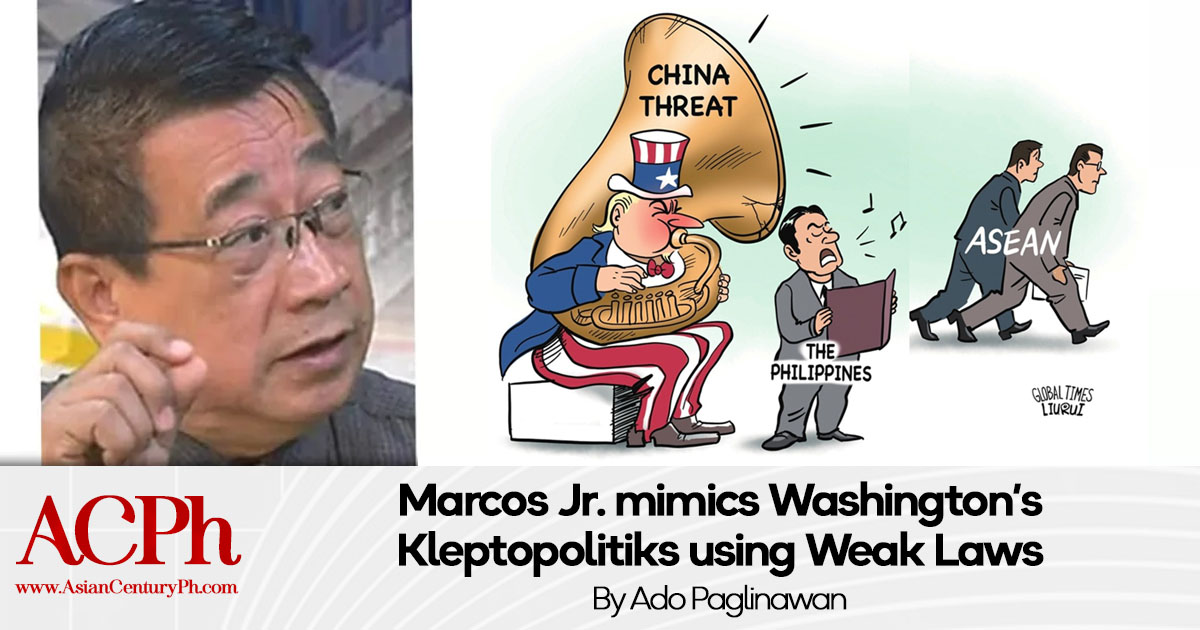
Perhaps the most glaring defect of this transparency initiative has been directly linked to a state that is neither coastal or regional, and is not even a member of the UN Convention of the Law of the Sea.
“Public information indicates that SeaLight is affiliated with Stanford University’s Gordian Knot Center for National Security Innovation, established in 2021 with sponsorship from the US Office of Naval Research and funding from the US Department of Defense. The (initial) funding sources amounted to approximately $12.8 million.”
Must Read:
https://www.globaltimes.cn/page/202608/1367768.shtml
Stanford University has been host to many platforms directly funded by the US Government or through its money laundering network of private suppliers to the Deep State or the United States war economy.
“Public records indicate that SeaLight’s “director” Raymond Powell served 35 years in the US Air Force, including posts in the Philippines, Japan, Germany, and Qatar. In 2022, following his departure from overseas service, he launched Project Myoushu, which evolved into SeaLight in 2023.”
Simply stated, SeaLight and the transparency strategy are an American-backed information warfare campaign.
Critics argue that publicizing every maritime friction point generates intense domestic outrage and media sensationalism, stripping diplomats of the quiet, closed-door space needed to negotiate compromises between Manila and Beijing.
Acting as an external wedge, it supplies Manila with satellite data and media framing, so that Washington can keep China entangled in reputational disputes with its neighbors without committing direct U.S. military forces.
Powell and his platform, however, lost their credibility when they expanded beyond tracking ships to investigating Chinese-language schools, media outlets, and academic exchanges in the Philippines, which Beijing views as an effort to sever normal people-to-people cultural and institutional ties.
Chinese sovereignty
Powell and Tarriela’s weakest point is the fact of Chinese sovereignty clashing with Philippine claims for sovereign rights.
The briefest explanation of how China acquired its sovereignty comes from Victor Zhikai Gao, is a Chinese lawyer, businessman, academic who is widely known in international media for commenting on China’s foreign policy, trade, and geopolitics. He is also vice president of the Beijing-based center for China and Globalization, and chairman and professor of international relations at Soochow University.
Gao asks: “To whom did Japan return the South China Sea after the Second World War?”

Forgive me but consider this as just a matter of review.
The structural construction starts in the 1895 Treaty of Shimonoseki when China was forced to declare Korean Independence and cede Formosa (Taiwan), its Pescadores Islands and the Liaodong Peninsula of Manchuria to the Japan after the Qing dynasty lost to the Meiji dynasty in the First Sino-Japanese War (1894-95).
Japan’s long-term expansionist policies in Asia, starting with the 1931 invasion of Manchuria and escalating into a full-scale invasion of mainland China after the Marco Polo Bridge Incident on July 7, 1937, started the Second Sino-Japanese War.
This was waged between the Empire of Japan and the Republic of China, as led by the Kuomintang Party with the initial backing by the Chinese Communist Party.
On September 1937, Japan occupies the Pratas Islands after claiming exclusive rights over several South China Sea archipelagos.
On December 1938, the Japanese Imperial Navy lands on and occupies parts of the Spratlys Islands, it calls Shinna Soto.
On February 1939, Japanese forces invade and occupy Hainan Island.
On March 1939, Japan took full control of the Spratly Islands by occupying portions that were earlier annexed by France in 1933.
The Japanese forces erected garrisons in the islands, and constructed a submarine base on the biggest island Itu Aba which they referred to as Nagashima or Long Island.
On April 1939: Japanese troops invade the Paracel Islands, declaring them a Japanese protectorate and later placing them under the administration of the Governor-General of Formosa (Taiwan) in 1941.
Deflection onto World War II
Japan expected a quick collapse of the Chinese resistance following a full-scale war after the Marco Polo Bridge Incident. Instead, Chinese forces under a Nationalist-Communist United Front refused to surrender, retreating inland to Chongqing.
Stalled in a massive, costly continental land war, the Imperial Japanese Army required vast amounts of raw materials—particularly oil, rubber, and steel—to sustain its war machine.
In anticipation that Western powers would prop up the Chinese resistance with financial and material aid, Japan signed the Tripartite Pact in September 1940, officially allying itself with Nazi Germany and Fascist Italy. This formally linked the Asian conflict with the European theater
During the same month, in order to choke off Western and Soviet supply routes into China, Japan invaded northern French Indochina from September 1940, and later expanded its occupation to southern French Indochina in July 1941.
In response to Japanese aggression in China and Indochina, the United States, Great Britain, and the Netherlands froze Japanese assets on July 26, 1941, and enacted the full oil and scrap metal embargo starting on August 1, 1941.
Because Japan imported over 80% of its oil mostly from the US, the embargo threatened to paralyze the Japanese military and economy, Japan had no choice but expand to Southeast Asia to seize its oil field.
To preempt any allied moves, Japan launched preemptive attacks on December, 1941 on Pearl Harbor, the Philippines, Malaya and Hongkong.
This transformed the Second Sino-Japanese War from an isolated regional conflict into the Pacific Theater of World War II, as China officially joined the Allied Powers alongside the U.S., Great Britain, and the Soviet Union.
Winning back lost territories
From November 22 to 26, Franklin D. Roosevelt, president of the United States; Winston Churchill, prime Minister of the United Kingdom, and Chiang Kai-shek, chairman of the National Government of China met in the First Cairo Conference in Egypt, focusing on coordinating military operations against the Empire of Japan in World War II and solidifying China’s role as the latest member of the “Big Four” major Allied powers.
The conference released a declaration on December 1, 1943, providing among others:
“It is their purpose that Japan shall be stripped of all the islands in the Pacific which she has seized or occupied since the beginning of the first World War in 1914, and that all the territories Japan has stolen form the Chinese, such as Manchuria, Formosa, and the Pescadores, shall be restored to the Republic of China.”
British Prime Minister Winston Churchill, and Chinese President Chiang Kai-shek again held a summit with the United States, this time represented by President Harry S. Truman, at Potsdam, Germany to establish the terms for Japan’s unconditional surrender at the close of World War II, warning of “prompt and utter destruction” if ignored.
The Potsdam Declaration was issued on July 26, 1945, Section 8 of which stipulated:
“The terms of the Cairo Declaration shall be carried out and Japanese sovereignty shall be limited to the islands of Honshu, Hokkaido, Kyushu, Shikoku and such minor islands as we determine.”
After Japan’s historic surrender, General Douglas MacArthur, in his General Order No. 1 on September 2, 1945, directed Japanese forces in mainland China, Formosa (Taiwan), and French Indochina north of 16° north latitude to surrender to Generalissimo Chiang Kai-shek.
Acting under that authority, the ROC government dispatched naval task forces in late 1945 and 1946. Chinese officials accepted the surrender of remaining Japanese garrisons at Yulin Naval Base on Hainan Island and planted stone sovereignty markers on Woody Island (for the Paracels) and Itu Aba/Taiping Island (for the Spratlys).
Japan consummated the Cairo and Potsdam Declaration when with the signing of the 1952 Treaty of Taipei with the Republic of China, and perfected through the 1972 Joint Communique between Japan and the People’s Republic of China.
Asymmetric idiot
The sovereignty of China over the land and sea of the South China Sea has not been diminished until China decided to share the waters and signed the UN Convention of the Law of the Sea on December 1982 and later ratified it on 7 July 1996.
For its part, the Philippine signed UNCLOS also in 1982 but ratified it earlier than China in 1984.
The Philippine claims in the Spratlys were formalized by Presidential Decree 1596 only in 1978 “creating” the Kalayaan Group of Island, has not been taken seriously except for the fact that we had occupied seven high tide elevations or rocks.
The decree has had no international binding effect because it only was enacted by internal or municipal legislation. The claims are also disputed by China, Vietnam and Taiwan.
But the Philippines, having no title to these features, only administers them on the basis of effectivités or effective control. They are: namely Pag-asa (Thitu), Likas (West York), Lawak (Nanshan), Kota (Loaita), Parola (Northeast Cay), Patag (Flat), Panata (Lankiam Cay), the earliest of which was in 1971.
Nonetheless, the decree that provided for the archipelagic “cover” of these features essentially contradicted Article 47 of UNCLOS that made a new definition of the maritime term “archipelago”, that subsequently it was effectively repealed by the Philippine ratification of UNCLOS in May 8, 1984.
Manifesting before the Arbitral Tribunal filed by the Philippines against China on July 8, 2015, our government and legal panel confirmed this under the principle of lex posteriori derogat priori.”
Under Philippine law, as a treaty lawfully entered into by the Philippines, UNCLOS is part of internal law, and it has the same status as national legislation.
And that means, to the extent that PD 1956 might be consistent with UNCLOS, PD 1956 is to be treated as having been effectively repealed by the Philippines’ subsequent ratification of UNCLOS.
Powell and Tarriela have no sense of history. To them international law only started with the UNCLOS effectivity in 1994, forgetting the Philippines has no historic titles outside what the United States bequeathed to the republic when its independence was declared in July 4, 1946.
Ayungin Shoal
Sarcastically, Dr. Zheng said “No country occupied Second Thomas Shoal as easy like Philippines did.”
There are three considerations affecting the Philippine claim to this feature also known as Ayungin Shoal or Rén’ài Jiāo to China.
First, on the basis of the 2016 Arbitral Award, Ayungin Shoal being by itself a low tide elevation (LTE) cannot be eligible for sovereignty claim.
Second, the arbitral tribunal walked over eggshells on this feature because it said it could not place the Philippine submission under the its jurisdiction, as UNCLOS makes an exception “quintessentially a military situation” (Award Paragraph 1181). A 27-year standoff involving the military on both sides started there in 1999 when the Philippines grounded a derelict military ship on the shoal
Where the Philippines can claim sovereignty over is the BRP Sierra Madre, but not the Ayungin Shoal.
Third, while it is true that the tribunal found the nine-dash line as having no legal basis under UNCLOS, China never consented to the arbitration, any of its processes and its ultimate award.

The 2016 Arbitral Award, which the Philippines has been celebrating as a victory for the past ten years, is nothing but a piece of paper that has no teeth.
The issues between the Philippines and China, still hang on a yet-uneven keel with no actual lawfully enforce value – unstable, unresolved, and lacks any legal weight or binding power, except by bilateral agreement on specific concerns.
China bases its claim over Ayungin Shoal on its broader historical and territorial claims to the Spratly Islands.
It consistently argues that Ayungin Shoal, and any maritime feature in the South China Sea has never been part of Philippine territory, pointing to historical treaties that defined Philippine boundaries and contending that proximity alone does not give the Philippines sovereignty over the feature.
Beijing categorically maintains that the presence of the BRP Sierra Madre infringes upon Chinese sovereignty and humanitarian needs of Philippine personnel there can only be resupplied through protocols agreed upon by both parties.
Conclusion
I was no longer surprised that the Marcos’ rotational chairmanship cannot conclude a Code of Conduct (COC) between China and the Association of Southeast Asian Nations (ASEAN).
Chatham House commentaries point out that some regional observers and Beijing have questioned how Manila reconciles its national security posture with its role as a “neutral” ASEAN mediator for the COC.
Specifically, the Marcos administration’s strengthening of defense ties with the United States, setting up of the Squad Combines Communications Center and synchronize defense efforts, diverge from the more cautious approaches favored by most other ASEAN members favoring China.
Within Manila itself, Philippine Defense Secretary Gilberto Teodoro Jr. was seen as sabotaging the talks as he publicly expressed personal distrust regarding China’s good faith in the negotiations. I was no longer shocked that the American pigs were even questioning whether the code should be legally binding.
I agree with Dr. Zheng that a COC would be ineffective without a fundamental consensus among China and ASEAN member states, but a non-binding political agreement or set of behavioral guidelines rather than enforceable international law is counterproductive and does not serve present imperatives for peace and stability in the region.
The 2022 Declaration of Conduct (DOC) already relies on political goodwill and diplomatic norms instead of legal obligations or formal enforcement mechanisms.
Notice how the Philippines observes it less in compliance but more in breach?
No compulsion and teeth will just make another non-binding paper tiger and a playground for legal wannabes like Carpios and Batongbacals, demagogues like Tarrielas, dilettantes like Trinidads, sycophants like Heydarians and De Castros and partisans like Manhits.
Because the Filipino has a problem for every solution.

Adolfo Quizon Paglinawan
is former diplomat who served as press attaché and spokesman of the Philippine Embassy in Washington DC and the Philippines’ Permanent Mission to the United Nations in New York from April 1986 to 1993. Presently, he is vice-president for internal affairs of the Asian Century Philippines Institute, a geopolitical analyst, author of books, columnist, a print and broadcast journalist, and a hobby-organic-farmer.
His best sellers, A Problem for Every Solution (2015), a characterization of factors affecting Philippine-China relations, and No Vaccine for a Virus called Racism (2020) a survey of international news attempting to tracing its origins, earned for him an international laureate in the Awards for the Promotion of Philippine-China Understanding in 2021. His third book, The Poverty of Power is now available – a historiography of controversial issues of spanning 36 years leading to the Demise of the Edsa Revolution and the Forthcoming Rise of a Philippine Phoenix.
Today he is anchor for many YouTube Channels, namely Ang Maestro Lectures @Katipunan Channel (Saturdays), Unfinished Revolution (Sundays) and Opinyon Online (Wednesdays) with Ka Mentong Laurel, and Ipa-Rush Kay Paras with former Secretary Jacinto Paras (Tuesdays and Thursdays). His personal vlog is @AdoPaglinawan.

This promo includes free delivery by JRS to anywhere in the Philippines.
Email: contact@asiancenturyph.com
Facebook: https://www.facebook.com/asiancenturyph/
Twitter: https://twitter.com/AsianCenturyPH
Substack:
Also read:



Leave a Reply