

Series #35: Forever peace or forever wars
It took China 100 years of humiliation.
The Philippines is past 500 years undergoing its own version that started with Ferdinand Magellan’s coming to our shores, continued on to the United States’ robbing us of our true independence proclaimed in Kawit, Cavite on June 18, 1898, and continuing to this present day as an American proxy in Southeast Asia.
China backgrounder
The “Century of Humiliation” (bǎinián guóchǐ) is a foundational historical and political concept referring to the period of intervention, subjugation, and fragmentation of China by Western powers, Russia, and Japan.
It generally spans from 1839 (the start of the First Opium War) to 1949 (the founding of the People’s Republic of China).
It marks the collapse of China’s status as the dominant “Middle Kingdom” and the onset of military defeats, territorial loss, and loss of sovereignty, with the following key drivers:
The British triggered the era by forcing the opium trade into China leading to the military defeats for the Qing Dynasty.
Millions in China were addicted to opium, driven by a massive spike in imports that jumped from 4,500 chests in 1810 to over 40,000 chests by 1838.
Agreements like the Treaty of Nanking forced China to cede territory (such as Hong Kong and a massive sphere of influence centered largely around the Yangtze River valley.). Significantly, China paid massive war indemnities, opened “treaty ports” to foreign trade, and granted extraterritoriality enabling foreigners to be subject to their own laws rather than Chinese laws.
France partnered with Britain in the Second Opium War (Arrow War, 1856–1860) to carved out influence in southwestern China (bordering French Indochina now Vietnam) and gain religious and commercial privileges, resulting in looting and burning of Beijing’s Old Summer Palace in 1860, creating an enduring symbol of foreign desecration.
This was in retaliation for the capture and death of a Western diplomatic and journalistic delegation by Qing imperial forces. Over 3,500 British troops set the massive garden and palace complex ablaze, burning it continuously for three days and scattering or stealing an estimated 1.5 million artifacts.
Russia exercised heavy expansionist pressure in China’s far west and northeast (Outer Manchuria), gaining rights to build the Chinese Eastern Railway and establishing a sphere of influence in north northeastern China.
Germany seized the Kiautschou (now Jiaozhou) Bay leasehold and exclusive mining and railway rights in Shandong province starting in 1897 following the killing of two German Catholic missionaries on November 1–2, 1897 in Shandong province using it as geopolitical pretext.
Unlike other Europeans, Portugal did not take Macau by military force; it gained control through a gradual process of uneven trade agreements, rent payments, and eventual treaties over several centuries.
The United States, however, did not carve out a formal territorial sphere of influence. Facing the risk of being locked out, it instead advocated the Open Door Policy to demand equal trading access for all nations in China.
Boxer uprising
The Boxers (the Society of Righteous and Harmonious Fists) staged a rebellion and targeted foreigners, missionaries, and Chinese Christians, prompting the Qing imperial government under Empress Dowager to eventually back the uprising and declare war on the foreign powers.
But an eight-country alliance comprising of Japan, Russia, United Kingdom, France, the United States (deploying troops drawn partly from the Philippines), Germany, Italy and Austri-Hungary, with a force numbering about 50,000 captured the Dagu Forts, Tianjin, and finally occupying and extensively plundering Beijing on August 14, 1900.
The conflict formally concluded with the signing of a protocol on September 7, 1901, which forced the Qing Dynasty to pay a crushing indemnity of 450 million taels of silver and allowed foreign powers to station troops in Beijing, debilitating events leading to the eventual collapse of the Qing Dynasty in 1911.
Japan was an east-Asian power, but it signed a formal military alliance with Great Britain (1902-1923) which allowed Japan to counter Russia in the Russo-Japanese War and to fight alongside Britain, France, and later the United States (1914-1918) against the Central Powers, enabling it to seize German territories in China and the Pacific.
Later historical and later demographic data, such as the 1909 International Opium Commission Report, estimated that user rates later climbed higher, with some mid-to-late 19th-century or early 20th-century estimates placing total opium addiction to around 13.5 million out of a population of what was then roughly 400 million.
Internal political fragmentation and a brutal full-scale invasion by Japan during World War II resulted in millions of Chinese deaths and severe war crimes, such as the Nanking Massacre where the International Military Tribunal for the Far East cite a death toll of over 200,000 to 300,000, reflecting the widespread devastation, mass executions of prisoners of war, and killings of civilians across Nanjing and its surrounding counties.
China suffered an estimated 14 to 20 million deaths (and over 35 million total casualties, including wounded and displaced) during the Second Sino-Japanese War and World War II (1931–1945), next only to Russia.
The Century of Humiliation is viewed as concluding in 1949 with Mao Zedong declaring the birth of the People’s Republic of China. The return of Hong Kong in 1997 are also tied symbolically to closing this chapter.
Today, the narrative serves to shape Chinese modern national identity, fuel vigilance against foreign oppression and justify strong-state and territorial objectives such as its reunification with Taiwan, to finally bury this sad chapter in world history and attain rejuvenation.
Philippine nexus
As we have explained in a previous article, the controversy surrounding Taiwan and the Batanes Islands did not start with China, nor was it the Chinese who reopened it this year.
In its haste to supersede the proclamation of our independence from Spain in 1898, denying the Philippines the fruits of a revolution defeating the Spaniards after 377 years of “humiliation”, the United States occupied the Philippine Islands and wrestled its control through a combination of military alliances, a staged battle in Manila Bay that demolished the aging Spanish armada), and manipulation of the Treaty of Paris.
Although Filipino revolutionaries had already defeated Spanish forces across most of the archipelago and declared independence, the United States bypassed their government to annex the islands.
Let us take this up one by one.
- An Unholy Alliance. When the Spanish-American War began in April 1898, the United States initially cooperated with Filipino revolutionaries who had been fighting Spanish rule since 1896.
After “defeating” the Spanish fleet at the Battle of Manila Bay on May 1, 1898, U.S. Admiral George Dewey transported revolutionary leader Emilio Aguinaldo from Hong Kong back to the Philippines.
Aguinaldo rallied Filipino forces, surrounded Spanish troops in Manila, and liberated most of the surrounding provinces. For its part, the Americans holed up behind the walls of Intramuros.
Believing the United States supported Philippine sovereignty, Aguinaldo proclaimed independence on June 12, 1898, in Kawit, Cavite, and began establishing the First Philippine Republic.
However, the U.S. government refused to recognize the declaration and clandestinely deployed tens of thousands of American ground troops to Manila, while it negotiated with Spain for the purchase of the Philippines.
- Mock Battle of Manila. By August 1898, Spanish forces were trapped inside Manila’s walled city of Intramuros, surrounded by Filipino trenches. Rather than surrendering to their former colonial subjects, Spanish commanders struck a secret deal with American generals.
On August 13, 1898, Spanish and American forces staged the Mock Battle of Manila to save Spanish military honor before “surrendering” the capital exclusively to U.S. troops.
American commanders ordered Filipino forces to stay out of the city. Despite months of besieging Manila, Filipino revolutionaries were completely barred from the surrender negotiations and the city’s occupation.
- The Treaty of Paris. “Peace” negotiations between the United States and Spain took place in France during the autumn of 1898 without any Filipino participation.
Under the Treaty of Paris signed on December 10, 1898, or six months after the formal declaration of Philippine independence, Spain formally ceded the Philippines to the United States in exchange for $20 million.
At the time of the signing, Spain no longer controlled the archipelago outside of a few isolated outposts, while the United States only occupied the city of Manila.
Aguinaldo sent diplomat Felipe Agoncillo to Paris and Washington to argue for Philippine sovereignty, but American officials refused to recognize him or allow Filipino delegates into the talks.
I hate to use this word, but his is how the United States “shanghaied” the Philippines.
Nexus to Batanes
Wang Yuanyuan, writing for Global Times last September,recalled that recent academic discussions regarding Batanes Islands have drawn widespread attention from the international community.
From the very beginning, Wang said Batanes Islands have been legally part of the Taiwan island.

At the same time, there is no legal basis to suggest that Batanes Islands fall within the territorial boundaries of the Philippines. None of the treaties defining the territorial boundaries of the Philippines explicitly includes Batanes Islands.
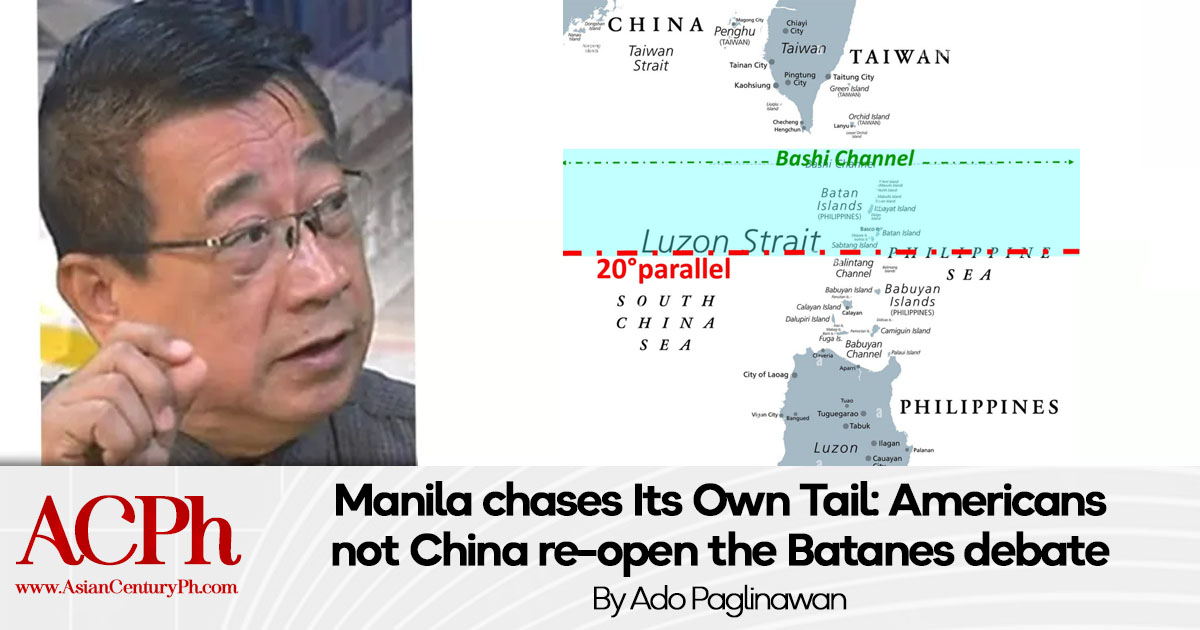
On August 17, 1895, the Japanese government officially published the contents of the Japan-Spain Declaration, also known as the Bashi Treaty, in the official gazette confirming the agreement between the two parties on the demarcation of their maritime boundary, which stipulated that the navigable route of the Bashi Channel would serve as the boundary line between the two parties.
But since neither party had specified the latitudinal and longitudinal coordinates, the Americans insisted at that time the sovereignty of Batanes Islands was to some extent ambiguous and somewhat “confusing”.
I dispute this allegation which has a linear framing. While there had been no numerical coordinates, the issue has long been resolved by estoppel, in the categorical stand of the Spanish commissioners to the Treaty of Paris talks that the extent of Philippine demarcation is at the 20th parallel.
There is nothing indefinite or debatable in that fixed coordinate.
The Spanish side categorically expressed that something that they no longer own cannot be sold to the United States because as they considered everything beyond the 20° parallel as already been transferred to Japan (as part of Taiwan).
The Americans, however, made a desperate move to send the gunboat USS Princeton, a gray military ship, to invade Batanes in January 1900.
Despite such blatant violation of international law to preempt negotiations with Spain to amend the Treaty of Paris, the Spanish side remained steadfast in its position, hence the exclusion of Batanes as one of specified outliers ceded by Spain to the US in the November signing of the 1900 Treaty of Washington.
Thus, the kleptomaniacal act of the Americans stealing the Philippines, repeating in the illegal annexation of Batanes.
When Filipino experts, thus claims on “constitutional and statutory grounds” to support the legality of our effectivités in Batanes, from 1935 as a commonwealth or from 1946 as republic to the present are merely layers upon layers of cover-up of the illegal acquisition of the Americans of this island group in 1900.
Unfortunately, some Filipinos seemed to inherit this vile and degenerate practice of “bending” international law.
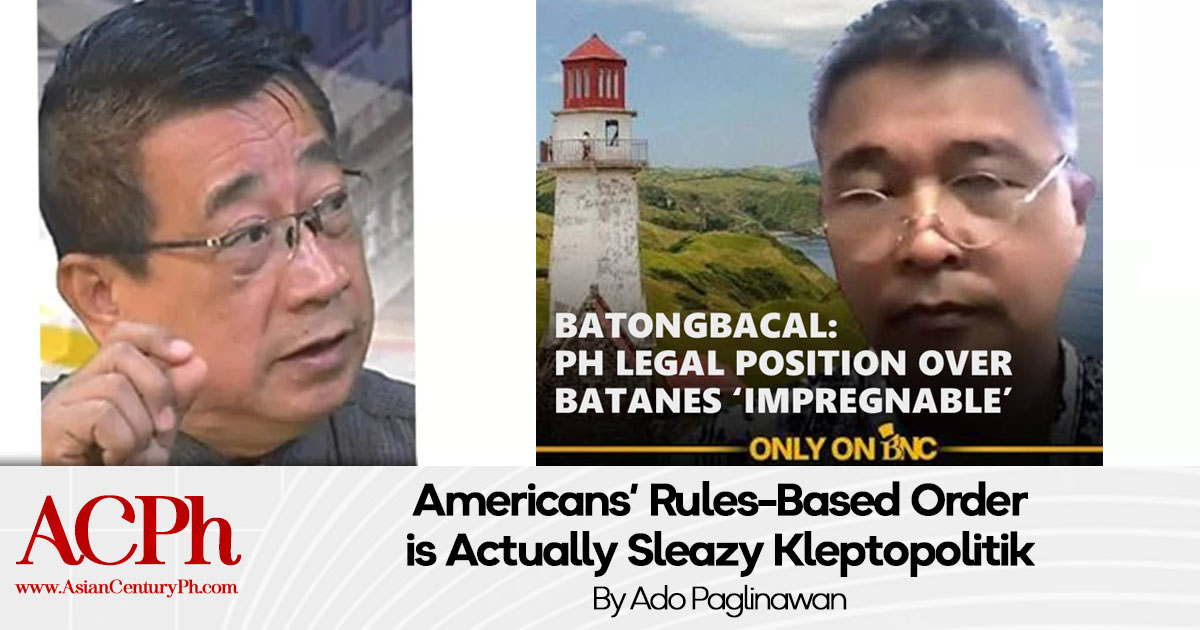
Today’s narratives of expired justice Antonio Carpio and pseudo maritime expert Jay Batongbal, only reveal that they are American partisans, in overthinking that the Batanes group (or for that matter Scarborough Shoal) were outliers amended into the Treaty of Paris.
By omitting the individuating note supplied by the word “particularly” they not only proved they are “liars”, but part of the continuing conspiracy to cover up the deliberate wrongdoings of the United States in history.
Carpio and Batongbacal do not need sophisticated bifocals to read that these two features were not part of the additions literally specified by the Treaty of Washington.
With all due respects, it is very difficult not to think that their “corrupted” version does not come in consideration of handsome compensation given the bonanza American 501c3s and the American Competes Act distributes in-country.
For those who follow these two self-proclaimed “international law experts”, one only has to verify the supporting maps that accompany the respective treaties. There are also the newspaper accounts of the negotiations.
But most compelling were the memorials of the Spanish Cortes, where Spain representative Don Eugenio Montero Ríos pointed out to the US that Japan and Spain had already demarcated their spheres of influence in 1895, a good three years before negotiations for the Treaty of Paris began.
Wang argued that if the US insisted on requiring Spain to cede Batanes Islands based on their 21°30′ north latitude version, it would be in direct violation of the existing boundary arrangements between Japan and Spain, as at the risk of being redundant, Spain no longer had authority to cede islands within Japanese sphere of influence, to the US.
The US acknowledged this position by affixing its signature. It was also ratified by the US Senate onFebruary 6, 1899 with effectivity on April 11, 1899.
So ultimately, the 20° north latitude was enshrined in the 1898 Treaty of Paris, a treaty of peace between the US and Spain, as without doubt, the northern boundary of the Philippine Islands.
“Nominalateralism”
Xu Qi, vice dean of the Academy of Foreign-related Rule of Law in Jinan University, recently issued a rejoinder last November 5:
“Whether viewed from the perspective of international treaties or the Philippines’ own constitutional instruments, whether the northern limit of Philippine territory lawfully encompasses the Batanes Islands remains a controversy that cannot be overlooked.
“The validity of the Philippines’ unilateral boundary expansion is open to question. It is particularly noteworthy that ‘this claim is of a piece with the Philippines’ methods of territorial expansion in other directions’ in the South China Sea.
I coin this style which the Americans conditioned our reflexes to as “nominalateralism”.
This is not a recognized word in philosophy, politics, or standard English dictionaries.
Nominalism is the doctrine that abstract or universal concepts have no independent existence and have nothing in common but their name. Put another way, only actual physical particulars are real, and universals exist only subsequent to particular things, being just verbal abstractions.
Expanded by modern philosophers like Thomas Hobbes, it submits thatabstract labels like “humanity,” “beauty,” or further “justice” are merely names or mental categories humans use to group similar things together.
Nominal as an adjective means something only exists in title or form, but lacks real power, function, or substance.
Nominalism when applied to global politics, diplomacy, or trade, motivates a form of unilateralism that makes it difficult for partisans, for instance, to accept the possibility of a community of shared future.
Its implications extend far beyond the bilateral and multilateral disputes itself; they mock the seriousness of the international legal system, regional stability, and the postwar order for forever peace.
Xu properly advises: If countries are allowed to use domestic laws to bypass their international obligations and create subsequent facts on the ground to support their nominal ambitions, the authority of treaties and the stability of borders will be weakened which often leads to forever wars.
Whether through original or derivative acquisition, the legal basis for the Philippines’ authority and the legitimacy of its exercise of sovereignty over the Batanes Islands have never been clearly established since the US invasion.
Its claim rests largely on residual facts from the colonial legacy that were never confirmed by treaty. This is precisely why Xu maintains that “sovereignty over the Batanes Islands remains unresolved under international law”.
Unsupported expansion
On a separate location, President Ferdinand Edralin Marcos Sr’s occupation of features in the Spratly Islands, beginning with secret military missions in 1970–1971.
Formalizing it through internal legislation seven years after, was driven by a combination of national security concerns, economic resource potential, Cold War geopolitics, and legal opportunism.
Because the eastern Spratlys lie directly west of Palawan, Marcos viewed foreign control over those features as a direct threat to Philippine national defense. He thought securing them would create a forward defensive buffer in the South China Sea.
The islands also sit alongside major international shipping routes connecting East Asia, the Indian Ocean, and the Pacific. Establishing a military presence, including building an airstrip on Thitu (Pag-asa) Island, would give the Philippines strategic leverage over critical maritime transit corridors.
In the late 1960s and 1970s, seismic surveys and the global energy crisis also sparked intense interest in potential offshore hydrocarbon deposits in the South China Sea. Marcos wanted to secure seabed rights for the Philippines and open the door to foreign energy exploration around areas like Reed Bank.
An expansion to surrounding waters would also offer abundant marine resources vital to the country’s long-term food security and fishing industry.
The Philippine president argued that when Japan renounced its sovereignty over the Spratlys in the 1951 San Francisco Peace Treaty without naming a beneficiary, the islands became terra nullius (land belonging to no one).
Marcos moved quickly to establish “effective occupation” under international law before neighboring countries could solidify their own claims.
Amid the Vietnam War and escalating Cold War tensions in Indochina, Marcos also sought to boost the Philippines’ strategic value to the United States. Fortifying outposts in the South China Sea reinforced Manila’s role as a key regional security partner while giving Marcos greater leverage when negotiating U.S. military base agreements.
In a move to “legitimize” state sovereignty, he issued Presidential Decree 1506 on June 11, 1978 formally annexed the features as the Municipality of Kalayaan under Palawan, ostensibly a patriotic expression of his motives to strengthen his country’s geopolitical position.
However, as a student of philosophy who read Virgil’s Aeneid and writings by 12th-century Cistercian Abbot Saint Bernard of ClairvauxI came across this saying “L’enfer est plein de bonnes volontés ou désirs” (Hell is full of good wills or desires).
In the 17th century, this would evolve into the proverb “The road to hell is paved (or peppered) with good intentions” that means that simply meaning well is not enough, and good intentions without proper action, foresight, or wisdom frequently lead to disastrous or harmful outcomes.
However, this is nominalateralism in motion.
To begin with, the Spratlys were not “terra nullius”. The Chinese, the Taiwanese and the Vietnamese already have long-standing historical claims to the features.
Thitu Island, for instance or Pagasa as we have renamed it, served as an garrison of Taiwan, operated in close coordination with a Taiwanese larger military detachment on nearby Itu Aba (Taiping).administered from Itu Aba (Taiping).
Following World War II and a 1956 maritime expedition, the Republic of China had established a continuous military presence on Thitu.
In April 1971, a severe typhoon struck the Spratly Islands and to keep its personnel safe, Taiwan temporarily evacuated its troops from Thitu Island to Itu Aba.
While the Taiwanese garrison was away and undergoing troop rotation, the Philippine military landed on the unoccupied island in July 1971. When Taiwanese naval vessels returned that day, they discovered Filipino troops already entrenched. They however received orders from Taipei to stand down and return to Itu Aba to avoid armed conflict with the Philippines who is an ally.
This brings us to the second argument that the Armed Forces of the Philippines’ occupation of Thitu (Pagasa) was null and void from the very beginning, as it violated the Article 2(4) United Nations Charter that states:
“All Members shall refrain in their international relations from the threat or use of force against the territorial integrity or political independence of any state, or in any other manner inconsistent with the Purposes of the United Nations.”
Conclusion
We shall continue this line of discussion in an immediately succeeding article.
For now, we conclude this part expressing that our President does not seem to be aware that whenever he speaks, words rarely stay just spoken; they frequently morph into formal directives, market shifts, or binding rules through several clear channels:
His public remarks often function as an informal marching order for executive agencies, signaling what to prioritize, investigate, or deregulate.
Even when Congress holds the constitutional power to write laws, the president’s speeches focus national attention, pressuring lawmakers to draft, stall, or pass specific bills.
Spoken guidance filters down into daily governance, where civil servants interpret presidential preferences to shape bureaucratic compliance, internal rules, memos, and enforcement priorities.
Presidential commentary can immediately sway investor confidence, spark industry self-policing, or mobilize public campaigns that force state and local governments to react, moving markets and public sentiment.
This is relevant to this discussion because we will be hosting the ASEAN Summit starting November 16. Marcos Jr. received the gavel for an annual rotational chairmanship of the Association of Southeast Asian Nations, just about this time last year.
During the vin d’honneur in an official reception hosted by the Philippines marking the start of his term, he proposed a toast among foreign envoys, government officials, lawmakers, members of the judiciary and business leaders:
“As the Philippines assumes the ASEAN chairship, we remain committed to dialogue, cooperation and a rules-based international order. Here’s to stronger ties and lasting friendships among our nations.”
Immediately, the ten other ASEAN members knew what the year would look like. Four words sold him out:
“Rules-based international order”, or RBO for short.
Legal scholars and the Global South know RBO is often invoked by dominant powers, like the United States or Western alliances, as a flexible substitute for binding international law.
This allows selective enforcement, exceptional privileges, or the promotion of non-binding norms that bypass formal consensus or state consent, sometimes leading to a hot war.
This is the same president who said, “I think, if there is a war over Taiwan … whether we like it or not, we will be drawn and dragged into that mess,” describing the scenario as being pulled in “kicking and screaming”.
The West did not have to bring opium to the Philippines.
It has never been proven, mainly due to Marcos Jr’s refusal to undergo a hair follicle test, but many of his constituents believe the allegation, admitted by his own sister who is a senator, that he has long been snorting cocaine.
So, are we foolishly becoming lily pads for a war meant to disguise American kleptopolitics?
To be continued


Adolfo Quizon Paglinawan
is former diplomat who served as press attaché and spokesman of the Philippine Embassy in Washington DC and the Philippines’ Permanent Mission to the United Nations in New York from April 1986 to 1993. Presently, he is vice-president for internal affairs of the Asian Century Philippines Institute, a geopolitical analyst, author of books, columnist, a print and broadcast journalist, and a hobby-organic-farmer.
His best sellers, A Problem for Every Solution (2015), a characterization of factors affecting Philippine-China relations, and No Vaccine for a Virus called Racism (2020) a survey of international news attempting to tracing its origins, earned for him an international laureate in the Awards for the Promotion of Philippine-China Understanding in 2021. His third book, The Poverty of Power is now available – a historiography of controversial issues of spanning 36 years leading to the Demise of the Edsa Revolution and the Forthcoming Rise of a Philippine Phoenix.
Today he is anchor for many YouTube Channels, namely Ang Maestro Lectures @Katipunan Channel (Saturdays), Unfinished Revolution (Sundays) and Opinyon Online (Wednesdays) with Ka Mentong Laurel, and Ipa-Rush Kay Paras with former Secretary Jacinto Paras (Tuesdays and Thursdays). His personal vlog is @AdoPaglinawan.

This promo includes free delivery by JRS to anywhere in the Philippines.
Email: contact@asiancenturyph.com
Facebook: https://www.facebook.com/asiancenturyph/
Twitter: https://twitter.com/AsianCenturyPH
Substack:
Also read:




Leave a Reply