

Series 26: Forever Peace or Forever Wars
Can you picture US Ambassador to the Philippines Lee Lipton frothing in his mouth when he said “The United States strongly condemns the use of dangerous blocking and other irresponsible maneuvers by the China Coast Guard and the People’s Liberation Army Navy (PLAN) that threatened a collision with a Philippine vessel and prevented a lawful and routine resupply(RORE) mission to Second Thomas Shoal” last September 24?
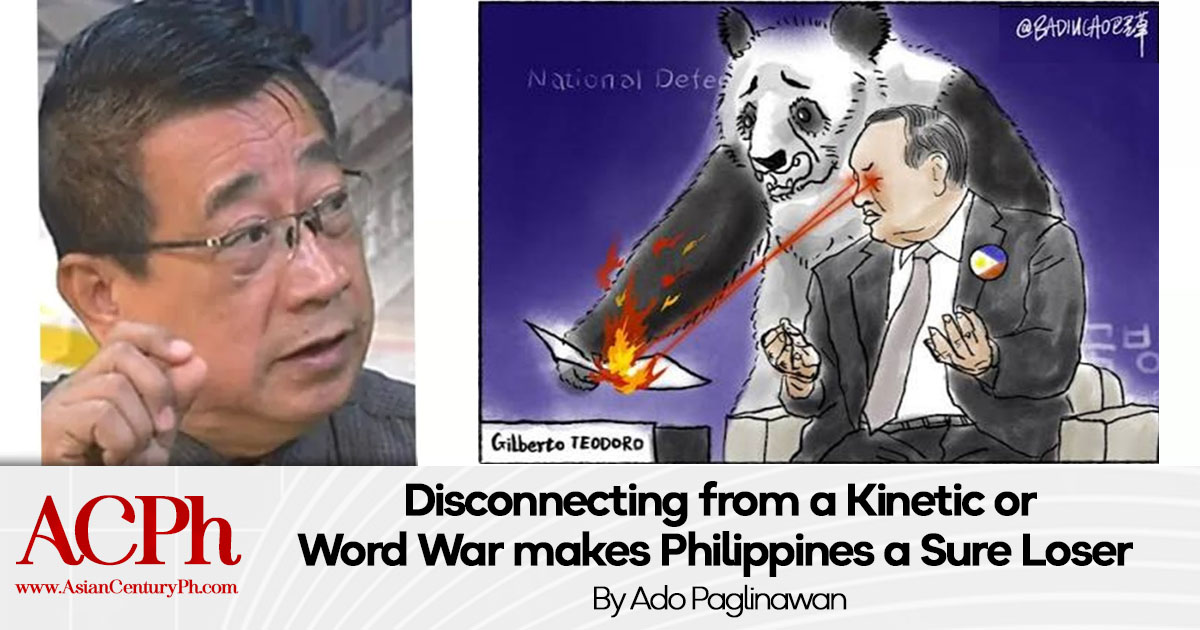
Obviously new in the neighborhood, the envoy appeared to be the latest trainee of Defense Secretary Gilbert Teodoro to megaphone Philippine expansionist ambitions in the Spratlys, using tired language like “lawful” mission.
Lipton reported that three PLAN warships and five China Coast Guard vessels interfered with the voyage of a Philippine supply vessel M/V Lapu-Lapu was accompanied by Philippine Navy and Coast Guard support vessels, some 60 nautical miles enroute to the BRP Sierra Madre, the derelict wreck the Estrada administration grounded at Ayungin Shoal in 1999.
The reports were so sensationalized that mainstream media out-performed each other cycling the news.
The most outstanding was DZRH posting: “The mission was temporarily suspended after the Chinese vessels approached and shadowed Philippine ships, with one China Coast Guard vessel reportedly closing to about 1,000 yards of the Philippine supply vessel, creating a serious risk of collision.”
The oldest radio station in the Philippines rejoined, “No collision or injuries were reported.”
How can a collision occur between a CCG and the supply vessel when their separation of 1,000 yards is more than 90% of a kilometer?
DZRH attributed to the PCG flagging this as a “severe collision risk in choppy, nighttime waters”.
Lipton also became PCG character Jay Tarriela’s newest kid on the block recruited to serve as chorus boys chanting “We stand by our Philippine Allies and laud their professionalism and restraint” as he called on the China Coast Guard and PLAN to stop what he described as “escalatory tactics that threaten freedom of navigation and a free and open Indo-Pacific.”
Fishing for false starts is now professionalism? What I see are professional provocateurs and saboteurs of peace. And withdrawing a mission with tails between their legs is cowardice not restraint.
Before appearing imbecilic and becoming a clueless kibitzer, the US ambassador should have first inquired why after 15 successful and peaceful routine resupply missions under a provisional understanding reached between the Department of Foreign Affairs and the Chinese Embassy last July 2024 intended to help manage tensions surrounding the disputed shoal, voyage #16 resulted in a blockade becoming the first disruption.

No longer routine
My first impression is this incident was not routine at all. Lipton should not have taken Philippine officials hook, line and sinker that the resupply missions are lawful and consistent with the country’s rights under international law.
The devil is in the details.
Last July 24, DFA Secretary Teresa Lazaro confirmed that the DFA said the “provisional understanding” is a set of principles and approaches both sides should observe in order to avoid misunderstanding and miscalculation in the conduct of RORE missions for soldiers and sailors stationed on the BRP Sierra Madre in Ayungin Shoal.
But last August 12, its maritime spokesman Deputy Assistant Secretary Rogelio Villanueva Jr. made a deflection in that DFA “defers” to the military establishment on the continued implementation of the provisional understanding with China if they still deemed it necessary.
He further said the planning, execution, scheduling, routes, and vessel deployment for RORE missions fall entirely under the mandate of the Armed Forces of the Philippines (AFP) and the Philippine Coast Guard (PCG), and not the DFA.
The new DFA tone was influenced by criticisms from former expired Supreme Court Justice Antonio Carpio and reinforce by rattles Defense Secretary Gilbert Teodoro.
Carpio earlier suggested that instead of collaborating with the Chinese, the use of air drops and fast boats should be implemented, but Villanueva called his suggestions as misplaced noting that these alternatives had already been carefully weighed before by relevant government agencies and found counterproductive.
What is now obvious is that Teodoro has resumed control of RORE missions and is implementing it on his terms, unilaterally, without the involvement of the DFA and not under any provisional understanding.
So, what was Lipton expecting? A birthday party?
The US response is the clear interference in this incident.
First, while his superior Donald Trump was according a red-carpet welcome in Washington DC, abandoning protocol by meeting President Xi Jinping at Andrews Air Base instead of waiting for him for a White House reception, Lipton incongruously served as a cheering squad for the Philippine click-baiting a unilateral resupply mission hoping to escape the Chinese eye.

Trump’s red-carpet welcome of China’s President Xi at the Andrews Air Base in Maryland, a departure from US established state protocol. The American president usually waits at the South Lawn or the South Portico of the White House to meet visiting top dignitaries for the first time. Contrast this with Ambassador Lipton’s adversarial statement against China, two days after Xi Jinping left Washington DC.
Second, the US is not a member of UNCLOS, so he has no business lecturing disputants about escalatory tactics that threaten freedom of navigation and a free and open Indo-Pacific.
Third he is not representing a coastal state. So, it is the United States, not China, who is awkwardly the interloper in this incident.
Fourth if he thinks the Spratlys is within the coverage of the US-Philippine Mutual Defense Treaty, he should learn from his predecessor Willian Sullivan who in a 1975 telegram declassified in 2006, was informed by Secretary of State Henry Kissinger that:
- “In USG (US government) view, Spratly Islands do not fall within either of the first two categories of Article V relating to territories” covered by the treaty.
- “We take no position on merits of claims of various disputants. We note that at time MDT (was) signed, GOP (government of the Philippines) had asserted no claim to any of Spratly islands… USG announced publicly at that time it considered sovereignty question undetermined.”
- ”Furthermore, Spratly Islands all fall outside Philippine territory as ceded to us by 1898 treaty with Spain. USG maps accompanying presentation of MDT also exclude Spratlys from territories covered by MDT.”

This should serve enough for the US ambassador’s elementary education on regional geopolitics. There are many more exclusions which I am deferring for later publication.

US gaslighting
Again, what is clear is that China, a UNCLOS member and more relevantly a coastal state, is not the interloper here, but the United States embassy mainly because of Lipton’s ignorance or sheer partisanship.
The Chinese Embassy in Manila gave Lipton his baptism of fire putting him in his rightful place, as it strongly condemned the U.S. Embassy’s statement on September 27, 2026:
- Condemnation of U.S. Stance: The embassy criticized the U.S. for “disregarding right and wrong” and taking sides, stating that Washington is deliberately distorting facts and spreading false narratives.
- Call to Stop Interference: China urged the United States to stop “fanning the flames,” provoking confrontations, and engaging in actions that undermine regional peace and stability in the South China Sea.
- Justification of Actions: Maintaining that the China Coast Guard (CCG) acted professionally, reasonably, and lawfully, Beijing asserted that the Philippines violated prior commitments during the September 24 mission and that the responsibility for any escalation or collision rests entirely with the Philippine side.
- Outside Involvement: The Chinese embassy reiterated that countries outside the region—such as the U.S.—are not parties to the maritime dispute and have no right to interfere in matters between China and the Philippines.
My two cents worth – Lipton should invite Ambassador Jing Quan to tea so that the latter can update him on the latest on US-China relations, a briefing I don’t think he can get from his boss Marco Rubio.
Any outbreak of violence between China and the Philippines can ruin Trump’s positioning the forthcoming American midterm elections this November.
The envoy’s credentials in diplomacy is almost bankrupt, evidenced by his biodata in US Embassy’s website, which included this obscure entry – he served as Interim Permanent Representative to the U.S. Mission to the Organization of American States (OAS) beginning in June 2025, where he helped lead U.S. engagement on a range of regional challenges, including efforts to counter “malign influence – particularly from the Chinese Communist Party within the Inter-American System”.
Decode that if you can.
But I think that is more a verbalization of Lipton marching orders rather than having an expertise in that field. I would say that Lipton’s OAS experience gives him a particular playbook for countering Chinese influence in the Philippines, but it is primarily an economic playbook rather than a traditional military or intelligence one.
In that light, the US ambassador should really study how he can help the Philippine development rather than complicate what is already an unnecessary and counterproductive geopolitical maze.
Declaration of Conduct
Based on Commodore Jay Tarriela’s account, the Philippine side finally withdrew its mission at 11:08 pm. The time frame clearly reveals that its was intended in the first place to take advantage of the stealth of the night.
Being approximately 60 nautical miles en route to Ayungin Shoal means the Philippine vessels are roughly 45 nautical miles away from the coast of Palawan.
Our security forces are so naïve (in fact unprofessional) thinking the Chinese law enforcers would not detect their intentions.
The account of Jiang Lue, spokesperson for China Coast Guard shows that the Chinese interception occurred or 33 nautical miles way beyond our territorial sea and in international waters.
“On September 24, the Philippines breached its commitments and, disregarding China’s warnings, went ahead with dispatching a resupply vessel to provide supplies to the Philippine vessel illegally “grounded” at Ren’ai Jiao. China Coast Guard, in accordance with the law, took measures including on-site monitoring and following, as well as issuing verbal warnings to the Philippine resupply vessel.
“The Philippines’ provocative actions and its subsequent hype and publicity during a traditional Chinese festival seriously violated the Declaration on the Conduct of Parties in the South China Sea (DOC) and severely undermined peace and stability in the South China Sea region.
“We urge the Philippines to immediately cease its provocative activities. China Coast Guard will, in accordance with the law, conduct rights-protection and law-enforcement activities in Nansha Islands, including Ren’ai Jiao, and their adjacent waters, and will resolutely safeguard China’s territorial sovereignty and maritime rights and interests.
The 2002 Declaration on the Conduct of Parties in the South China Sea (DOC) signed on November 4, 2002, by member states of the Association of Southeast Asian Nations (ASEAN), including the Philippines, and the People’s Republic of China in Phnom Penh, Cambodia.
As a mere declaration it is non-binding but it is the only document in international law that could serve a semblance of rhyme and reason for territories that the Philippines has inhabited in the South China Seas.
To understand this, one must proceed from the basic point of departure that China exercises sovereignty over the whole of the South China Seas by virtue of historic rights and title to land and seas.
In modern history these rights can be traced from 1895 to 1972, based on extent of Japanese occupation from 1895 Treaty of Shimonoseki to the 1945 formal surrender of Japan to the Allied Forces. This is followed by a statutory reconstruction from the 1943 Cairo Conference involving the United States and Great Britain up to its perfection in 1972 Joint Communique between Japan and the Peoples Republic of China.
The intervening historical event is the adoption of UN Convention of the Laws of the Seas in 1982 and its effectivity in 1994 of which China is a signatory.
Despite UNCLOS, however, China’s position is that it has primacy in law enforcement in the area because of the maxim “the land dominates the sea” (la terre domine la mer) a foundational tenet underlying the United Nations Convention on the Law of the Sea (UNCLOS) though the exact phrase is not explicitly written in the treaty text.
We find that affirmation in paragraph 272 of the 2016 Arbitral Award:
“Finally, because the Tribunal considers the question of historic rights with respect to maritime areas to be entirely distinct from that of historic rights to land, the Tribunal considers it opportune to note that certain claims remain unaffected by this decision.
“In particular, the Tribunal emphasises that nothing in this Award should be understood to comment in any way on China’s historic claim to the islands of the South China Sea.”
China shares the sea
In short, China has agreed when it signed UNCLOS that it will share the sea, and the Declaration of Conduct defines the terms and common grounds on which it and ASEAN countries intend to conduct themselves.
While the agreement does not expressly recognize any claimant’s sovereignty, title, or legal entitlement to the features it occupied, it can reasonably be read as accepting the factual situation of existing occupations as “status quo”.
The distinction is important.
The key language is in its paragraph 5:
“The Parties undertake to exercise self-restraint … including, among others, refraining from action of inhabiting on the ‘presently uninhabited’ islands, reefs, shoals, cays, and other features.”
The critical phrase is “presently uninhabited”.
It did “not” say that parties must withdraw from features they were already occupying in 2002. Instead, it prohibits the new inhabitation of features that were uninhabited at the time.
To be very graphic, that necessarily creates a distinction between:
- features “already occupied or inhabited as of 2002
- from features “unoccupied or uninhabited in 2002”.
So, there is a strong argument that the DOC froze the existing physical situation, at least as a matter of agreed conduct which is to be distinguished as not being the same as recognizing sovereignty.
This is the crucial legal distinction that is being kept by the Philippine-side from the public, for reasons that we will reveal later.
The DOC simultaneously says that the parties will resolve their “territorial and jurisdictional disputes” peacefully.
Therefore, the fact that Vietnam, the Philippines, Malaysia, China or another claimant was physically present on a particular feature did not mean ASEAN or China accepted that claimant’s sovereignty over it.
De facto occupation does not equate with de jure sovereignty.
The DOC effectively says something closer to: A claimant may retain the situation that existed, but it cannot create new facts on previously uninhabited features while the sovereignty dispute remains unresolved.
This is particularly important for the Spratlys because by 2002, several claimants already had military or civilian installations on various Spratly features.
What China accurately concedes
The wording of paragraph 5 therefore makes much more sense if understood as a status-quo provision. Had the parties intended everyone to withdraw from disputed features, they could have said so. Instead, they specifically prohibited new inhabitation of presently uninhabited features.
There is scholarly support for this interpretation. Some analyses describe the DOC as effectively freezing existing occupation situation, while emphasizing that this did not settle sovereignty.
We have to be careful about equating the DOC’s language with legal recognition of “occupation”. The actual and operative word is “inhabiting”, not “occupation.”
That matters because international law distinguishes between:
- physical presence,
- military occupation,
- effective control,
- possession, and
- sovereign title.
The DOC deliberately uses relatively neutral language. It doesn’t identify which state occupies which feature, nor does it say that existing occupation is lawful.
This brings us to the useful way of framing China’s 2002 position as “China accepted a political commitment not to establish habitation on features that were then uninhabited.”
This is where even prominent names in Philippine legal practice fail.
That framing is considerably different from China recognizing that the other claimants had sovereignty over the features they already occupied.” The first is defensible from the text. The second is much harder to sustain.
Indeed, the DOC itself preserves the underlying disputes by stating that territorial and jurisdictional disputes remain to be resolved.
This is classic international law and in maritime affairs, reflected all over UNCLOS and in Article 59 of UNCLOS for most pertinently in matters of EEZ that the Philippines is obsessed:
“Basis for the resolution of conflicts regarding the attribution of rights and jurisdiction in the exclusive economic zone
In cases where this Convention does not attribute rights or jurisdiction to the coastal State or to other States within the exclusive economic zone, and a conflict arises between the interests of the coastal State and any other State or States, the conflict should be resolved on the basis of equity and in the light of all the relevant circumstances, taking into account the respective importance of the interests involved to the parties as well as to the international community as a whole.”
What China actually concedes, therefore, must be uniquely and specifically the result of a bilaterally-negotiated settlement between China and another coastal state, be it on land or maritime domains.
I brought the discussion to this point because the DOC’s wording may be quite useful when analyzing China’s post-2002 activities at Mischief Reef, Second Thomas Shoal, and the other features, because the legal question becomes not merely “Who owns the feature?” but “Was the feature already occupied or inhabited when the parties agreed to the DOC?”
That gets you into a much more precise analysis of what China and the ASEAN claimants actually committed themselves to in 2002.
So, Teodoro and Tarriela’s narrative accusing China of expansive claims in its occupation of the Mischief and Subi Reef in 1995 is delusional as it has already been fait accompli when we signed the DOC.
Before it signed and ratified UNCLOS, it owned the whole block. After UNCLOS, it is simply commonsensical for China to protect whatever residual sovereignty that it could retain, not only because the Chinese government is answerable to its own constituents.
It has to attain peace in the South China Seas at all cost, which includes sharing the sea, and in how that sea is shared, thus the DOC.
A problem for every solution
But the Philippines appears to be all over the place but really nowhere.
China only accepts bilateral negotiations as mode of conflict-resolution with other states. It has made this formal declaration submitted in August 2006 to the United Nations taking advantage of exceptions available through UNCLOS Article 298.
We therefore abandoned the protection of the 2002 Declaration of Conduct, by taking the arbitral route, and dictating to China that is our bottom line, manifested by our confrontational conduct within the South China Seas, feigned to the Philippine public as strengthening our claim.
On Page 21 of the Memorials of the Arbitration First round submissions on the Final Transcript Day 1, July 7, 2015, the late Philippine Foreign Affairs Secretary Albert del Rosario formally manifested: “The most that has been achieved was the issuance in 2002 of a “Declaration on the Conduct of Parties in the South 12 China Sea”. Although that document recorded the parties’ commitment to work toward the establishment of a code of conduct in the South China Sea, China’s intransigence in the 13 years of subsequent multilateral negotiations has made that goal nearly unattainable.”
Despite claims of arbitral victory for the past ten years, this has action has only brought us from the frying pan to the fire, so to speak, because our situation now is much more discombobulated than before.
Significantly, only the United States and 13 of its allies recognized the 2016 Arbitral Award, with none from the ASEAN.
Why is this not to the best interests of our claims in the South China Seas? To be very frank about, I do not think we have any legal grounds for our claims. Our very own historic titles and rights say so.
China recognizes Philippines territory “as determined by a series of international treaties, including the Treaty of Peace between the United States and Spain in 1898, the Treaty between the United States and Spain for Cession of Outlying Islands of the Philippines in 1900 and the Convention between the United States and Great Britain Delimiting the Boundary between the Philippine Archipelago and the State of North Borneo.
“All these documents state that the border line of the western part of the territory of the Philippines is 118° East in longitude.
“China’s Nansha Islands (Spratlys) and the Huangyan Island (Scarborough Shoal) of the Zhongsha Islands do not lie within the boundary of territory delimited by any of the above treaties or conventions.
“Moreover, the 1935 Constitution of the Republic of the Philippines, the Treaty of General Relations between the Republic of the Philippines and the United States of America in 1946, the Mutual Defence Treaty between the Republic of the Philippines and the United States of America in 1951… reiterated the legal effect of the above three treaties or conventions and reaffirmed the scope of the Philippine territory.”
Conclusion
The solutions China offers the Philippines politically will take generations to resolve legally, maybe never at all…
…because we Filipinos have a problem for every solution.
As for Lee Lipton, it will serve him well, to welcome his continuing education because he still has more tea to sip to become a China or Philippine expert.
The ambassador must abandon any conspiratorial reflexes he acquired from his homeland because the Chinese make themselves so clear and predictable, one need not overthink dealing with them.
Which explains why even before we were named after King Philip II of Spain, we have already dealt with them for millennia.
It is his Philippine counterparts that he must be cautious about, as some of them have already announced their political ambitions.

Adolfo Quizon Paglinawan
is former diplomat who served as press attaché and spokesman of the Philippine Embassy in Washington DC and the Philippines’ Permanent Mission to the United Nations in New York from April 1986 to 1993. Presently, he is vice-president for internal affairs of the Asian Century Philippines Institute, a geopolitical analyst, author of books, columnist, a print and broadcast journalist, and a hobby-organic-farmer.
His best sellers, A Problem for Every Solution (2015), a characterization of factors affecting Philippine-China relations, and No Vaccine for a Virus called Racism (2020) a survey of international news attempting to tracing its origins, earned for him an international laureate in the Awards for the Promotion of Philippine-China Understanding in 2021. His third book, The Poverty of Power is now available – a historiography of controversial issues of spanning 36 years leading to the Demise of the Edsa Revolution and the Forthcoming Rise of a Philippine Phoenix.
Today he is anchor for many YouTube Channels, namely Ang Maestro Lectures @Katipunan Channel (Saturdays), Unfinished Revolution (Sundays) and Opinyon Online (Wednesdays) with Ka Mentong Laurel, and Ipa-Rush Kay Paras with former Secretary Jacinto Paras (Tuesdays and Thursdays). His personal vlog is @AdoPaglinawan.

This promo includes free delivery by JRS to anywhere in the Philippines.
Email: contact@asiancenturyph.com
Facebook: https://www.facebook.com/asiancenturyph/
Twitter: https://twitter.com/AsianCenturyPH
Substack:
Also read:




Leave a Reply