

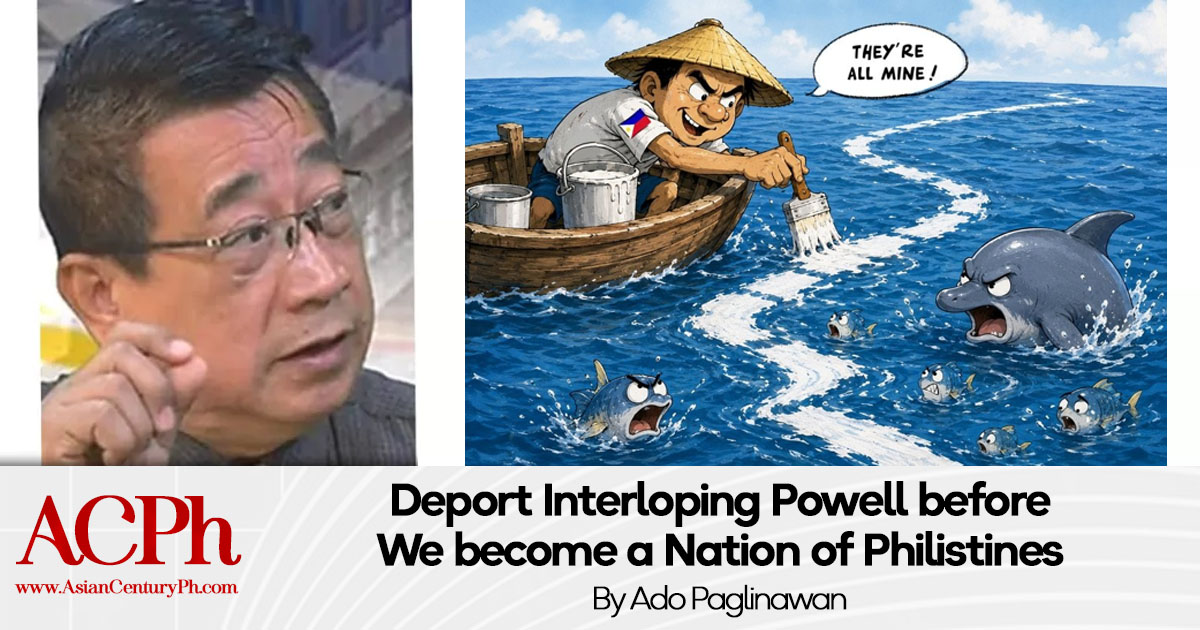
The problem with Raymond Powell is that while the right side of his brain has started shifting his maritime transparency narrative in the South China Seas to “malign influences” in Philippine society, the left side is in denial that such stigmatizes the Chinese people and the local Chinese-Filipino community.
While he rejects crossing redlines, he categorically claimed at a March 2026 forum in Quezon City covered by a flurry of mainstream media that “SeaLight has been investigating a network of interlocking organizations all connected to the Chinese communist party, all operating here in the Philippines.”
That statement is damning because what authority has SeaLight, its parent program Gordian Knot Center for National Security Innovation and its public charity Stanford University, to directly interfere with our internal affairs?
What is unsettling is while “still investigating”, Powell has already established a conclusion:
“Beijing’s goal is not to merely to control the reefs and shoals of the West Philippine Sea; it is to convince the people of the Philippines to stop resisting, to accept Chinese control as a permanent fact of life”.
How SeaLight got burned
Powell accused Beijing’s messaging has been embedded in many forms such as Chinese state media and their embassy’s press releases, which is often echoed in Filipino-Chinese language media.
“Since 1991, the Philippine Chinese Education Research Center had the ‘blood transfusion’ plan, dispatching 5000 mainland teachers to Philippines Chinese language schools,” the SeaLight director said.
Because of incriminating statements like this constructed on syllogisms that are non-sequitur, and not evidence-based, the American himself invited scrutiny.
A month after in April, a Chinese Embassy statement exposing Powell, a US former air force colonel as a habitual anti-China agitator who according to statistics it gathered, has posted since 2024 more than 6,000 social media messages related to the South China Sea, relentlessly attacking China:
“Not long ago he once again traveled all the way across the Pacific to the Philippines to attend seminars, give interviews, and publish articles. His mission? Demonizing anything related to China, from maritime issues to the local Chinese community, Chinese-language media, and Chinese-language education in the Philippines.”
According to the Manila Times, Powell has falsely labeled Chinese language education in the Philippines as a “tool of infiltration” while attacking an essay competition organized by a Chinese education center, commemorating World War II Victory of Resistance Against Japanese Aggression.
The fact, however, is that Chinese-language education has a long history in the Philippines and serves as a legitimate means of cultural preservation and friendship-building between China and the Philippines for not just a century but since time immemorial.
Now that the Filipino-Chinese community has decided to send back to China 150 Chinese language teachers that they invited, mostly on the fear of their parents for their relative safety in our country, Powell is backtracking on his previous demonization of the educators and Chinese language education in the Philippines, as suspects of espionage.
What burned SeaLight?
Actually, it is not difficult to pinpoint who is the party engaged in deleterious “malign influences” here, despite the denial of this American that $500 billion budget is in the works from the US government.
But I have always said, where there’s smoke there is fire.
USAspending.gov, I have already discussed in articles previous to this how the juice is laundered from the Deep State to Stanford University, a tax-exempt nonprofit organization registered under US Internal Revenue Code Section 501(c)(3) (issued February 3, 1927) and classified as a public charity under Section 509(a).
Its papers are under different name, however, as “The Board of Trustees of the Leland Stanford Junior University” and if you want to check it out, its Federal Tax ID (EIN) is 94-1156365. It is also a California trust rather than a standard corporate entity.
This burns SeaLIght’s cover.
While it is true what Powell implies that the center’s analytical work relies heavily on unclassified, commercially available Automatic Identification System (AIS) data and commercial satellite imagery, its structural financial pipeline is anchored directly by U.S. Navy and defense procurement frameworks.
The Gordian Knot Center for National Security Innovation (GKC), based at Stanford University’s Freeman Spogli Institute for International Studies (FSI), serves as the primary academic and operational incubator for the SeaLight (formerly known as Project Myoushu)
The cat’s out of the bag.
It was Powell himself who brought geopolitics to the classroom and the academe, as how can SeaLight disassociate itself from Stanford University especially now that it has shifted framing its work beyond national security innovation in maritime affairs onto great-power competition, influencing no less than the foreign policy of a country he is not a citizen of.
The first thing he forgot was his country, the United States of America is not a member of the UN Convention of the Law of the Sea, and neither is it a coastal state in the South China Sea. In this respect, how can an American have any moral ascendancy in the Philippines?
Powell is a dangerous spy and must be deported before anybody gets hurt.
Why SeaLight has failed
At this juncture I remember a quote from retired navy man Roy Vincent Trinidad, a mouthpiece of his talking points, who despite manifestations of low IQ has been retained as military spokesman for the ghost West Philippine Sea.
““I don’t have the letter itself. I have not seen any official report establishing who produced and circulated it…(but) indicators point to moves by the Chinese Communist Party or its proxies.”
That is tantamount to a soldier pulling the trigger, without first ascertaining “who goes there” is friend or foe, human or whatever.
This indicts not just the military, but the Marcos government’s incompetence to manage our national defense.
When I was taking up pre-law at San Beda, I took up heavy loads in Philosophy and English, precisely because the next level would be heavily vested in correct thinking and a facile pen.
It was from Dean Recaredo Enriquez that I learned that arguing from possibility to reality is an error in logic. Just because something can happen does not mean it actually did or will happen.
Why SeaLight Logic Fails
Besides poor messengers like Trinidad and PCG’s Jay Tristan Tarriela, its narratives often do not connect. Classic statements after a confrontation between ships of China and the Philippines, are often attributed with no ifs and buts, by this duo, to “Chinese aggression”.
- The Gap Between Potential and Fact: Reality requires concrete proof, evidence, or causal mechanisms to actually occur.
- Confusing “Can Be” with “Is”: This error assumes that if a scenario is imaginable or not strictly impossible, it already carries weight as an actual fact.
- Ignoring Probability: Many things are possible (like winning the lottery twice in a row), but they are so unlikely that treating them as real or inevitable is a severe mistake in reasoning.
What already exists, presents an unmistakable possibility that it can exist. The reverse does not necessarily follow – that something can exist does not prove it exists.
Why would a Philippine ship be challenged in the first place if it were in its rightful place? To be rightful means it must have a valid claim to start with?
The specific setting should be the first step in considering an issue. The next premise is he qualification of the actors.
Only then can you proceed with how the actors have behaved.
For instance, if actors have been properly validated, subsequent behavior often determines who aggressor is.
The waters are not fair game, they have rules governed by another treaty – the Convention on the International Regulations for Preventing Collisions at Sea (also known as COLREGS of the International Maritime Organization) to guide safe vessel navigation and prevent collisions.
To obscure clarity in the discussions, sample this for starters – the Philippine knocked down China’s nine-dash line at The Hague. After coming home to Manila, it legislated its own West Philippine Sea.
In comparative videos submitted both by the PCG and the CCG, the Philippine side is often attempting to overtake the Chinese vessel, and worse when it reaches the bow of the latter it cuts across its bow. Yet what the PCG always claim is that the CCG undertook dangerous maneuvers.
Twisted logic fueling politics
Returning to the track, the recent attack of the security community under the baton of a foreigner on Chinese language educators only confirms that we have a government that has turned rogue.
Besides not having any substantial accomplishment to its credit, trillions have been stolen from the national treasury to fund ghost insertions in the national budget and hundreds of billions more extracted from government-related institutions.
To cover up this plunder, the vice president is being impeached for an iota amount of what has been stolen, whistleblowers and witnesses, including senators and congressmen, have been discredited, framed and arrested on trump-up charges just to keep them away from public probe.
To compensate for the prosecution’s losing narrative in the ongoing Senate impeachment trial of Sara Duterte, criminal charges have also been filed against her in the regional trial courts, in what was “otherwise” unconstitutional before Marcos took over as president, as charges could only be filed against impeachable officers, when they are no longer in office.
To complicate issues, former bar topnotcher defense secretary Teodoro, awkwardly stated that funds allegedly received by a company associated with Vice President Sara Duterte and her husband from China-linked businesses have national security implications.
Worse, Marcos validates Teodoro’s twist – “VP Duterte China-linked funds are ‘security threat at highest level’ but quickly suffixes “if true”.
Of course “if true”, but is it? This is again begging a possibility to already becoming a fact, when incontrovertible evidence under interrogation of the witness points to a private trading company receiving payment for banana chips.
A simple “no comment” would have been prudent.
It is Teodoro and Marcos who have deficits of trust in this respect because the positions in government that requires the occupant to be just as Caesar’s wife beyond reproach – and yet Teodoro’s citizenship has a checkered past and Marcos is suspected to be snorting cocaine
Unappealing even to Pinoy academics
These innuendos are premature. As such, they boomerang almost automatically because the Filipino is politically aware of the country’s affairs that most government functionaries.
Putting the cart before the horse has made Teodoro a partisan who has negligible following, because his word according to a recent Tangere survey, is only worth 5% in the race for the 2028 elections.
As the testimony of the executive director of the Anti-Money Laundering Council, Ronel Buenaventura, turned into another failed fishing expedition for the prosecution, Teodoro’s statement became a fool’s errand.
PhD Anna Malindog-Uy writes, “apparently, in the Philippines today, even banana chips can become a national security threat — provided the buyer is Chinese and the company selling them has a connection to the Duterte family.
“Welcome to the latest spectacle in Philippine politics, where ordinary commercial transactions become geopolitical intrigue, Chinese corporate ownership becomes a convenient insinuation of foreign interference, and allegations appear as established facts long before the evidence catches up.”
Teodoro should have anticipated the trap – because the jump from banana chips production and sale is a long jump from trade to malign influences.
His mentor Powell’s transparency narrative has failed,
The security sector has been busying itself in engaging in dangerous theatrics in the South China Seas “defending Philippine sovereignty against foreign intervention” an issue that has earned only 3% in the people priorities according to the July 2026 PulseAsia poll.
Shifting to Powell’s pitch for “malign influences” in classrooms, has now backfired.
Besides, when has cultural exchanges become “malign influence” in the lexicon defense secretary Teodoro and his mentor former US airman turned navy operative Raymond Powell have been propagating?
We cannot edit history
A mere twist in lexicon using culture and language as a clutch won’t wash. One of the main reasons why Filipinos revolted against the Spaniards was the latter was stingy in sharing what was the lingua franca of those times.
The best reason why Americans are endeared by Filipinos was they did not only share English to the nativos, but their public school system.
Our people’s friendship with the Chinese, was not forged yesterday but has crossed over millennia. This is the reason why the conquistadores erased our history after they arrived.
But coños, and now Powell, can no longer hold back what has been recorded in other countries engaged in commerce before Miguel Ruy Lopez de Legaspi started took over Philippine governance in 1565.
The truth can no longer be imprisoned because volumes of pre-Hispanic data kept in other countries started jumping out since the birth of the information highway.
For instance, Admiral Zheng He (Cheng Ho) significantly impacted pre-colonial Philippine culture and society during his early 15th-century maritime expeditions (1405–1433).
Aside from facilitating the exchange of commercial goods, his massive treasure fleets acted as tools of what can be categorized as imperial diplomacy, cultural osmosis, and technological transfer.
His travails constitute the Seven Voyages of Sinbad that I gloated over as a grader in the late1950s and later incorporated in my first book A Problem for Every Solution(2015). I will discuss the details of this in my next article.
A Nation of Philistines?
Secretary Teodoro’s surname Cojuangco is written as 許寰哥 (in traditional Chinese broken down into:
- 許 (Xu / Khó͘): The family surname (pronounced Kho or Co in Hokkien). The character literally means “to allow,” “to permit,” “to promise,” or “to praise”.
- 寰 (Huán): Part of the personal or given name of the clan patriarch, Co Yu Hwan (Khó Giok-khoân), who migrated from Fujian, China, to the Philippines in 1861.
- 哥 (Gē / Ko): A Hokkien and Mandarin honorific suffix meaning “older brother,” commonly attached to names as a sign of respect (ko)
This should make Manny Pacquiao, the latest recruit to promote Pagasa Island as a local tourist destination for heroic wannabes very uncomfortable. His ancestral name which means buying wholesale or in bulk comes from Chinese ba giao (by bundle) or combinations like pa̍k (to tie/bind) and kiáu (to hand over).
According to Imee Marcos, her family was Chua of Batac, Ilocos Norte, and her grandmother was a Lim, before his grandfather Mariano adopted “Marcos”.
However, an unverified historical rumor and political myth has persisted rather than an official name change.
- The Myth: Biographies and political critics (most notably detailed in Sterling Seagrave’s book The Marcos Dynasty) popularized a claim that former President Ferdinand Marcos Sr. was not the biological son of Mariano Marcos. Instead, the theory alleges his real biological father was Ferdinand Chua, a wealthy Chinese-Filipino municipal judge from Batac.
- The Adoption Theory: According to this rumor, because Josefa Edralin (Marcos’ mother) was unmarried or seeking to conceal the relationship, the child was given the surname of Josefa’s subsequent husband, Mariano Marcos, who functioned as his adoptive father.
In official and legally documented genealogy, however, the family line remains strictly Marcos. The Chua family remains a completely separate, prominent political clan in Batac, Ilocos Norte, that maintains close ties with the Marcoses.
Of the three spokesmen in the echo mechanism of Powell and Secretary Teodoro, only Arsenio “Andolong” presents an indigenous ancestry dating back to the Austronesians. Roy Vincent “Trinidad” and Jay Tristan “Tarriela” are of Hispanic origins.
This makes Tarriela’s namedrop of Andres Bonifacio in an interview incongruous not only because the national hero fought the coños, but it took three centuries after the Sangleys started rebelling against colonial Spain in 1603, that he founded the Katipunan in 1892.


Are we deteriorating into a nation of fools just because Powell has infiltrated the Philippine military? I once called the American operative “pea brain” but now he attempting to clone us as philistines or people without a culture
A philistine is a person who dislikes, ignores, or does not understand art, literature, music, and intellectual values, caring instead only for material wealth and practical comfort.
Just because those who are ignorant of and hostile or indifferent to culture and the arts, are suddenly in high places in government, does not give them the license to be lowbrow, boors, barbarians or vulgarians.
Going against the current
Lucio Blanco Pitlo III, a policy and risk consultant, told South China Morning Post that targeting educational exchanges in the name of security threatens an effective channel for Manila to understand and engage Beijing.
The consultant said “Educational and cultural exchanges have become a new casualty of rising tensions between the Philippines and China (with) 150 Chinese language teachers left the Philippines months after Defense Secretary Teodoro renewed warnings that such people-to-people ties could pose security concerns.”
Beyond disrupting classes and potentially harming tourism in the Philippines, Pitlo said, this could further narrow interaction between the two sides, creating more conditions for misunderstanding:
“At a time when official relations are fraying, putting academic exchanges under increased scrutiny could close one of the few channels to bridge the growing rift between the two neighbours.”
Going back to geopolitics, I threw a few interjections to more of Pitlo’s takeaways:
Securitization, he added, is eroding the economic ballast of bilateral relations and is now threatening even people-to-people linkages.
Educational ties becoming subject to national security considerations could deprive Manila of the language proficiency that can provide a foundation for an adept and nuanced policy towards Beijing.
- It runs counter to the promotion of Chinese language in educational settings elsewhere in Southeast Asia.
Thailand has five times as many Confucius Institute locations as the Philippines. Indonesia has twice as many. The number of volunteer Chinese teachers in Thailand rose from 23 in 2003 to more than 17,000 in 2019.
- Instead of sending a chilling effect to scholars engaging in China studies, Manila should encourage academic dialogue to gain a range of views about its largest trade partner and the rising global power next door.
Multilingual graduates of Chinese-Filipino schools with links to Chinese peers have contributed to Philippine governance, business, professions and public life.
- They are anchors and sources of inspiration. Deep knowledge of Chinese language and culture has helped Filipino companies succeed in the world’s most competitive market. Examples of these successes include Liwayway Marketing Corporation – the maker of popular snack brand Oishi – property developer SM Group and the Jollibee restaurant group.
Conclusion
Finally, developing China expertise is essential for the Philippines at this time of our history. From industry and technology to defense and foreign affairs (and cultural development), China looms large.
A policy based on (fallacy and) fear, misconception or reliance on third-party sources should give way to one grounded in intimate knowledge and constant, multifaceted engagement.
An attempt to supplant culture and tradition in favor of a declining Western power and its hegemonic rules-based order is going against the grain.
Even Donald Trump is building friendship with Xi Jinping.
His grandchildren – Arabella, Joseph and Theodore – speak Chinese. Special note goes to Arabella who began learning Mandarin as a toddler from a Chinese nanny and finishing at the Carousel of Languages in New York). She has famously sung songs and recited poetry in Mandarin for Chinese President Xi Jinping.
Only teacher Raymond Power, and his students in our government, are singing contrapelo.
The American president may be playing shrewd when it comes to regional tactics but there is no doubt that he has adjusted his true north towards an Asian century built with China at its heart. The reason why he said he will not war with China over Taiwan, is obviously because doing so will alienate the world’s emerging largest market against the United States.
The Chinese who has a record at building civilizations have won the day and Filipinos are refusing to turn philistine just because neo-colonial appetite has to be served and some greedy pockets have to be filled.
The bus has long left the station, but the Filipino people is destined to rejoin the bandwagon leading to that century, as soon as the unwanted tenant in Malacañan vacates.
To be continued.
Arabella Rose Kushner has won the hearts of the Chinese people. She is the 15-year-old eldest daughter of Ivanka Trump and Jared Kushner, and the eldest granddaughter of U.S. President Donald Trump.

Adolfo Quizon Paglinawan
is former diplomat who served as press attaché and spokesman of the Philippine Embassy in Washington DC and the Philippines’ Permanent Mission to the United Nations in New York from April 1986 to 1993. Presently, he is vice-president for internal affairs of the Asian Century Philippines Institute, a geopolitical analyst, author of books, columnist, a print and broadcast journalist, and a hobby-organic-farmer.
His best sellers, A Problem for Every Solution (2015), a characterization of factors affecting Philippine-China relations, and No Vaccine for a Virus called Racism (2020) a survey of international news attempting to tracing its origins, earned for him an international laureate in the Awards for the Promotion of Philippine-China Understanding in 2021. His third book, The Poverty of Power is now available – a historiography of controversial issues of spanning 36 years leading to the Demise of the Edsa Revolution and the Forthcoming Rise of a Philippine Phoenix.
Today he is anchor for many YouTube Channels, namely Ang Maestro Lectures @Katipunan Channel (Saturdays), Unfinished Revolution (Sundays) and Opinyon Online (Wednesdays) with Ka Mentong Laurel, and Ipa-Rush Kay Paras with former Secretary Jacinto Paras (Tuesdays and Thursdays). His personal vlog is @AdoPaglinawan.

This promo includes free delivery by JRS to anywhere in the Philippines.
Email: contact@asiancenturyph.com
Facebook: https://www.facebook.com/asiancenturyph/
Twitter: https://twitter.com/AsianCenturyPH
Substack:
Also read:




Leave a Reply