

The Philippines under Bongbong Marcos today is caught between the Devil that is the hegemonic United States of American and the Deep Blue Sea of a Rising China that Singaporean diplomat and former U.N. Security Council president Kishor Mahbubani say can no longer be stopped by any party seeking to contain it.
In 2020 Kishor Mahbubani published the book “Has China Won? The Chinese Challenge to American Primacy.” Nine years before that book the U.S. had already taken notice of the Rise of China and the challenge it posed prompting a redirection and the Obama announcement of America’s “Pivot to Asia” to move 60% of its military forces to the Asia-Pacific.
Since the “Pivot to Asia” the U.S. has had its three client states Japan, the Philippines and South Kore,a stage political scenarios to implant “lawfare” issues against China: Japan nationalizing the Diaoyu Islands, the Philippines filing the spurious “arbitration case” and South Korea ended its “Sunshine Policy” towards the North.
In 2017 the U.S. started Trade War 1.0 under President Trump’s first term and the first loud bang was the 2018 arrest of Huawei Chief Finance Office Meng Wanzhou in Canada at the request of the U.S. In 2019 the U.S. introduced Covid 19 into China. Biden continued the tariff war on China that Trump 2.0 escalated. After Trump 2.0 trade war with China U.S. trade deficit with it is still $ 202-billion in 2025.
Trump started the February 28, 2026 Iran War to constrict West Asian oil and energy supplies to China, but it has backfired on the U.S. While China continues to thrive on its diversified energy sources and especially self-reliant renewable resources. China’s diversified global supply chain and market has from America’s continued attempt to constrain and constrict its constant rise.
Mahbubani: The real reason why China can’t be stopped.
In the Bloomberg interview of Mahbubani by Mishal Husain she asked the crucial question, “Would you say that is a foolish desire, to stop the rise of China?” Mahbubani’s reply was surprising. It was not about technology, productivity, number of armaments, defense technology or export power and other regular measures of power. Mahbubani’s reply comes from a completely surprising angle.
Mahbubani replied, “No, I would say it’s not wise policy. China can no longer be stopped. The only way is to ask the government to stop improving the livelihoods of its own people — that’s the only way that China will stop growing. But [it] still has a long way to go; per capita income is way behind that of the United States.
We live now on a small, interdependent, fragile planet. Our overall priority should be to try and preserve planet Earth before we lose it — to climate change and other forces. There’s a common interest for the US and China to come together, far more important than whatever you gain in this geopolitical game of one-upmanship.”
The Cold War parallel.
The other significant question asked: “You’ve written that what’s happening now is like the Cold War, only ‘America is behaving like the Soviet Union did’” That the Soviet Union ‘behaved unilaterally and ignored international opinion, while America acted multilaterally and marshaled global opinion to its side.’ It’s a very unflattering comparison.”
The reply, “Well, that comparison has been made by other scholars too, that in the contest between the United States and the Soviet Union, American society was flourishing, but Soviet society wasn’t flourishing. Today, in the contest between [the] United States and China, the bottom 50% of the American population hasn’t seen their standard of living improve in several decades. 4
(4 This is a reference to the work of Nobel laureate Angus Deaton, a British-born self-styled “immigrant economist” who has researched inequality in the US since arriving in the country in 1983. Among his conclusions: “Less well-educated Americans have seen little or no improvement in their material circumstances for more than fifty years.”)
The logical thing for the United States to do is first focus on uplifting its people. But I can tell you in geopolitics, unfortunately, common sense doesn’t work. This desire to be number one is so deeply ingrained into the human brain that it’s very hard to persuade the policymakers, Hey, step back and think — what is a better approach to take?
The goal of my writings is not to say that China should win or the United States should win. The goal is they should reflect on whether it is in their larger, long-term, interest to engage in such a zero-sum contest.”
China’s Structural Edifice for Caring for its People.
Lifting 1.4-billion people out of abject poverty within 75 years from a backward feudal society broken by war and civil war to one of the two largest economies on Earth, and top in the majority of technological fields, does not just happen. It happens because first and foremost because of Ideology. China’s development has been led by the Socialist ideology with Chinese Characteristics implemented by the Communist Party of China (CPC) consistently.
The pillars of the CPC socialist vision are: People-Centered Development, Common Prosperity, Socialist Modernization, to achieve prosperity, democracy, civility, harmony, freedom, equality, rule of law and patriotism to guide public morality and culture through efficient public resources, market mechanism and State balance. China aims to double its middle-income population to 800-million by 2030.
The Chinese people are not only cared for but they feel cared for: new housing for the abject poor, the fastest modern trains even for farm folks to carry their chickens and harvest on to market, electricity cost a third of that of the U.S., medical care a fraction of U.S. such as angioplasty 1/20th the cost in the U.S., security in the streets even at unholy hours, and so on.
The Capitalist, Profit-Seeking Society.
In contrast, the U.S. is ideologically a capitalist state and society led by a plutocracy that rules the two-party system dedicated to promoting profit-seeking corporations at the expense of the people’s welfare and national development. Hence, the U.S. has one of the world’s largest economies but some of its most antiquated public railroad transport systems, and the most number of homeless poor people in the developed world.
U.S. industries move to China where market and profits are to be made, U.S. defense industries can’t produce enough or the quality for U.S. global ambitions unless profits are high, shipyards can’t produce enough warships as shipbuilding isn’t profitable, Fentanyl addiction and school shooting are national scourges. U.S. socialist candidates are gaining ground in New York and Michigan, and the U.S. and MAGA is fracturing.
In the Bloomberg interview Mahbubani cited a most important observation that capitalist society face:
“The architect of the success of the United States in the Cold War, George Kennan, said way back in 1949 that the outcome will be determined not by the number of bullets, warships, aircraft carriers or jet fighters. It’ll depend on which society creates a spiritual vitality that leads to its people flourishing. If George Kennan were alive today, he would advise the United States: Don’t try to get more aircraft carriers. Try to focus on improving the livelihood of the bottom 50% of American people.
If you succeed in doing that, you win the long-term contest against China.”
“Neither Hegemony nor Expansion”
Deng Xiaoping famously declared during his 1974 UN General Assembly Speech that China is not a superpower and will “never seek hegemony.”
If that does not satisfy the skeptics of China’s claim that it will never seek hegemony as it rises to superpower then we have history to point to: Between 1405 and 1433, Chinese Admiral Zheng He commanded seven massive maritime expeditions across Southeast Asia, the Indian Ocean, the Persian Gulf, and East Africa, visited countless countries but never since then has China conquered any country.
China prefers to focus on developing and enriching its nation internally. In contrast the Western Powers enriched themselves in the past 500 years by conquest, occupation, colonization, exploitation through wars and domination. Even today when China is already a superpower, it strictly adheres to international law of the United Nations and develop internally to generate its productivity unlike the U.S. that applies its own “Rules Based Order.”
On July 31, 2026 on the occasion of the 99th founding anniversary of the Chinese People’s Liberation Army Chinese Ambassador Jing Quan addressed the issue of Chinese military development as solely aimed at national defense and not to pursue regional dominance or territorial expansion: “Neither Hegemony nor Expansion.” The expansion I see China doing is moving industries in its coastline to its internal landlocked provinces and moving southern waters north.
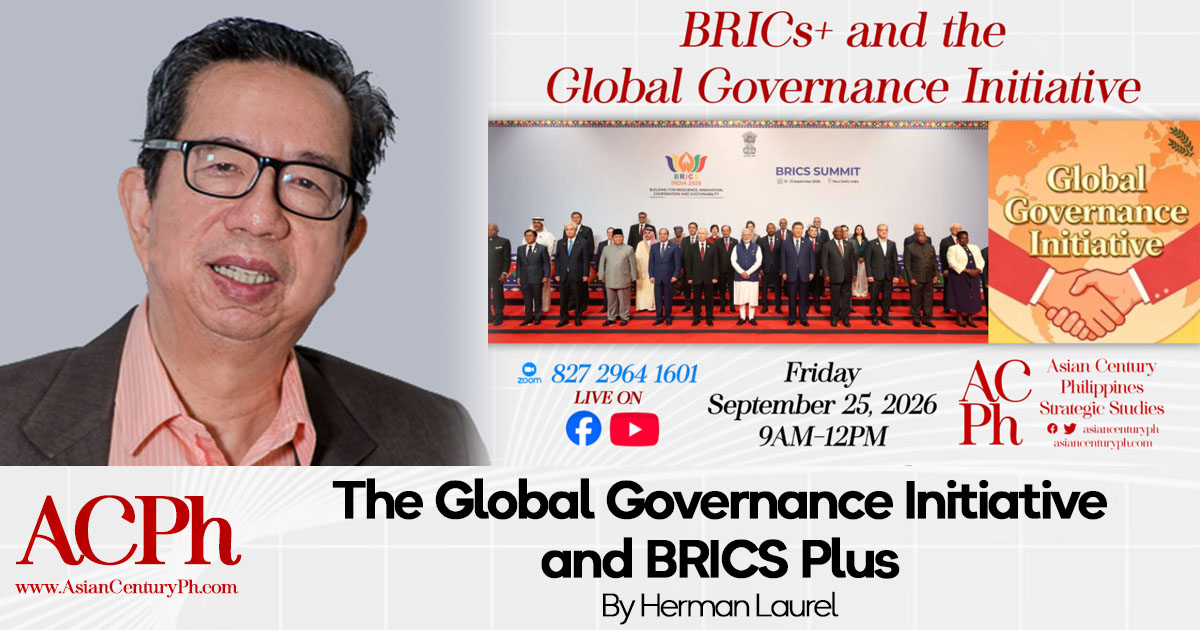
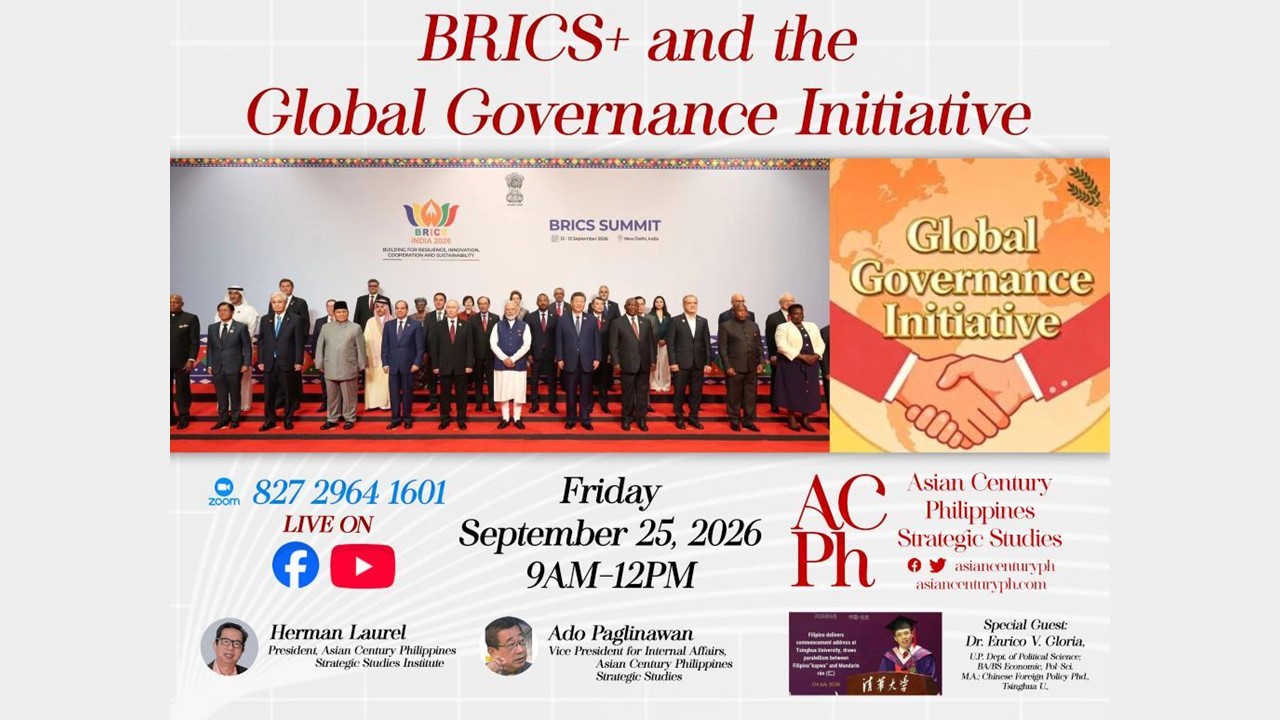
The Global Governance Initiative (GGI)
What role does China see for itself then as a superpower?
China sees itself as one among the equal nations, big and small, among the 193 countries in the United Nations, as well as one of the leading supporting voices for the developing and newly emerging nations. To enhance the power of the block of poorer nations China in September 2025 introduced the Global Governance Initiative (GGI) to advice on reform of international rules to increase representation of the Global south countries.
The building blocks towards the GGI initiated earlier are the Global Development Initiative, the Global Security Initiative and the Global Civilization Initiative covering the major concerns of the Global Majority of economically developing nations, assuring indivisible security, promoting “True Multilateralism” and harmonizing civilizations to overcome clashes of normative values.
Nearly 160 countries and international organizations have backed or participated in the Global Governance Initiative (GGI). More than 60 countries have joined the formal “Group of Friends of Global Governance.” The GGI is the practical, strategic action plan and organization too achieve the final end of the “Community of Shared Future for Mankind” and the cherished dream of “Forever Peace” to end the West’s “Forever Wars.”
Quo Vadis Philippines?
Chinese Foreign Minister Wang Yi on July 22, 2026 during a bilateral meeting in Manila with Philippines Foreign Affairs Secretary Ma. Theresa Lazaro on the sidelines of the ASEAN Foreign Ministers’ Meeting remarked that China-Philippines bilateral ties face serious difficulties advising Manila to choose the correct path and avoid acting as a pawn for external forces. In short, the Philippines stands at the crossroads between the path towards peaceful development or the path the way of Ukraine.
Malaysian Prime Minister Anwar Ibrahim has openly and forcefully protested the US-Philippine expansion of military activities and military bases in Mindanao and Palawan, Singapore’s former Prime Minister Lee Hsien Loong has openly asked over Philippine media if the Philippines wants to be caught in a superpower conflict. The silent message is that the Philippines is drifting away from ZOPFAN, the ASEAN Zone of Peace, Freedom and Neutrality pact.
President Bongbong Marcos Jr. in July 2026 called for a “reset” in Philippine-China relations The primary objective is establishing communication channels to avoid miscalculations or dangerous maneuvers between coast guard vessels at sea and de-escalate, and make progress on joint oil and gas exploration with China – but can this prosper while his defense secretary and establishment are taking illegal actions against Chinese nationals and enterprises, contradicting official Department of Foreign Affairs undertakings with China? ###

Herman “Ka Mentong” Tiu Laurel
Herman “Ka Mentong” Tiu Laurel is a broadcast journalist and the President of Asian Century Philippines Strategic Studies Institute.
He is hosting the live stream program Opinyon Online every Wednesday 6PM-8PM and Unfinished Revolution every Sunday 8AM to 10AM on his personal Facebook page Herman Laurel (fb.com/hermantiulaurel) and the Global Talk News Radio Facebook page (fb.com/globaltalknewsradio).
He was the host of the radio and live stream program Sulo ng Pilipino on DZRJ 810AM. He is a former columnist of Daily Tribune (INFOWARS and DIE HARD III; Mondays and Wednesday) and OpinYon (Consumers’ Demand!, Critic’s Critic, and People’s Struggle; weekly). He hosted Talk News TV and Journeys: Chronicles of our Asian Century, both on Global News Network.
He was also the former Administrator of the Philippine Refugee Processing Center (PRPC; now called the Bataan Technology Park, Inc.) during the administration of Corazon C. Aquino.
Facebook | Facebook Page | Twitter
Email: hermantiulaurel@asiancenturyph.com
Email: contact@asiancenturyph.com
Facebook: https://www.facebook.com/asiancenturyph/
Twitter: https://twitter.com/AsianCenturyPH
Substack:
Also read:


Leave a Reply