

Series 13: Forever peace or forever wars
When Barack Obama told his audience in the 2008 presidential campaign trail., “You can put lipstick on a pig, but it’s still a pig,” he was merely echoing an old concept, with a new phrasing. The famous maxim dates back to the 16th century as many porcine proverbs describe vain attempts at converting something from ugly to pretty, or from useless to useful.
The “lipstick” variation is relatively novel since the word lipstick itself dates only to 1880. Before Obama, however, the most famous usage was Anne Richards disparaging line against George W. Bush’s negative ads in the 1994 race for Texas governor when she said |“You can put lipstick on a hog and call it Monique, but it is still a pig.”
Foreign policy application
The Interpreter, a digital magazine published by the Lowy Institute, a think tank based in Sydney, Australia, recently observed that when China’s Foreign Minister Wang Yi told his Philippine counterpart Teresa Lazaro on the sidelines of an ASEAN gathering in Manila on 22 July that bilateral relations “now stands at the crossroads”, it read that the phrasing was deliberate.
A crossroads is both warning and invitation: a prompt to make what Wang called the “correct, rational decisions about the path ahead”.

Two days before, after 15 successful, safe and incident-free routine resupply mission by the Philippine military for the humanitarian needs and rotation of our personnel stationed at BRP Sierra Madre at Ayungin Shoal, Philippine Marines (military) provoked a violent confrontation against Chinese Coast Guards (civilian law enforcers) who took photographs and challenged repairs that were being done at the derelict wreck in violation of a provisional agreement between China and Philippines made in July 21, 2024.
Coming on the eve of the ASEAN foreign ministers’ meetings in Manila, Beijing did not read the timing as coincidence, which it portrayed as an attempt to force the dispute onto a multilateral agenda and cast China as the aggressor.
The publication comments “For Beijing, this was never a quarrel over rocks and reefs alone. Marcos abandoned what it preferred as the quiet bilateralism of the Duterte years, publicised nearly every coast-guard encounter, and rebuilt his case on the 2016 arbitral award that Beijing dismisses as ‘illegal and void’ – mobilising law, media and outside powers to constrain China in what Beijing regards as its maritime backyard.
“Both capitals are now invested in narratives – Beijing’s of external subversion, Manila’s of principled resistance – that leave little room for the quiet compromises that once managed the dispute.”
Not an isolated case
This Ayungin incident is not happening in a vacuum. Today, the Interpreter’s analysis explains why in February 2023, Marcos Jr started embargoing a rosy cooperation with China, only a month after Xi Jinping pledged another $23 billion in packaged donations and economic assistance, in addition to $17 billion in the donated, joint, financed or assisted infrastructure projects left by the Duterte administration in the pipeline.
His foreign policy can now be defined as internationalizing of the Philippine-China in the South China Sea from a bilateral irritant to one of the more vexing problems in China’s peripheral diplomacy, as Manila foolishly thinks it is succeeding drawing external powers into the dispute, carelessly oblivious that the shift has moved Manila closer to the vortex of a possible hot war involving the South China Seas or Taiwan.
According to the Interpreter, his first lever is Washington. The 1951 Mutual Defense Treaty, long treated as a background guarantee, has been reinvigorated: expanded American access under the Enhanced Defense Cooperation Agreement, the Typhon (Weapons) System retained beyond its initial deployment, and the NMESIS anti-ship system rotated during 2025 war exercises.
The more striking development is political. Days later, Marcos secured a call, in which US President Donald Trump pledged to raise Manila’s concern with China President Xi Jinping (during the latter’s state visit to Washington DC next month.) That a single Philippine incident can now enter the agenda of a US–China summit is, to Chinese eyes, precisely the form of escalation Beijing believes Manila seeks – a superpower’s prestige tethered to a reef,” the digital magazine added.

His second lever that could worry Beijing more is Japan. The Reciprocal Access Agreement and the January 2026 military logistics accord, have given Tokyo a foothold in maritime Southeast Asia that China regards as historically loaded. I wish to add here a more recent move by Marcos and Japanese PM Sanae Takaichi to join perceived EEZs between the Philippines and Japan, disregarding China in the middle.
The Lowly Institute publication exposed, “Where Washington’s involvement is expected, Japan’s return – a former occupying power reentering the region along the first island chain China is trying to break out of – touches a more sensitive nerve. Chinese commentary now casts Japan, not the US, as the power fueling South China Sea tensions.
“Behind this inner pair lies a widening circle. Australia, Canada and European states have joined the Philippines in maritime cooperative activities and joint patrols, alongside continuing US freedom-of-navigation operations that draw ever-closer Chinese intercepts.”
The pattern was clearest this July, when Washington and its partners marked the (arbitral) ruling’s tenth anniversary with a joint statement – what Beijing portrays as encirclement dressed in legal language. Conspicuously absent from it was ASEAN. Manila’s own neighbors have neither endorsed or opposed it, leaving most of Manila’s explicit backing to partners outside Southeast Asia.
Crossroads defined
From this perspective, Wang’s “crossroads” is an attempt to reassert Beijing’s preferred framing that by blaming “external forces” and unnamed Philippine “military and law enforcement factions”, and warning that Manila risks becoming a pawn manipulated by others, China casts itself as the patient neighbor and Manila as a state led astray.
Its deeper wager is that Manila has misjudged the moment.
The magazine said that “As Wang and US Secretary of State Marco Rubio argued that the space for the Philippines to fish in troubled waters is shrinking as the two powers stabilise their rivalry; an opportunistic Manila will be ‘pushed to the front line’, while Washington ‘will never foot the bill for Philippines ‘losses’. “
A 2006-declassified clarification by former US State Secretary Henry Kissinger in 1975 excludes South China issues as outside the first two categories defining the scope of the Mutual Defense Treaty. He however qualified that its third category could cover it under “armed attack” but the convention does not allow an automatic retaliation seeking instead US Congress authorization.
The paper pointed out that Marcos’s maneuver is “no whim but an institutionalised reorientation”– a Maritime Zones Act armed forces retooled for “archipelagic defence” – that a successor would struggle to dismantle quickly. The more accommodating bilateral approach of the Duterte era is unlikely to return, and Beijing’s hope that turmoil in Manila reopens that door may prove a costly miscalculation. That is the hazard the metaphor obscures. Both capitals are now invested in narratives that leave little room for the quiet compromises that once managed the dispute.
Each new clash hardens views further.
Avoiding a slide into conflict will require a crisis-management channel insulated from public messaging and alliance politics – one able to handle resupply missions and incidents before either side turns them into tests of national resolve.
What Beijing may not have reckoned with is that Manila has found internationalizing the dispute can generate leverage with Washington, Tokyo and other Western partners – and may see little value in returning to quiet bilateralism, given a Philippine president who may not be any more capable of equilibrium.
Lame duck spokesman
The clear and present danger to our Constitutionally-mandated independent foreign policy is that the Marcos presidency is seemed locked in tolerating his verbally abusive and unprofessional Secretary of National Defense.
Gilberto “Gibo” Teodoro’s credibility is seriously being questioned in and out of government as politically self-serving, unconstructive and consistent, colored with “irresponsible remarks” and “ad hominem attacks”, and overly aligned with U.S. and Japanese security interests, rather than presenting neutral, legal arguments and impartial defense of Philippine sovereignty and preempting DFA Secretary Teresa Lazaro from engaging in diplomatic dialogue.
When his incendiary statements are challenged by the working press, or Chinese counterparts at foreign meetings, such as the ShariLa Forum in Singapore or the ASEAN Defense Ministers’ Meeting, he deliberately avoids addressing the core issue and instead use the old and tired excuse that China has a “trust deficit”, exposing his own lack of confidence despite being a former bar topnotcher.
One narrative that sounded ridiculous was typecasting Chinese students schooling in the Philippines as potentially engaging in espionage. As result, the influx of Chinese students and so-called “student tourism” in Cagayan province and other parts of the Philippines dropped sharply following intense national security investigations, congressional inquiries, and strict regulatory oversight initiated in April 2024.
A Mongolian tourist who enrolled in a flying school on Iba, Zambales was also arrested for taking pictures of the municipal airport and at its Palauig River resort, for violating security measures prohibiting picture and video taking of military facilities. Curiously, the nearest military installation is 75 kilometers or two hours away located at Subic Bay Freeport Zone.
Beyond rhetorics
The rhetorics were mostly feverish until the straw that hit the camel’s back, when Teodoro used his office to arrest more than 60 Chinese workers in a raid conducted the Sanjia Steel Factory in Tagoloan, Misamis Oriental last May 2026, inside the Philippine Veterans Investment Development Corporation (PHIVIDEC) Industrial Estate, a semi-autonomous government-owned and controlled corporation (GOCC) supervised by the Department of National Defense (DND).
Political harassment and personal motives were evident in the ensuing ANS-CBN interview of Teodoro himself:
“Ito ay pag-aari ni Tony Yang na kapatid ng notorious drug lord na si Michael Yang, kung saan dapat nakakulong ‘yan. Nakakulong naman talaga, pero tuluy-tuloy pa rin ito na nag-ooperate,” he added. “So, hindi ko alam kung paano pa nakakuha ng business permit ito. Hindi na dapat eh.”
(This is owned by Tony Yang, brother of Michael Yang, the notorious drug lord who despite being jail is still operating. I don’t even know how he gets his business permits when he is not supposed to.)
Michael Yang has earlier been linked to Philippine Offshore Gaming Operator (POGO) operations but has long divested himself of interests in the steel mill. (Re: Full Sanjia position at end of this article.)
“What we have here is a case of prima facie undocumented illegal aliens na nagtatrabaho dito,” Teodoro told reporters in Tagoloan town.
The defense chief said the PAOCC sought assistance from the DND after receiving reports (?) that operations at the facility continued despite previous controversies involving Yang. The raid was conducted through a search warrant, with prosecutors and agents from the National Bureau of Investigation (NBI) processing evidence onsite.
But o complicate issues, the authorities started investigating for possible violations involving labor and employment, environmental and workplace safety regulations, as well as allegations of smuggling and the production of substandard steel products. That in itself was highly suspicious of a fishing expedition because the raiding party did not have representatives from labor, environmental, safety, customs and trade agencies of the government.
Teodoro even dished out a threat against any attempts to interfere in the investigation, calling the issue a “matter of national security”, justifying that that the facility which is industrial estate for Philippine veterans is being designed to become the Philippine Navy’s largest naval base for Northern Mindanao and the Visayas, a logistics hub, and a dockyard for maintaining Navy warships and frigates.
If that was so, why did he not simply tell the Chinese factory to schedule a transfer?

Saniia Steel management and lawyers denied all criminal accusations. They stated that the raid was unfair harassment and argued that the minor problems were just administrative issues that should have been handled through the regulatory powers of the respective government agencies with regular warnings instead of a sudden police shutdown.
What was damning was the Chinese workers who were flown all the way to Manila on board military planes and hauled into immigration detention centers were all later released after having found to be properly-documented, and as a result of the closure of the factory more than 300 Filipino factory workers have so far lost their livelihood.
Teodoro was caught flatfooted firing a blank bullet.
New soapbox after sanctions
Just like Senator Francis Tolentino, who was indiscreet with his political dalliance with former US Ambassador Mary Kay Carlson, authoring a mindless National Maritime Zones Act that has created a law complicating the various issues in the South China Sea discussion, by creating mythical codes that cannot be enforced outside of the country as most of them conflicted with the very UN Convention of the Laws of the Sea and the 2016 Arbitral Award that it codified, Teodoro is the second government official, and the fourth Filipino citizen, who has been sanctioned from entering China.
The other private citizens who have been banned from entering China were the late former Secretary of Foreign Affairs Albert del Rosario and former Ombudsman Conchita Carpio-Morales.
(The ban prohibited del Rosario from attending a board meeting of First Pacific Company Limited, which finally broke into the open his direct connections and vested interest accepting an independent non-executive directorship of the holding company in June 2003 even when he was ambassador of the Philippines to the United States. He only stepped down from the board when was appointed secretary of foreign affairs of the Philippines under President Benigno Aquino III on February 201, a month before two Chinese surveillance and seven fishing vessels shadowed and confronted MV Veritas Voyager, chartered by the UK-based company Forum Energy, a subsidiary of First Pacific. He returned to the First Pacific board after finishing his government service on June 30, 2016 until his retirement on July 1, 2019 for health reasons.

(Secretary Teodoro also has impediments to his appointment to the President’s Cabinet. To date he has not made public documents regarding approval of his renunciation of his citizenship with Malta and his reacquisition of his Filipino citizenship, in face of confirmed facsimiles that he and wife have been using Maltese passports for their foreign travel.)
The Chinese sanctions on Teodoro issued on June 11, 2026, is however unique, as it includes all his family members in the ban from entering Chinese territories and blocking all their business dealings.
Despite this, Teodoro hid his hurt but defiant, he increased the decibels of his attacks on China mustering mainstream media and social media trolls.
The recent arrest of 100 Filipino workers in China has given him another soapbox, as he rejected any comparison between Filipinos nabbed in China and Chinese nationals arrested locally, especially the embarrassing consequences of the raid he led in Misamis Oriental, where he hypocritically targeted Chinese nationals lawfully working in the Philippines.
The defense chief said that “the action against 100 Filipinos is plain and simple extortion and blackmail,” even before the Department of Foreign Affairs could verify the details of the Chinese action on alleged Filipino illegal workers.
“We strongly condemn both the attempt by China to interfere in our law enforcement processes and the blatant blackmail against Filipinos,” he added without first establishing the context of China amended immigration policy.
Without directly referring to the detention of Chinese nationals by the Philippine government, China embassy spokesman Guo Wei said the operations were part of China’s efforts to strengthen supervision of foreigners illegally entering, living or working in the country and were carried out in accordance with Chinese law. He also said Chinese immigration personnel acted in a “standard and civil manner” during the operations and ensured the protection of the rights and interests of the foreign nationals concerned.
This contrasted with Teodoro’s treatment of Chinese nationals arrested in Misamis Oriental.
Obviously, the Defense Secretary is ignorant of the principle of “reciprocity” in international relations.
“The Philippines respects China’s sovereign right to enforce its immigration laws, as it does the right of every state to enforce its own laws on foreign nationals within its jurisdiction,” the DFA said.
OFWs in harm’s way
Unless Manila, however, has evidence supporting Teodoro’s wild allegations, they can be more described as the defense secretary’s kneejerk reaction rather than an established fact.
My concern is Teodoro’s rhetoric could create risks for legitimate Overseas Filipino Workers who are much more exposed to the consequences of deteriorating bilateral relations than Teodoro is.

Our Overseas Filipino Workers spend their weekly day off every Sunday by turning public spaces in districts like Central, Causeway Bay, and Kowloon into vibrant community hubs for resting, eating, and socializing.
Teodoro can make a statement from Manila and move on. Almost 300,000 OFWs in Guangzhou, Shanghai, Shenzhen, Hong Kong and Macau, still has to deal with Chinese authorities, employers, immigration officials and local communities the next morning.
If his statements contribute to a perception in China’s communities that the Philippine government is hostile toward China, ordinary Chinese nationals could potentially become more suspicious of Filipinos, and they might become “fair game” to street violence.
After travelling twice to China as a tourist and a journalist, what I found out that Sinophobes do not understand is that what Chinese government officials are most scared about is not the United States, or any country in the world, but being driven by homegrown public opinion to a policy they cannot turn their backs on.
The across-the board net posed on illegals in China is in anticipation of stricter controls on people entering and leaving the country from September 15, 2026 that was published last July 31. Under the rules, the stated purpose of an application to enter or leave China, or to stay or reside in the country, must be truthful and lawful.
The new regulations are even stricter for Chinese citizens planning to visit countries or areas facing serious risks from armed conflict, crime, natural disasters, major accidents or infectious-disease outbreaks and who have received administrative detention for fraudulently obtaining entry or exit documents, or for entering or leaving a country illegally, may be barred from leaving China for between six months and three years after completing their punishment. Chinese citizens may also be prevented from leaving for violating export-control or technology import-export rules in ways that could endanger national industrial or technological security.
Conclusion
There is no found evidence, whatsoever, showing that Teodoro’s recent remarks have caused a systematic crackdown against Filipino workers.
Besides, this is no longer part of Teodoro’s mandate of defending Philippine sovereignty, something least accepted by most Filipinos garnering only 3% in the July 2026 Pulse Asia survey.
Teodoro’s obnoxious behavior making sweeping accusations without first publicly establishing the factual basis, especially when ordinary Filipinos overseas may bear the consequences as collateral damage, must be gagged by Marcos, lest the latter suffer further reduction in his numbers that have already breached the cellars in trust and approval.
If Marcos is of any consequence, he must ask Teodoro to resign for sending this country to the brink of war and our OFWs to unnecessary risk; he can very well run his presidential ambitions outside of Camp Aguinaldo. #
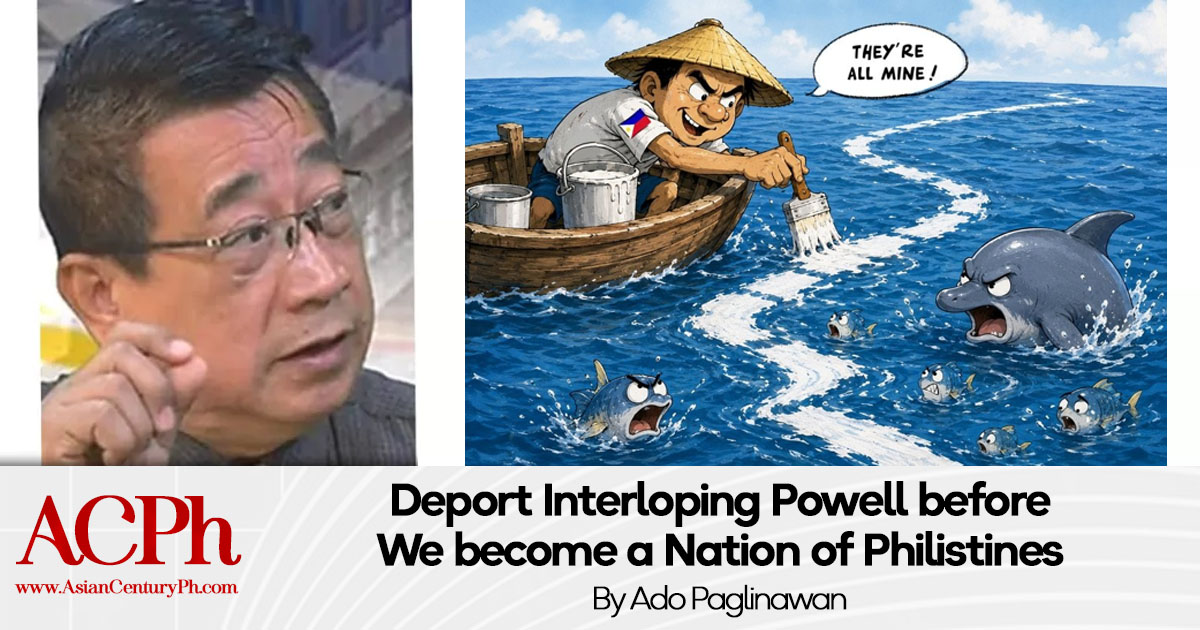
Credits: Top artwork by Steven Pabalinas


Adolfo Quizon Paglinawan
is former diplomat who served as press attaché and spokesman of the Philippine Embassy in Washington DC and the Philippines’ Permanent Mission to the United Nations in New York from April 1986 to 1993. Presently, he is vice-president for internal affairs of the Asian Century Philippines Institute, a geopolitical analyst, author of books, columnist, a print and broadcast journalist, and a hobby-organic-farmer.
His best sellers, A Problem for Every Solution (2015), a characterization of factors affecting Philippine-China relations, and No Vaccine for a Virus called Racism (2020) a survey of international news attempting to tracing its origins, earned for him an international laureate in the Awards for the Promotion of Philippine-China Understanding in 2021. His third book, The Poverty of Power is now available – a historiography of controversial issues of spanning 36 years leading to the Demise of the Edsa Revolution and the Forthcoming Rise of a Philippine Phoenix.
Today he is anchor for many YouTube Channels, namely Ang Maestro Lectures @Katipunan Channel (Saturdays), Unfinished Revolution (Sundays) and Opinyon Online (Wednesdays) with Ka Mentong Laurel, and Ipa-Rush Kay Paras with former Secretary Jacinto Paras (Tuesdays and Thursdays). His personal vlog is @AdoPaglinawan.

This promo includes free delivery by JRS to anywhere in the Philippines.
Email: contact@asiancenturyph.com
Facebook: https://www.facebook.com/asiancenturyph/
Twitter: https://twitter.com/AsianCenturyPH
Substack:
Also read:




Leave a Reply