

by Daniel Long
A younger, more China-friendly generation is emerging in the Philippines.
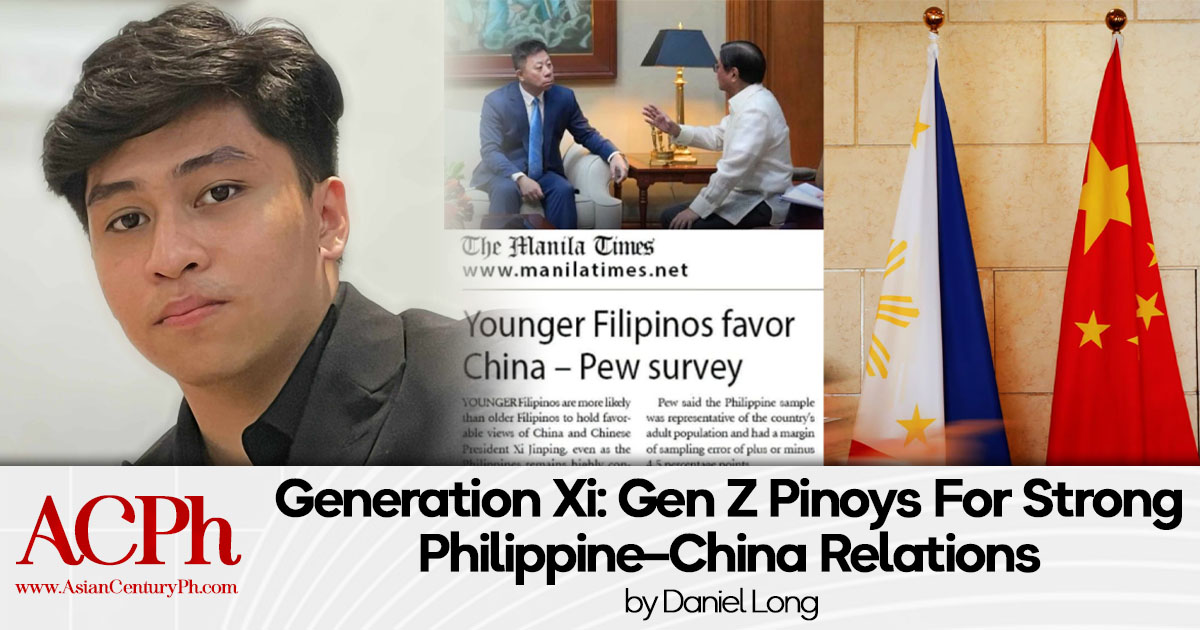
According to Pew Research Center’s 2026 Global Attitudes Survey, 47% of Filipinos aged 18 to 34, like me, said they had a favorable opinion of China. That compares with 44% among those aged 35 to 49 and just 27% among Filipinos aged 50 and older. Meanwhile, 61% of Filipinos aged 18 to 34 expressed confidence in Chinese President Xi Jinping to do the right thing regarding world affairs, compared with 55% among those aged 35 to 49 and 32% among those aged 50 and older. Overall, 40% of Filipinos had a favorable opinion of China, up from 34% in 2024.

A recent analysis by Fulcrum describes this distinction as the difference between Beijing and “everyday China.” For many younger Filipinos, China is encountered through smartphones, social media, Chinese entertainment, online shopping, food, tourism, technology, business, and images of Chinese cities and infrastructure.

Developments between Manila and Beijing this year provide plenty of opportunities for younger Filipinos to encounter China through economic and cultural channels. LABUBU has endeared itself to us, while Mixue Ice Cream and Chagee milk tea – with 20 new branches opened across the country – have become staples for students and workers. Huawei, Vivo, and Xiaomi smartphones offer affordable alternatives to Apple’s iPhones. Linda Walker has also become an inspiration for young Filipinos to become overachievers in school. The adidas Chinese New Year Jacket has become massively popular.

AGRICULTURE
One of the most significant developments in Philippine-China relations this year has occurred in agricultural trade. Davao made its first commercial eel shipment to China. When international fertilizer markets tightened this year, China restricted exports of several products to protect domestic supply. The Philippines received an exemption.

At the China-ASEAN Expo in September, a Davao-based exporter signed an agreement to sell 14 metric tonnes of fresh durian to a Chinese buyer. Serving as the designated “Country of Honor” for the second time since 2013, the Philippines presented its largest commercial participation in CAEXPO history. The Philippine government has described these agreements as opportunities for local producers, consolidators, and exporters to gain access to international markets.

TOURISM
Tourism is another area where 2026 has produced measurable changes. The Philippines introduced a 14-day visa-free entry program for Chinese nationals in January. By July 1, Chinese arrivals had reached 221,747, up 64.08% from the same period in 2025. The Philippine Tourism Promotions Board said 99.63% of those arrivals entered under the visa-free program.

New direct routes have also been introduced or expanded, including connections between Manila and Chongqing, Hangzhou, and Changsha, as well as Fujian and Cebu. Travel times on some of these routes are around three to four hours.

The Philippine tourism industry has simultaneously increased its business engagement with China. A Philippine tourism mission in May brought 35 Philippine tourism companies together with approximately 280 Chinese travel agencies in Beijing, Chengdu, and Guangzhou – the largest Philippine tourism business mission to China since the pandemic.

TRADE
In 2025, China supplied US$38.44 billion of Philippine imports, equivalent to 28.6% of total Philippine imports, according to the Philippine Statistics Authority. Philippine-China merchandise trade reached approximately US$47.75 billion, consisting of about US$9.31 billion in Philippine exports and US$38.44 billion in imports.

Finance Secretary Go has also described China as the Philippines’ most important trading partner, noting that it is the country’s largest source of imports and fourth-largest export market. He has also said that the economic team wants to deepen the country’s trade and investment relationship with China. These figures demonstrate that Philippine policymakers and businesses are increasingly treating the Chinese market as an important destination for Philippine products.

Panhua Group’s steel project in Sarangani is an example of how Chinese engagement can contribute to Philippine industrialisation. This is considered to be the Philippines’ largest foreign industrial investment. The Chinese steelmaker has committed up to US$3.5 billion to an integrated steel development, with the first phase representing around US$1 billion in investment and targeting 2 million tonnes of steel production annually. The broader three-phase project could eventually reach 10 million tonnes of annual capacity and create up to 25,000 jobs, with more than 4,000 direct jobs expected from the first phase.

ENERGY
Energy security has also pushed Manila and Beijing back toward practical engagement. Beijing and Manila have continued discussions about possible joint oil and gas exploration. In August, Marcos said joint exploration with China was a “distinct possibility” amid global supply disruptions. Deepwater drilling is difficult, and China’s state-owned firms have decades of experience, along with equipment and funding that can be readily deployed. A partnership would give the Philippines access to these resources now.

ELECTRIC VEHICLES (EV)
Chinese electric vehicle companies have rapidly expanded in the Philippines. BYD sold more than 26,000 vehicles in the Philippines in 2025, representing year-on-year growth of more than 400%. In August 2026, BYD became the second-best-selling automotive brand in the Philippines, marking a historic shift as it displaced Mitsubishi from its long-held position. BYD sees the Philippines as one of its most promising markets for electric vehicles.

RESET
The simplest interpretation of the Pew survey is that young Filipinos are becoming more “pro- China” because of developments this year that point towards a relationship increasingly characterized by rapprochement, where we experience tangible benefits in our everyday lives.
President Marcos’ description of a “reset” shows this balancing act: continued engagement with China, with dialogue being used to manage differences without implying that Manila has abandoned its position on maritime rights. As the Department of Foreign Affairs (DFA) has repeatedly emphasized, the differences in the West Philippine Sea are not the sum total of Philippine-China relations. The DFA is the authoritative voice and lead agency responsible for the conduct of the Philippines’ foreign policy.

For young Filipinos like me, this is the environment in which their views of China are being formed. They are growing up in a Philippines where China is simultaneously a major trading partner, a reliable supplier of raw materials, a source of consumer technology, a tourism market, an investor, and a manufacturing superpower.
Long live the Friendship between the Philippines and China!


Daniel Long
Daniel Long is a college student of entrepreneurship at Thames International and a Filipino-Chinese writer who contributes to the Asian Century Journal, The Manila Times, Mindanao Times, and SunStar Davao. He currently serves as ISDA Youth’s National Director for Publications and Journalism. He is also a guest host of the “PH-China Talks” radio program on DWAD 1098 and a member of the Youth Committee of the Association for Philippines–China Understanding (APCU).
Previously, he served as a speechwriter for Senator Imee Marcos and as a guest host of “Opinion Ngayon” on Golden Nation Network. He was also part of the official Philippine press delegation to China in 2023, an ASEAN-China social media influencer delegate to China in 2024, and an APCU delegate to Fujian, China, in 2025.
Email: contact@asiancenturyph.com
Facebook: https://www.facebook.com/asiancenturyph/
Twitter: https://twitter.com/AsianCenturyPH
Substack:
Also read:



Leave a Reply