

Series 14: Forever peace or forever wars?
This was my answer to a Facebook follower’s question as she commented on my previous column that exposed the dustbin where President Ferdinand Marcos Jr. and Defense Secretary Gilbert Teodoro have driven our country in terms of foreign relations and economics:
“Will the Philippines most likely end up as another Ukraine?”
Ukraine’s shift from a country balancing between Russia and the West into a society closely aligned with the United States and Europe was driven primarily by internal democratic revolutions and a reaction against Russian military aggression, amplified by U.S. diplomatic, economic, and military backing.
1) But Ukraine did not begin as uniformly pro-Russian
Ukraine’s independence was not simply something America manufactured. Ukraine’s December 1, 1991 referendum overwhelmingly endorsed independence, with more than 90% voting in favor, and Leonid Kravchuk winning the presidential election held the same day.
This was despite it inheriting enormous connections with Russia: Russian was widely spoken, the economies were integrated, families were spread across the border, and much of the population had Soviet identities and cultural ties, especially on its eastern oblasts.
According to data from the Razumkov Centre, about 64% of people in western regions and roughly 63.5% in southern and eastern regions expressed leaning to a distinct political European identity.
So, the starting point wasn’t really “pro-Russian Ukraine or pro-American Ukraine.” It was closer to “independent Ukraine balancing between Russia and the West.”
2) The United States invested heavily in institutions rather than simply changing public opinion
On May 6, 1992, U.S. President George H. W. Bush met Ukrainian President Kravchuk in Washington. Their governments issued a “Declaration on U.S.-Ukrainian Relations and the Building of a Democratic Partnership”.
Declassified notes from their conversation show Kravchuk expressing concern about Russian territorial claims and activity in Crimea. Bush responded that the United States saw strengthening Ukraine’s relationship with the West as an important way of balancing its security concerns.
Bush did not yet promise Ukraine a NATO security guarantee but was trying to encourage democratic reform in Russia and avoid a new confrontation with Moscow, explicitly saying that isolating Russia could make it “more imperialistic,” which would be bad for neighboring countries.
But thereafter, American and European governments began shaping Ukraine’s political environment. Capitol Hill legislation explicitly authorized assistance to improve democratic governance, strengthen civil society NGOs, fund political parties, diversify the Ukrainian economy and energy supplies, and expand independent media.
3) The Orange Revolution was first major turning point
In 2004, Viktor Yanukovych was the Moscow-friendly candidate, while Viktor Yushchenko was more Western-oriented. The disputed presidential election produced enormous demonstrations.
Following the Orange Revolution, the Ukrainian Supreme Court called for a new election, which Yushchenko won. This was significant because it demonstrated that a large portion of Ukrainian society wanted a political alternative to the Russian-oriented model.
But the country remained deeply divided geographically and politically. Local governments continued alternating between Western-oriented and Russia-oriented forces.

4) Europe was actually more important to the ideological transformation than America
One of the biggest misconceptions is to equate Western orientation with just American orientation.
For many Ukrainians, the attraction wasn’t primarily Washington. It was Europe.
The European Union represented higher living standards, rule of law, freedom of movement, democratic institutions and integration with prosperous Western economies.
After Yushchenko’s term ended, Yanukovych was elected president in 2010 over Yulia Tymoshenko, but as his government became increasingly authoritarian, EU’s attraction further accelerated.
Yanukovych’s ran on the platform of economic modernization, greater economic ties with the EU, and military non-alignment but his years in power saw what analysts described as backsliding which included the jailing of Tymoshenko, a decline in press freedom and a rise in cronyism and corruption
5) Euromaidan changed the trajectory
In November 2013, Yanukovych’s government abandoned plans to sign the EU Association Agreement, a major trade and political deal with the European Union, and instead moved toward closer economic relations with Moscow.
Protests began in Kyiv. These protests were called “Euromaidan”, the word combines “Euro” (for Europe) and “Maidan” (the Ukrainian word for square), referring to Maidan Nezalezhnosti (Independence Square) in Kyiv where the crowds gathered
Initially, this wasn’t simply an anti-Russian movement.
Academic research emphasizes domestic political factors—including corruption, government policy and institutional failures—as important causes of the protests.
But American officials openly supported the protesters and the opposition, and U.S. assistance to Ukrainian civil society and political institutions was substantial.
That provides the strongest argument for the claim that the U.S. helped facilitate Ukraine’s Western political transformation.
But saying “the U.S. created Euromaidan” goes substantially beyond what the evidence establishes. The demonstrations involved hundreds of thousands of Ukrainians and reflected genuine domestic grievances.
6) February 2014 was the decisive rupture
The political crisis escalated dramatically as around 100 demonstrators were allegedly shot by government snipers.
Yanukovych fled Kyiv and eventually went to Russia. Ukraine’s parliament removed him and installed an interim government.
Russia rejected the legitimacy of the new authorities and subsequently annexed Crimea while supporting separatist forces in Donbas.
This is where the transformation of Ukrainian public opinion progressively became more dramatic.
Before the crisis, Ukraine remained highly ambivalent.
In February 2014, for example, 78% of Ukrainians surveyed still expressed a positive attitude toward Russia, while 66% wanted Ukraine and Russia to remain friendly neighbors with open borders.
So, the idea that Ukraine was already overwhelmingly anti-Russian before 2014 doesn’t fit the polling.
7) Russia itself became the biggest force pushing Ukraine West
Russia annexed Crimea in March 2014 to secure its vital military naval base in Sevastopol, block Ukraine from aligning with NATO. Owning the peninsula gives Moscow strategic control over maritime trade routes, military projection in the Black Sea, and a staging ground for broader regional operations.
Despite Valdimir Putin’s framing the annexation as a correction of historical injustices, citing Soviet leader Nikita Khrushchev’s 1954 transfer of Crimea from the Russia to Ukraine, the annexation of Crimea and war in Donbas Region changed Ukrainian perceptions of Russia far more profoundly than American aid programs had.
In 2013, Ukrainian society was still debating: Russia or Europe? But one 2014 survey found that support for EU membership had risen to 59%, compared with 42% a year earlier, while support for joining the Russia-led Customs Union had fallen from 37% to 17%. with NATO support also increasing substantially.
8) The United States then reinforced the new orientation
After 2014, Washington’s funding became much more geometric and consequential, as this Ukraine increasingly adopted Western institutional models and started orienting its security policy toward NATO.
But again, Ukraine became primarily Euro-Atlantic, rather than simply American.
9) The 2022 invasion completed the psychological transformation
The full-scale Russian invasion in February 2022 produced another enormous shift.
Again. Russian had to move decisively as Gallup reported that large majorities expected Ukraine eventually to join both NATO and the EU.

Credits: Aljazeera
However, the war produced an enormous consolidation of Ukrainian national identity around independence and the West
The interesting historical irony is that American and European assistance created institutions, networks and incentives that made Western integration attractive. But Russian military intervention pushed that preference into something much closer to a national-security imperative.
While the US and European allies support Ukraine, they do not engage in direct combat against Russia, who has nuclear bombs in its arsenal, in order to avoid starting a wider global conflagration.
Thus, what exists is a war, proxied by Ukraine.
Contrasting scenario
The Philippine model that the United States has been building since the presidency of Noynoy Aquino is based more on restoring military alliance and seeding propaganda to shame China but sorely lacking in political and economic gravitas.
Aquino’s dalliance with the Americans was, as a matter of fact, strategically interrupted with President Rodrigo Duterte’s balancing impoverishing bilateral relations with the US with pragmatic economic ties with China.
The shift, however, did not settle well with Barack Obama who reacted more like a spurned lover than a faithful ally, misunderstanding Duterte’s move towards a national interest that placed the protection of the masses against narcopolitics ahead of any highfalutin security alignments.
Obama criticized Duterte’s war on drugs, sparking a diplomatic clash that went as far as displaying of historical photographs of the 1906 American massacre of Filipino Muslims at Bud Dajo, during the Philippine president’s international and local speeches.
What started with animosity with the US provided an opening towards a genuine friendship with Xi Jin ping, that later left Donald Trump to do the balancing.

As to what Faustian pact Bongbong Marcos sold the Philippines out to Americans remains unknown when he authorized additional US bases in country, turning his back on Xi Jinping’s pledge of $23 billion in packaged assistance and investments in addition to $17 billion projects in the pipeline, made only a month before in January 2023.
Today, as the Philippines face only 2.3% gross domestic product this year, lower than the Covid pandemic year and lowest since 2009, Marcos turns a blind eye to his defense secretary’s rudderless and often uncouth anti-China narratives.
White Paper
Quite timely, a friend gave me the following analysis which I am quoting verbatim below for documentation purposes and for the attention of our ambassador in Beijing who seems to be sitting on his ass, isolated from Secretary Teresa Lazaro’s career policy making circle:
START OF PAPER
China’s patience with the Philippines appears to be diminishing. What was previously manageable strategic friction is increasingly being perceived in Chinese political and business circles as a broader confrontation encompassing military, political, economic, and information domains.
The central concern is not simply individual incidents in the South China Sea. Rather, Beijing appears increasingly convinced that Manila is becoming an operational component of a broader U.S.-Japan strategy intended to constrain China’s regional rise.
This perception creates a dangerous loop:
- Philippine cooperation with the United States and Japan is viewed by Beijing as evidence of containment;
- Chinese diplomatic and economic pressure is then interpreted in Manila as Chinese coercion;
- and both sides subsequently harden their security positions.
The most consequential risk is therefore not an immediate military confrontation, but the progressive destruction of strategic trust.
1. Chinese Perception of the Philippines
Chinese interlocutors increasingly characterize the Philippines not as a difficult neighboring state with competing maritime claims, but as a country being strategically aligned against China.
Three developments appear particularly significant:
- Expanded U.S.-Philippine defense cooperation
- Growing Philippine-Japanese security cooperation
- Increasingly confrontational public rhetoric surrounding the South China Sea
From Beijing’s perspective, these developments are interconnected rather than independent.
China’s strategic concern is that Philippine territory, infrastructure, military facilities, and political institutions could increasingly support U.S. and Japanese efforts to monitor, deter, and constrain Chinese military activity.
This does not necessarily mean Beijing has decided that confrontation is inevitable. It does, however, suggest that the Philippines is increasingly being viewed through the lens of great-power competition rather than solely through bilateral relations.

Containment of China by UK Council for Geostrategy
2. The Teodoro/Tarriela Factor
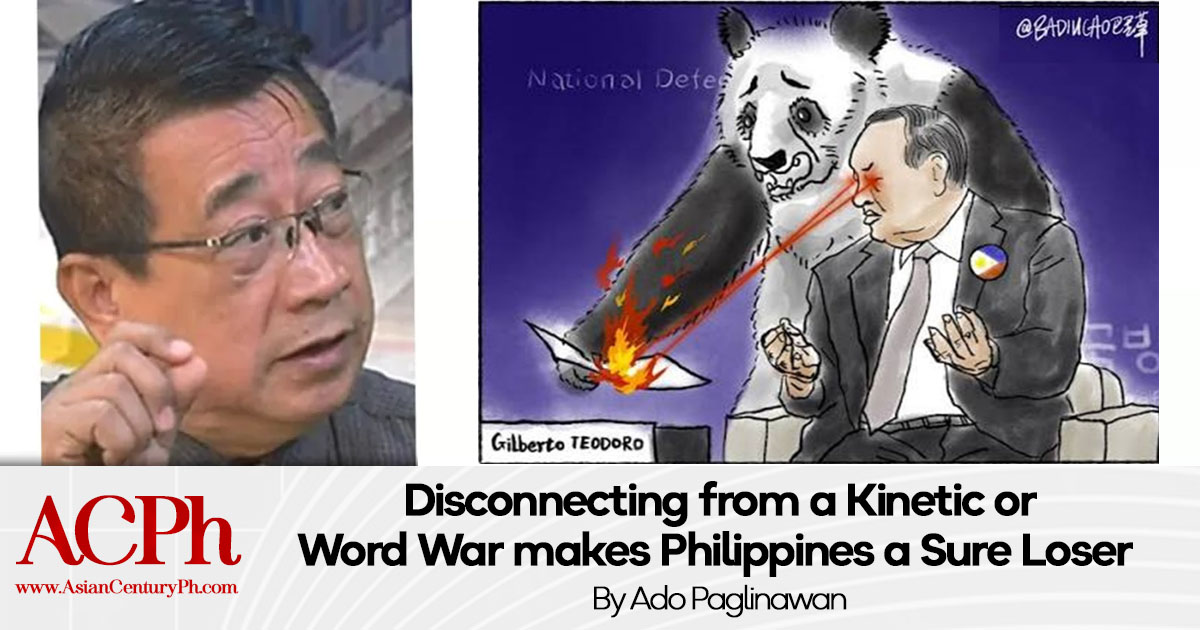
Philippine officials, particularly Secretary of National Defense Gilbert Teodoro and PCG Commodore Jay Tarriela, have become prominent figures in Beijing’s negative assessment of Manila.
Chinese observers interpret their public statements and operational policies as evidence of a deliberate effort to internationalize and confront China over maritime disputes.

In a forum organized by De La Salle-St. Benilde College. PCG Spokesman Jay Tarriela in uniform at that, shows AI-generated caricatures smearing Chinese President Xi Jinping. In her public response, however, Foreign Affairs Secretary Ma. Theresa P. Lazaro did not correct Tarriela but noted that government officials must remain professional and prudent stressing that responses to foreign governments must be firm and assertive in defending the national position, but measured and composed in tone to maintain the higher ground. Further, DFA explicitly stated that foreign leaders “should be off-limits or at least treated with respect, regardless of our personal views”. Despite the rebuke, Tarriela refused to apologize, stating the imagery was a valid response to aggressive actions in the so-called “West Philippine Sea”.
Beijing also thinks that some Philippine officials are receiving dictations from foreign actors, including US Naval Institute’s agent Raymond Powell and the Center for Strategic and International Studies (CSIS) of Washington DC through its local adjunct Stratbase Albert delRosario Institute.
Nevertheless, the perception itself is politically significant. For Beijing, the distinction between direct U.S. intervention and strong policy alignment may matter less than the resulting behavior.
If Philippine actions consistently advance U.S. strategic objectives, Chinese officials may conclude that Manila has effectively surrendered strategic autonomy regardless of the actual decision-making process inside the Philippine government.
Read more at: https://tribune.net.ph/2026/01/16/china-lodges-protest-vs-tarriela-over-smear-campaign-against-xi-jinping
3. Symbolism and the Escalation of Public Provocation
Recent political caricatures depicting Chinese President Xi Jinping, Chinese Foreign Minister Wang Yi, and China’s ambassador, including imagery involving a casket and other insulting representations, have generated concern among Chinese observers.
The importance of these images should not be underestimated.
Chinese political culture places the highest importance on national dignity, political authority, and respect for senior state leadership.
Public ridicule of China’s top leadership can therefore be interpreted not merely as criticism of a government policy, but as an affront to the Chinese state and national identity.
4. Information Environment and the Chinese-Philippine Media Space
An additional concern involves the behavior of Chinese-language media operating in the Philippines.
These outlets appear cautious about aggressively reporting politically sensitive material because they could subsequently be accused of acting as agents or intelligence assets of Beijing.
This creates an unusual information environment.
The resulting dynamic deserves monitoring because it could further erode confidence between Philippine institutions and the country’s Chinese-Filipino community.
5. Economic Retaliation Risk
The most consequential potential Chinese response may not initially be military.
Beijing possesses substantial economic leverage over Philippine commercial interests, supply chains, tourism, investment, agriculture, infrastructure, and trade.
Chinese authorities and businesses could respond through a gradual reduction of economic engagement rather than through a dramatic formal sanction.
Such measures could include:
- Reduced Chinese tourism;
- Delayed or cancelled investments;
- Restrictions affecting selected imports;
- Reduced participation in infrastructure projects;
- Increased regulatory scrutiny;
- Reduced commercial engagement (including trade) with Philippine companies;
- Informal discouragement of Chinese business activity in the Philippines.
Most of these have already been subtly happening since 2003, and whose cumulative effect have already been significant even without an official economic embargo.
6. The Overseas Filipino Worker Question
A particularly sensitive issue is the approximately 300,000 Filipino overseas work force in China and Chinese-linked economic environments.
There is speculation that Beijing could seek to impose pressure on Philippine interests through measures affecting overseas Filipino workers.
A few days before the Chinese government implemented arrest of Filipinos who are supposedly working and living in China illegally, some Chinese commentators suggested about hitting the Philippines where it hurts the most, and that is the overseas Filipino workers who are a main contributor to the Philippine economy.
For this reason, Philippine officials should avoid assuming that economic retaliation would remain confined to corporations or government to government relations and trade.
7. Perception of a “Point of No Return”
A growing concern among Chinese observers is that bilateral relations may be approaching a strategic point of no return.
The argument is that Beijing can tolerate temporary disputes, but may respond more permanently if it concludes that Manila has made a long-term strategic choice to align itself with Washington and Tokyo against China.
Under this scenario, China could reassess the Philippines not simply as a neighboring claimant but a strategic adversary. Such a shift would have consequences extending beyond the Marcos administration. Even if a future leadership replacement attempts to restore relations, Beijing could remain distrustful for years.
This is particularly important because Chinese strategic planning tends to operate on a much longer time horizon that electoral cycles.
8. Political Implications for the Philippines
The political danger is that Philippine policymakers may underestimate the cumulative effect of their actions.
From Manila’s perspective, individual decisions may appear reasonable:
- Strengthening the alliance with the US
- Expanding defense cooperation with Japan
- Publicizing maritime incidents
- Challenging Chinese claims
- Seeking international support
From Beijing’s perspective, however, these actions can be interpreted as components of a single strategic campaign.
The resulting problem is one of strategic signaling. What Manila considers deterrence may be interpreted by Beijing as provocation.
The result is a classic security dilemma.
9. Implications for US Policy
For Washington, the central policy question is not whether the Philippines should maintain its alliance with the United States as that could a major component of regional security architecture.
The more difficult question is how Washington can strengthen Philippine deterrence without unintentionally accelerating a permanent rupture between Manila and Beijing.
A prolonged China-Philippine confrontation could ultimately impose costs on US interests by:
- Increasing the probability of a military incident
- Creating pressure for direct US intervention
- Increasing economic instability in the Philippines
- Complicating ASEAN diplomacy
- Increase pressure on Filipino migrant workers
- Encouraging Chinese economic disengagement from the Philippines
- Making diplomatic de-escalation increasingly difficult
Washington, therefore, also has a stake in preserving Philippine strategic autonomy while simultaneously strengthening its deterrence objectives.
END OF PAPER
Conclusion
The nightmare scenario is that the Philippines becomes so militarily and politically entangled in the U.S.-China confrontation that Manila loses control over the escalation and the Philippines become disposable.
But I do not think the Philippines could become another Ukraine. What I anticipate in case of a shooting war involving China, is the Philippines ending up just as countries hosting US bases in the Middle East were targeted by Iran.
First, there is no appetite among Filipinos to war with China.
The Filipino people know Bongbong Marcos’ narcissism and vested interests have only less than two years to go with no possible successor that match up with either Sara Duterte or Robinhood Padilla, who shares President Rodrigo Duterte’s commitment to the Constitutionally-mandated independent foreign policy which Secretary of Defense Teodoro has been toying for two years now.
In fact, the tarpaulin of Teodoro and Tarriela (TNT) “protecting our sovereignty against foreigners” has been torn down to an all-time low of only 3% in the latest Pulse Asia July survey. These latter-day saints of American propaganda turning every disagreement into a test of patriotism and mouthing inflammatory mantras against China, are not gathering traction.
The people’s misfortune is that they elected a weak and greedy leader who has not only hurt the Philippine economy and driven away foreign investments and tourism but looks the other way.
The TNT tandem’s lie that the China is targeting Filipino workers also won’t wash because legal OFWs themselves know that Chinese laws protect them. In fact, what has backfired on Teodoro’s face is that he destroys Pinoy jobs here and abroad.
Second, Filipinos may have colonial mentality viewing living in Los Angeles, Chicago or New York as the greener pasture but the US image has also been failing even among Filipino-Americans, especially on how inflation has been eating up their hard-earned incomes and a home country that is facing another economic recession as early as late this year.
The America for the baby boomers is no longer the haven for the Generation Alpha (2013–2024) who are mostly the children of Millennials, growing up with advanced smart devices and streaming technology, and definitely not of Generation Beta (2025–2039) consisting of children born from 2025 onward where artificial intelligence and daily digital integration would be standard.
Already, I am asking my children to school theirs in Mandarin as early as possible. China is the future.
Lastly, the military alliance between the Philippines and the US is only on a piece of paper the lifeline of which may vary after each election season whereas the shared heritage between China and the Philippines is in the DNA of every Filipino.
What most Filipinos now know is that Gibo Teodoro has not only turned traitor to the Cojuangco family and to his ancestral roots, but the Filipino people.
Filipinos and Chinese shared heritage spans over 1,000 years of early trade and cultural contact, with permanent community roots and intermarriage dating back more than 400 years.
As my grandmother used to say, there will always be an “intsik” (Hokkien: uncle) in every community street corner.
Just as there will always be a Russophone, east of Ukraine.

Adolfo Quizon Paglinawan
is former diplomat who served as press attaché and spokesman of the Philippine Embassy in Washington DC and the Philippines’ Permanent Mission to the United Nations in New York from April 1986 to 1993. Presently, he is vice-president for internal affairs of the Asian Century Philippines Institute, a geopolitical analyst, author of books, columnist, a print and broadcast journalist, and a hobby-organic-farmer.
His best sellers, A Problem for Every Solution (2015), a characterization of factors affecting Philippine-China relations, and No Vaccine for a Virus called Racism (2020) a survey of international news attempting to tracing its origins, earned for him an international laureate in the Awards for the Promotion of Philippine-China Understanding in 2021. His third book, The Poverty of Power is now available – a historiography of controversial issues of spanning 36 years leading to the Demise of the Edsa Revolution and the Forthcoming Rise of a Philippine Phoenix.
Today he is anchor for many YouTube Channels, namely Ang Maestro Lectures @Katipunan Channel (Saturdays), Unfinished Revolution (Sundays) and Opinyon Online (Wednesdays) with Ka Mentong Laurel, and Ipa-Rush Kay Paras with former Secretary Jacinto Paras (Tuesdays and Thursdays). His personal vlog is @AdoPaglinawan.

This promo includes free delivery by JRS to anywhere in the Philippines.
Email: contact@asiancenturyph.com
Facebook: https://www.facebook.com/asiancenturyph/
Twitter: https://twitter.com/AsianCenturyPH
Substack:
Also read:





Leave a Reply