

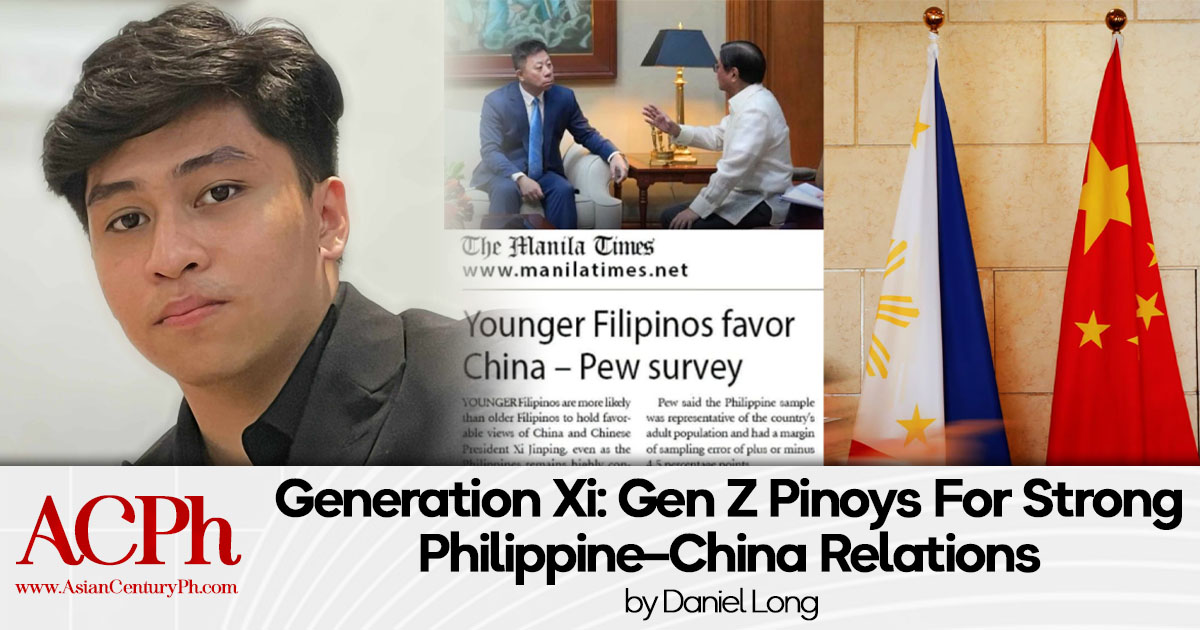
by Daniel Long
President Ferdinand Marcos Jr. recently offered a useful framework for Philippine foreign economic policy. Speaking about the US-led Pax Silica initiative, he rejected the idea that accepting one partnership requires rejecting another. Investments that serve Philippine interests should remain welcome whether they come from the United States, Europe, China, Japan, South Korea, Canada or Australia.

That same principle should guide Manila’s approach to the Shanghai Cooperation Organisation (SCO). The Philippines does not need to choose the SCO over ASEAN, the United States, Japan or Europe. It needs more markets, suppliers, capital and technology, and less dependence on any single country.

Developments in 2026 already show what this approach can produce. The Philippines resumed Russian oil imports after five years. China exempted Philippine fertilizer purchases from restrictions affecting other markets. Chinese tourist arrivals increased by more than 64% after the introduction of 14-day visa-free entry. New direct flights linked the Philippines with several Chinese cities. Manila and Beijing moved forward with talks on joint oil and gas exploration.
Davao also made its first commercial eel shipment to China.

These developments did not require the Philippines to abandon its alliances or territorial position. They simply widened its economic options. The SCO could make that diversification more systematic.
The SCO brings together China, India, Russia, Pakistan, Kazakhstan, Kyrgyzstan, Tajikistan, Uzbekistan, Iran and Belarus. Together, they account for roughly 40% of the world’s population and around 25% of global economic output. Its network also includes dialogue partners such as Saudi Arabia, the UAE, Qatar, Kuwait, Türkiye, Egypt, Cambodia, Laos, Myanmar, Nepal and Sri Lanka.

The organization began primarily as a security grouping, but its work now extends to trade, investment, agriculture, energy, transportation, customs, industrial cooperation and digital commerce. Its members are also developing a 2026-2030 program for multilateral economic cooperation. For Manila, Dialogue Partner status makes more sense initially than full membership. It would allow the Philippines to participate, negotiate sector by sector and determine whether the relationship produces measurable economic gains.
Energy should be near the top of the agenda. The disruption of Middle Eastern energy flows this year exposed Philippine dependence on imported fuel. In March, the Philippines resumed Russian crude imports for the first time in five years. Two cargoes carrying approximately 1.5 million barrels of ESPO crude arrived in Limay, Bataan. Russia remains one of the world’s largest oil and gas producers, while China and India already purchase most Russian oil exports.

Coal presents an even greater concentration risk. Around 98% of Philippine coal imports in 2025 came from Indonesia, while coal generated roughly 57% of Philippine electricity.
Indonesia’s suspension of spot exports in early 2026 therefore immediately exposed the Philippines to potential supply disruption.

That 98% dependence should be reduced. A practical five-year objective would be to bring Indonesia’s share below 70%, provided alternative supplies remain commercially competitive. Russia and Kazakhstan can provide additional sources, while Kazakhstan also possesses major uranium resources. But replacing Indonesian coal with Russian or Kazakh coal is not a long-term energy policy. The larger objective must be to reduce coal dependence through gas, battery storage and eventually nuclear power. China already dominates global manufacturing of solar panels, batteries and much of the equipment required for this transition. SCO engagement can therefore help diversify today’s energy supply while developing alternatives for tomorrow.


Agriculture presents a similar vulnerability. The Philippines imported an average of around 2.38 million metric tons of inorganic fertilizer annually from 2021 to 2024. When international fertilizer markets tightened this year, China restricted exports of several products to protect domestic supply. The Philippines received an exemption. By March, the government had secured approximately 84% of its estimated 2026 fertilizer requirement.Manila was simultaneously pursuing additional supplies from India and Russia and preparing discussions with Belarus. China, India, Russia and Belarus are all SCO members. Rather than negotiating emergency supplies during every global shortage, the Philippines should establish multiyear arrangements with several producers and aim to secure at least 90% of annual fertilizer requirements before the main planting seasons.
Rice is another vulnerability. Philippine rice self-sufficiency improved from 71.7% in 2024 to 78.1% in 2025. Imports fell nearly 30%, from a record 4.68 million metric tons in 2024 to around 3.39 million metric tons in 2025. Yet more than one-fifth of national requirements still effectively depend on foreign supply. Import diversification can help, particularly through India and Pakistan, but it cannot substitute for domestic productivity. Philippine agricultural total factor productivity in 2023 was only around 4% higher than in 2008. Over the same period, Indonesia improved by approximately 41% and Vietnam by around 25%. China and India have extensive experience in agricultural mechanization and irrigation, while Kazakhstan brings expertise in large-scale grain production. A reasonable Philippine objective is to raise rice self sufficiency from 78.1% to at least 85% by 2030 while maintaining diversified imports for shortages and emergency reserves.

Manufacturing requires the same approach. China remained the Philippines’ largest source of imported goods in July 2026, supplying $4.17 billion, or 29.5% of total imports. South Korea supplied 12.7%, Japan 7.9%, Indonesia 5.7% and the United States 5.4%. China alone therefore supplied more Philippine imports than South Korea, Japan and the US combined. Electronic products accounted for 32.6% of imports, raw materials and intermediate goods 40.4%, and capital goods another 27.2%. Philippine manufacturing itself remains dependent on imported machinery and components.

The objective should not be fewer Chinese imports. It should be more Chinese, Indian and other foreign manufacturing inside the Philippines. There is no room for economic decoupling with the major powers in the multipolar world order.
BYD shows us the opportunity. The company sold more than 26,000 vehicles in the Philippines in 2025, an increase of more than 400% from the previous year, making it the country’s dominant new-energy vehicle brand. The next step should be localization: battery packs, charging equipment, electric motors, and eventually vehicle assembly. Last July, the President issued an executive order establishing a ₱60-billion Electric Vehicle Incentive Strategy (EVIS) program to boost local electric vehicle manufacturing in the Philippines.

Tourism already shows how quickly policy changes can produce measurable results. The Philippines introduced 14-day visa-free entry for Chinese nationals in January 2026. By July 1, Chinese arrivals reached 221,747, up more than 64% from the same period in 2025. Almost all entered through the visa-free program. Direct services also expanded between the Philippines and Hangzhou, Changsha, Chongqing and Fujian.

More direct seats and simpler entry requirements translate into hotel nights, restaurant spending, retail activity, aviation revenue and employment. That model can be repeated across the SCO. Market access should produce buyers, buyers should produce shipments, and shipments should become recurring export industries.
Minerals offer an even larger opportunity. The Philippines accounted for approximately 9.5% of global nickel production in 2024, making it the world’s second-largest producer. Yet mining and quarrying contributed only around 0.9% of Philippine GDP. In 2024, the Philippines exported around 44.5 million wet metric tons of nickel ore and concentrates. China took approximately 77% and Indonesia the remaining 23%. Almost the entire export stream therefore went to two countries where much of the higher-value processing takes place. China accounted for roughly 58% of global refined nickel production in 2024, while Chinese-controlled companies held approximately 75% of Indonesia’s nickel-refining capacity. Indonesia shows what moving downstream can accomplish. In 2024, it exported approximately $14.1 billion of nickel pig iron and ferronickel. Philippine exports of nickel ores and concentrates were worth only around $1 billion. The Philippines does not simply need more mining. It needs more processing.

A serious minerals strategy should seek at least three major nickel, copper or battery-material processing projects by 2030 and aim to process at least 50% of domestically mined nickel through Philippine value-adding facilities within a decade. Executive Order No. 122, signed by the President on August 18, 2026, establishes the first national policy framework to develop the Philippines’ critical minerals industry. The policy pushes the country to move past raw mineral extraction by prioritizing local refining, advanced material processing, and manufacturing finished products like green technology and batteries. The new policy grants priority access to raw mineral ores only to those mining firms that will establish domestic refineries.

Technology transfer is the most important thing here. China accounts for roughly 70% of global rare-earth mining but close to 90% of processing. The real industrial capability lies in separation, refining, metallization, alloys and eventually magnet manufacturing. The Philippines should seek access to this know-how – advanced training for Filipino mining, metallurgical and chemical engineers. China has extensive commercial experience in mineral processing. India is expanding its critical-minerals industry. Russia and Kazakhstan have deep mining and metallurgical expertise. These relationships can complement, rather than replace, cooperation with Japan, Australia, the US and Europe.

This is exactly why Marcos’ position on Pax Silica is pragmatic. Semiconductor cooperation with Washington does not prevent mineral-processing cooperation with Beijing. Russian energy does not require dependence on Russia. Different partnerships can serve different Philippine requirements.

Semiconductors themselves demonstrate why this matters. Electronic products generated approximately $45.9 billion in Philippine exports in 2025, around 54% of total merchandise exports. Yet the country simultaneously imported roughly $32 billion in electronics because Philippine production remains dependent on foreign wafers, components, machinery and intermediate goods.

The next step must be higher-value production: advanced packaging, integrated-circuit design, power and compound semiconductors, semiconductor materials, and battery electronics. China and India are investing heavily in these industries.
Joint oil and gas exploration with China provides another example of how this approach can coexist with Philippine sovereignty. Marcos confirmed in August that discussions had moved forward and described an agreement as a distinct possibility. The Department of Foreign Affairs has maintained that any arrangement must comply with the Constitution, Philippine law and Philippine sovereign rights within the country’s exclusive economic zone and continental shelf. The initiative brings in the capital, technology, and expertise that we currently lack. Deepwater drilling is difficult, and China’s state-owned firms have decades of experience, along with equipment and funding that can be readily deployed. Last year, China hit a total oil and gas production of a new high at 420 million tonnes of oil equivalent. A partnership would give the Philippines access to these resources now, without requiring us to wait decades to develop the same capabilities independently.

That should remain the standard. Commercial cooperation does not require surrender. If an arrangement protects Philippine sovereign rights while bringing commercially viable gas into the domestic economy, it should be judged on those terms.
The case for SCO engagement is therefore grounded in identifiable economic weaknesses.
Around 98% of imported coal comes from Indonesia. Rice self-sufficiency stands at 78.1%. China and Indonesia receive virtually all Philippine nickel ore exports while much of the downstream value is captured abroad. Electronics generate around 54% of merchandise exports but remain heavily dependent on imported inputs. China alone supplies around 29.5% of Philippine imports in the latest monthly figures.
These are concentration risks that can be measured and reduced. By 2030, the Philippines should aim for rice self-sufficiency of at least 85%, bring its largest single-country coal dependence below 70%, secure at least 90% of fertilizer requirements, and bring at least three major mineral-processing projects into construction. Within a decade, at least 50% of domestically mined nickel should undergo Philippine value addition.
None of this requires abandoning ASEAN, RCEP, the alliance with the United States or strategic relationships with Japan, Australia and Europe. It requires an independent foreign policy broad enough to use all of them. The Philippines has already begun doing this in 2026. It bought Russian crude when traditional energy routes became vulnerable. It secured Chinese fertilizer access. It reopened Chinese tourism, expanded direct flights and entered new agricultural markets. It continued energy discussions with Beijing while maintaining Philippine territorial and maritime positions.
The future is win-win cooperation and diversification, not economic decoupling and being a proxy for great-power rivalries. The SCO can become another instrument of that policy. The Philippines should begin as a Dialogue Partner, engage selectively and judge the relationship according to results: more secure energy, higher agricultural productivity, more mineral processing at home, more factories, more exports, more tourists and more technical knowledge transferred to Filipino firms and workers. The purpose is to make the Philippines engage more with the countries of the Global Majority and view them not as competitors and threats, but as markets, donors, and providers.

Daniel Long
Daniel Long is a college student of entrepreneurship at Thames International and a Filipino-Chinese writer who contributes to the Asian Century Journal, The Manila Times, Mindanao Times, and SunStar Davao. He currently serves as ISDA Youth’s National Director for Publications and Journalism. He is also a guest host of the “PH-China Talks” radio program on DWAD 1098 and a member of the Youth Committee of the Association for Philippines–China Understanding (APCU).
Previously, he served as a speechwriter for Senator Imee Marcos and as a guest host of “Opinion Ngayon” on Golden Nation Network. He was also part of the official Philippine press delegation to China in 2023, an ASEAN-China social media influencer delegate to China in 2024, and an APCU delegate to Fujian, China, in 2025.
Email: contact@asiancenturyph.com
Facebook: https://www.facebook.com/asiancenturyph/
Twitter: https://twitter.com/AsianCenturyPH
Substack:
Also read:




Leave a Reply