

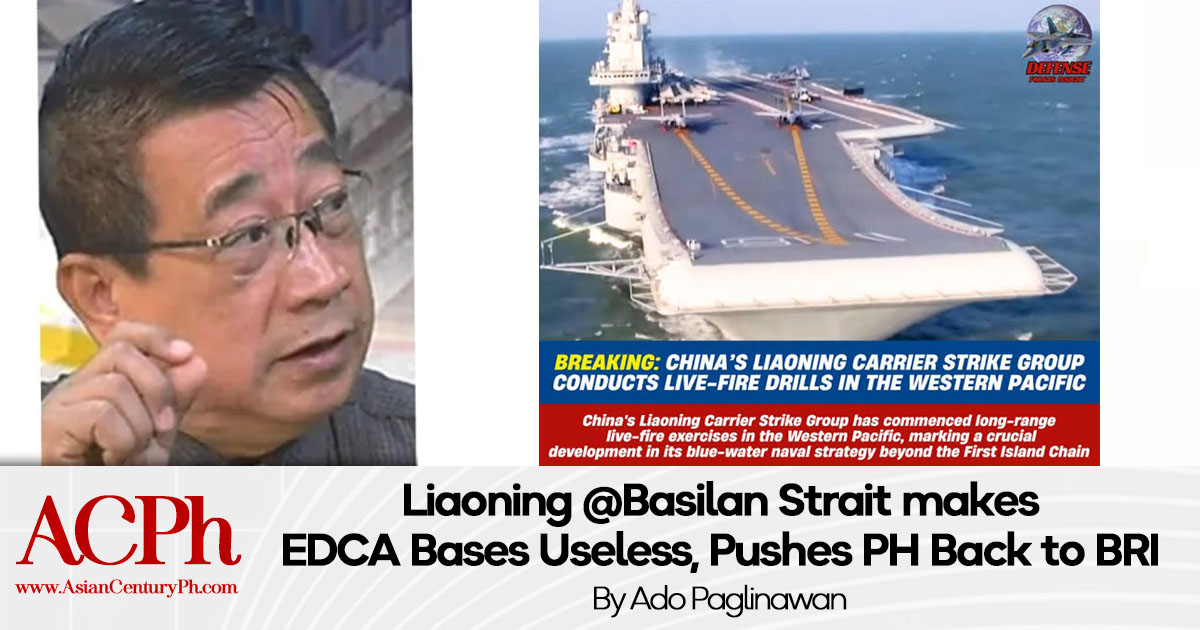
The Peoples’ Liberation Army Navy aircraft carrier Liaoning, alongside two Type 055 destroyers, the Anshan and Wuxi , with one Type 052D destroyer, the Huainan, was spotted approximately 15.2 nautical miles northwest of Taluluro Point in Zamboanga, Philippines last October 22.
The group was sailing south at a speed of 14 knots, subsequently passing through the Basilan Strait to move from the Sulu Sea into the Celebes Sea.
Says a vlogger, “If, after completing its scheduled training in the Philippine Sea, the Liaoning group returns via the Bashi Channel, it will have completed a full circumnavigation of the Philippines—this time in a counter-clockwise direction, reversing the clockwise route taken previously.”
This demonstrates that China’s uncontested maritime supremacy in the South China Sea when factored with a Taiwan contingency, spells control of the First Island Chain.
China Ambassador to the Philippines Jing Quan might have been magnanimous when he said a week before that his country “wants peace”, denying later that his premise PRC could “easily win” an armed conflict with the Philippines, was a veiled threat.
But neither was it an empty sheath. In fact, it carries a lot of gravitas.
The Liaoning voyage exposed the uselessness of the nine US-EDCA bases and other facilities in the Philippines.
Worse, it and only explains how the history could repeat itself when by the end of the first day of the Japanese attacks in the Philippines (December 8, 1941), the US Far East Air Force was reduced by half and eliminated as an effective fighting force.
In World War II, only 418,500 military and civilian American casualties died in both the European and Pacific theatres.
Our death toll was 2-1/2 more exceeding one million our roughly 7% of our population. 10% of that or 100,000 civilians perished in the Liberation of Manila, mostly because of the indiscriminate artillery and air bombing by the Americans to flush out retreating Japanese forces.
After 85 years, the United States is again converting us into a battleground for its hegemonic ambitions another Ukraine in the making.

Road back to BRI
While meandering around the road to war President Marcos Jr has taken the Philippines since February 2023 when he started pivoting to the zero-sum bosom of Uncle Sam, I could not simply dismiss the valuable time and opportunity we wasted when he removed the country from China’s Belt and Road Initiative.
In a peak of madness and political immaturity, Marcos Jr snubbed the BRI in Beijing on October 2023, during its 10th anniversary of the US$1 trillion globe-spanning infrastructure-building program.
It would be remembered that eight months before that, Bongbong Marcos went to a state-visit to China, and Xi Jinping pledged $23 billion in investments in the Philippines, in addition to the $17 billion that was already in infrastructure projects in the pipeline.
That was a total of $40 billion, which was a substantial commitment to a single country, when on that Beijing Summit, China only provide for another $100 billion for the rest of the BRI world.
In an obviously tragic miscalculation, Marcos Jr. skipped the BRI to impress the world a major geopolitical pivot deliberately distancing itself from the pro-Beijing policies of the previous Duterte presidency and choosing to revitalize the Philippines’ traditional security alliance with the United States and relying on Uncle Sam for economic development.
Up to now it is still mystery what alluring potion the US had Bongbong drink to make that historic mistake. The propaganda was he was provoked by our transportation czar Jaime Bautista’s failure to leverage China on infrastructure projects that were already in the pipeline.
As events proceeded, the idiot’s crystal ball was totally blindsided by the effects of Russia’s full invasion of Ukraine in February 2022, a disaster that had been brewing since 2014 that would ultimately sap the development resources of the United States and the portfolios of its Western allies.
In our neck of woods, Japan’s economy slipped into stagnation due to sluggish private consumption and weak business spending. Its real GDP grew by a measly 1% in 2022, about 1.5% in 2023, but finally heavily lost momentum to a spit of only 0.1% for the full year of 2024, causing Japan to lose its status as the world’s third-largest economy to Germany.
South Korea’s economy experienced a slowdown or cooling phase between 2022 and 2024, largely driven by a combination of weakening global demand, aggressive central bank interest rate hikes to combat soaring inflation, and a severe downturn in the global semiconductor cycle that saw growth decelerating to an estimated 1.4%.
We cannot turn back the clock; the BRI bus had already left the station. The question now is how do we jump back into the bandwagon?
Inspiration from Vietnam
Reversing the trend towards robust recovery, I now draw my vision from the Vietnamese scoreboard that is powering near 10% growth in its gross domestic product.
I noticed that Vietnam’s economy headed towards rapid growth helped by large-scale projects coming into operation, recovering export orders and faster public-investment disbursement.
Most of which are being recorded not in Hanoi or Ho Chi Minh City, but across a cluster of northern industrial provinces closely tied to electronics manufacturing, foreign investment and global supply chains.
Of Vietnam’s 34 provinces and cities, twelve recorded gross regional domestic product, or GRDP growth of at least 10 per cent in the first nine months of 2026,
Of the twelve, seven were in the north, three in the central region and just two in the south.
The pattern was also evident in the latest quarter, when nine of the 17 localities posting double-digit growth were in the north, compared with three in the south.
“The north’s high concentration of electronics industries enables the region to ride on the current global electronics and AI capex upturn,” said Brian Lee, an economist at Maybank, who sees northern Vietnam benefiting disproportionately from the current cycle.

Data released by Vietnam’s National Statistics Office on October 3 showed that exports of computers, electronics and components surged 59.6 per cent to US$123.7 billion in the first nine months, while phones and components rose 18.8 per cent to US$51.8 billion.
Together, the two categories generated about 40 per cent of Vietnam’s exports and almost two-thirds of the year on-year increase in the country’s merchandise exports over the period.
South Korea follows suit
This is also where South Korea has exhibited resilience as its major electronics group located some of their biggest manufacturing operations in Vietnam, creating supplier networks that make the region a natural choice for further investment.

The dynamics have been simple.
- Proximity to Southern China’s Ecosystem: Northern Vietnam shares a border with China, allowing for a seamless flow of intermediate parts, raw materials, and machinery shipped over well-established cross-border transport routes.
- “Follow Sourcing” and Cluster Transplantation: Major South Korean giants moved first and forced or encouraged their primary tier-1 and tier-2 component suppliers to relocate alongside them (“follow sourcing”). This transplanted an entire industrial cluster directly into northern Vietnam rather than forcing companies to build supply chains from scratch.
- Mitigating Rising Costs in China (“China Plus One”): Escalating wages, operational overhead, and geopolitical or trade risks in coastal China pushed South Korean firms to diversify their manufacturing footprint. Northern Vietnam offers a lower-cost alternative while staying physically close to the Chinese mainland.
- Favorable Local Environment and Trade Agreements: Vietnam features competitive labor costs, political stability, and 15 free trade agreements that ease global export operations.
- Self-Reinforcing Supplier Networks: When Samsung and LG—established massive manufacturing hubs in the Bac Ninh and Thai Nguyen
provinces due to a mix of geographic, economic, and supply chain factors, they established an ecosystem with lowers risks and transaction costs that accounts for about half of its global smartphone output.
On top of that, Samsung and LG created deep local supplier density and technical spillovers, making northern Vietnam a natural gravity center for further electronics and semiconductor investments such as facilities by Amkor Technology, world’s largest U.S.-headquartered outsourced semiconductor assembly and test (OSAT) company.
The two provinces now serve as key nodes in Vietnam’s electronics manufacturing and export base.
Meanwhile, despite the present sad predicament of the Philippine economy under Marcos, Samsung Electro-Mechanics Philippines Corp. (SEMPHIL) announced late last year that it is set to invest an additional $1billion in the Philippines generating some 3,000 new jobs, as enticed to receive tax incentives under the CREATE MORE Act.
Subsequently, around 30 Tier-1 suppliers of Samsung have been expected to visit the Philippines this month to assess opportunities for setting up manufacturing operations, giving the country a potential boost to its semiconductor and electronics supply chain.
Beyond tunnel vision
Hope springs eternal.
The president seems to be running short of his term, but where his tunnel vision failed us, could be where we can pool together build the foundation for real recovery, even before he exits from power. There is no reason why we should not start earlier.
If Marcos plays his cards well in the November APEC and ASEAN summits this year, he may still be able to save the Philippine peso from deteriorating to P65 against the US dollar by December.
So let us stop playing cards not of our own and backtrack a bit to see where it could be strategic to begin a reconstruction.
We missed the commonsensical logic of the Vietnamese and the South Koreans, because we allowed the Americans to play us with its false promises.
The grand deception was – embargo the Chinese projects and the US will take over with the help of the Europeans, the Japanese and the South Koreans.
The US and European economies which were heavily invested in the war in Ukraine have deteriorated into recession, while the Japanese experienced stagnation.
Instead of jumping in, the South Korean government refused extending loans to the Philippines due to massive corruption, instead Seoul brought its investments to North Vietnam, enjoying unprecedented profits.
What if instead of serving as a proxy for the United States and its lust for great power competition, we max on our economic opportunities and pushed better lives for our people?
We are the only ASEAN country that is now in bed with the Americans, and as a result facing a miserably near 2% GDP growth.
What if instead of paying attention to the conflicts in the South China Seas, which is west of the country, we took notice instead of the United Nations’ delimitation of 200 validated exclusive economic zone and 150 extended continental shelf that is the Benham Rise? A total of 350 nautical miles of uncontested and enforceable sovereign rights entitlements.
Imagine if the tonnage of fuel being wasted by the Philippine Coast Guard, the Philippine Navy and ships of the Bureau of Fisheries and Aquatic Resources just playing cats and mouse with their Chinese equivalent, were devoted instead to fishing and exploratory expeditions east of Luzon.
What if instead of adding four additional sites (two of which are in Cagayan and one in Isabela) for the Enhance Defense Cooperation Agreement aimed at war games with China, we connected them into a Chinese “belt and road” development plan at least for Northern and Central Luzon?
That mini-BRI corridor could start at Port Irene at Cagayan and from there flows down to Isabela, Quirino. Nueva Vizcaya, Nueva Ecija, Tarlac, Pampanga (Clark), to Zambales (Subic Bay).
This connects the Cagayan Economic Zone Authority to its equivalent freeports in Clark and Subic, while everything in between could have been poised for agriculture and agri-industrial growth.
Significantly, the process of Clark being connected to Tutuban and the ports of Manila and onto Batangas is also already ongoing in the pipeline. The trains and wagons have already arrived at the Subic port.

Apec, Asean summits ahead
The Association of South East Asian Nations’ (ASEAN) summit will be held in Metro Manila from November 16 to 18 under the theme “Navigating Our Future, Together” with the following agenda:
- The formal signing and implementation steps for a Digital Economy Framework Agreement, targeting a US$2 trillion regional digital economy by 2030.
- Continued deliberations on the South China Sea Code of Conduct (COC) and regional maritime security, with Philippine officials and lawmakers emphasizing active defense of national interests amidst ongoing tensions.
- Formulation of ASEAN Community Vision 2045: Reviewing early implementation milestones for the post-2025 regional vision, focusing on the three pillars: Peace and Security Anchors, Prosperity Corridors, and People Empowerment.
- Engagement on the sidelines with high-level global dialogue partners and guest invitees, including representations from the US, China, Japan, Australia, India, the UN, and the EU (such as potential Quad-related or Plus Three side meetings).
- Turnover of ASEAN rotational chairmanship to Singapore.
An ASEAN Business and Investment Summit (ABIS) 2026 would be earlier held on November 12–13, 2026 at Okada Manila, gathering business leaders to focus on MSME growth, food security, artificial intelligence integration, sustainability, and public-private partnerships.
Following the ASEAN summit, is a wider spin.
The Asia-Pacific Economic Cooperation (APEC), an intergovernmental forum established in 1989 to promote free trade, economic growth, and regional cooperation across the Pacific Rim, will hold its Summit in Shenzhen, Guangdong Province, China, on November 18–19, 2026, with the theme “Building an Asia-Pacific Community to Prosper Together.”
China is hosting 20 other member economies, including Taiwan.
The prospects are broad, and I hope the Philippine security and economic clusters can bring their act together to respond constructively to host Xi Jinping’s challenge:
“China stands ready to take this as an opportunity to bring all parties together to advance the goal of an Asia-Pacific community, promote growth and prosperity in the region.”
His roadmap priorities on free trade, connectivity, digital economy and AI, “so as to inject greater vitality and impetus to development in the Asia-Pacific and deliver more benefits to the people of the region.”
Conclusion
As host and chair of ASEAN, the Philippine government finds itself at a critical juncture.
The domestic economy is grappling with significant cyclical headwinds—including a sharp deceleration in GDP growth below 3%, inflation spiking to 7.2%, and the Philippine peso breaching a historic record low of ₱64.17 per US dollar, in addition to budgetary deficits, constraints on infrastructure, and environmental vulnerabilities.
A major diplomatic test during the Manila and Shenzhen summits will be navigating maritime disputes in the West Philippine Sea.
It has already been established that pursuing a dual-track strategy: maintaining a self-serving narrative on “international law” while walling off economic, cultural, and trade cooperation with major dialogue partners, like China, won’t work.
Premised on weak legalistic claims, it so transparently reeks of bad faith.
We absolutely have no leverage. With our high vulnerability to oil shocks, relying on the Middle East for 95.2% of its crude oil imports, our backs are to the wall.
An earnest return to an independent foreign policy, approximating neutrality, can only be the starting point.
Then at APEC, we must leverage foreign investment by removing structural barriers in electricity and accelerating green renewable grid integration are urgent moves to offset our 95% on imported coal and diesel.
We must pivot away from a pure reliance on state-funded projects toward blended finance, risk-sharing guarantees, and public-private partnerships, and improve project bankability to crowd in private capital, realigning national planning to focus strictly on digital connectivity and urban transport links to bolster investor confidence.
We must push a regional agenda centered on cross-border e-commerce, paperless trade, and cheaper digital transaction fees. Facilitating accessible formal credit and strong data governance allows local MSMEs to serve as shock absorbers against fluctuating domestic consumer demands.
Strategically for now, the only way to compensate for the historic plunder under Marcos Jr, we must prioritize on people and constituency-based governance, shifting public spending from generic economic packages to targeted social services that directly build human capital, ensuring safety nets for vulnerable low-income households without triggering a wider fiscal deficit.
We did this in the 1990s under the Multilateral Aid Initiative championed by Ambassador Emmanuel Pelaez under the Cory and Ramos presidencies. We can do it again.
Marcos Jr’s signal to reset Philippine-China relations and possibly make the road back to the Belt and Road Initiative, may already be past denouement.
The climax and the final emotional or practical fallout of his maladministration have already happened, leaving nothing left to resolve, decide, uncover or burn further.
The outcome is complete, but we cannot allow the dust to settle.
From the ashes, a new phoenix must rise.#

Where was the Philippines, before we were rudely interrupted? Ang hindi lumilingon sa pinanggalingan, hindi makararating sa paroroonan. This picture can launch a thousand ships toward a better future for Filipinos.

Adolfo Quizon Paglinawan
is former diplomat who served as press attaché and spokesman of the Philippine Embassy in Washington DC and the Philippines’ Permanent Mission to the United Nations in New York from April 1986 to 1993. Presently, he is vice-president for internal affairs of the Asian Century Philippines Institute, a geopolitical analyst, author of books, columnist, a print and broadcast journalist, and a hobby-organic-farmer.
His best sellers, A Problem for Every Solution (2015), a characterization of factors affecting Philippine-China relations, and No Vaccine for a Virus called Racism (2020) a survey of international news attempting to tracing its origins, earned for him an international laureate in the Awards for the Promotion of Philippine-China Understanding in 2021. His third book, The Poverty of Power is now available – a historiography of controversial issues of spanning 36 years leading to the Demise of the Edsa Revolution and the Forthcoming Rise of a Philippine Phoenix.
Today he is anchor for many YouTube Channels, namely Ang Maestro Lectures @Katipunan Channel (Saturdays), Unfinished Revolution (Sundays) and Opinyon Online (Wednesdays) with Ka Mentong Laurel, and Ipa-Rush Kay Paras with former Secretary Jacinto Paras (Tuesdays and Thursdays). His personal vlog is @AdoPaglinawan.

This promo includes free delivery by JRS to anywhere in the Philippines.
Email: contact@asiancenturyph.com
Facebook: https://www.facebook.com/asiancenturyph/
Twitter: https://twitter.com/AsianCenturyPH
Substack:
Also read:





Leave a Reply