

Series #34: Forever Peace or Forever Wars
Even my friend Sass Rogando Sasot disagreed with me.
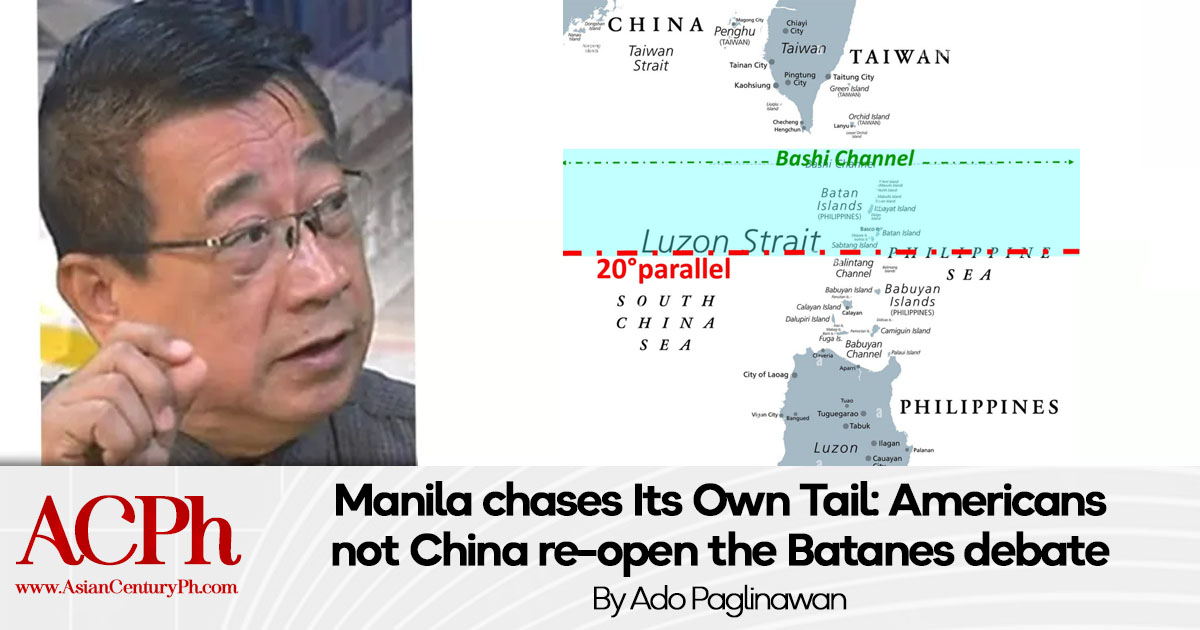
She said: “Batanes Islands is outside the 20th degree parallel that defined the treaty limits in 1898 Treaty of Paris. Even for the sake of argument that this is true, this is a very weak argument.”
Her dissenting opinion is best read separately at
I have no intention to engage in a debate over who is right or wrong, or what is strong or weak here which is better left to legal peabrain of expired justice Antonio Carpi, duplicitous experts like Jay Batongbacal and pseudo-journalists like Richard Heydarian.
I only wish to do a few fact-checks before this discussion devolves from legalities into polemics, a pattern characteristic of public discourse in the Philippines.
Why? Because there some facts she did not dabble on, that may have unraveled after she wrote:
“She was making a distinction between the question of sovereignty over Batanes and the South China Sea conflict, when she said “These are apples and oranges. The issue conflates the South China Sea conflict with the Batanes.”
So, after my own fact-checking, I give my prognosis.
Mind you, I am not even using the mainland Chinese scholars’ platform on this discourse, but the perspective from Taiwan which can be referenced from Hurng-yuChen of Tamkang University of New Taipei City –https://www.researchgate.net/publication/355461070_The_Pending_Territorial_Sovereignty_of_the_Batanes_Islands_A_Taiwan_Perspective
Sasot said, “Spain displayed such authority over Batanes continuously from 1753 to 1898. The United States, upon cession, continued that administration. The Philippines, upon independence, continued it again.”
However, her conclusion of an unbroken chain of effective sovereignty is not supported by facts; as indeed, there were disruptions, which are very relevant to today’s prognostications.
Following Japan’s victory in the First Sino-Japanese War and its subsequent acquisition of Taiwan via the Treaty of Shimonoseki in 1895, Spain grew concerned about securing the northern frontier of its colony in the Philippines. The two nations met to clearly separate their territorial boundaries in the Western Pacific.
- The “Declaration determining the limits of the Western possessions in the Pacific Ocean”—commonly known as the Treaty of Bashi—was a diplomatic convention signed between Japan and Spain on August 7, 1895 in Tokyo by Spain’s minister to Japan, Don Jose de la Rica y Calvo, and Japan’s Acting Foreign Minister, Prince Saionji Kinmochi.
The convention established the definitive maritime boundary between Japanese-controlled Taiwan and the neighboring Spanish-ruled Philippines.
Instead of mapping out precise numerical coordinate points (such as latitude or longitude), the treaty defined the boundary using geographic landmarks, inadvertently created minor geopolitical confusion when Spain lost the Spanish-American War a few years later.
- Thereupon, Japan took over administration of the Batanes Islands, as evidenced by Japanese colonial records in Taiwan showing that Japanese authorities implemented fishing regulations that extended into the Bashi Channel.
Certain historical accounts mention Japanese flags being raised by fishermen or sailors on the islands during this era.
- Because the 1895 agreement defined the border using the middle of the Bashi channel rather than exact geographic latitude and longitude coordinates, it later influenced territorial negotiations during the 1898 Treaty of Paris between the United States and Spain after the Spanish-American War.
The United States are masters of ambivalence in international relations. Whether in determining the boundary a line was drawn in 1895 between Spain and Japan and not expressed in actual numerical coordinates caused a “confusion” in the minds of the Americans during the negotiations for the peace treaty, what brought resolution to any confusion was the firmness of the Spanish side in their conviction that they cannot commit anything beyond the 20 ° latitude that already belonged to Japan.
Of course, the US commissioners pressed on asking that the “cession of the Philippine Islands archipelago proper” be put on paper as – “that is, beginning on the north, the islands of Batanes, Babuyanes, Luzon, Visayas, and all the others following to the south as far as the Sulu Sea, Spain reserving to the south of this sea the island of Mindanao and Sulu, which have never formed a part of the Philippine Islands archipelago proper.”
But the American and Spanish commissioners held a meeting once again from November 30 to December 2, and conclusively reached the final version of the treaty, with Article 3 to read:
“Spain hereby cedes to the United States the archipelago known as the Philippine Islands, and comprehending the islands lying within the following line: A line running from West to East along or near the twentieth parallel of North latitude, and through the middle of the navigable channel of Bachi, from the one hundred and eighteenth (118th) to the one hundred and twenty-seventh (127th) degree meridian of longitude East of Greenwich…”
Consider the Americans were also rushing to sign anything from Spain that would subdue and “delegitimize’ the Philippine declaration of independence from Spain in June 12, 1898. (The Treaty of Paris was signed, December 10, 1898. This is yet another controversy.)
As the record indicates. under the duress of an “insurrection” brewing in the archipelago, the US commissioners, were hard put to agree to a 20 °North latitude as the northern boundary line of the Philippines,
On the other hand, the Spanish commissioners remained steadfast that Spain cannot transfer to any party anything that they no longer own.
But the US was relentless despite the 1898 signing. For two years following the 1898 Treaty of Paris, the Americans pursued to lobby Spain in their desire to move the 20 ° North parallel to 20 ° 30’ by amendment, or as John Bassett Moore suggested to John Hay on January 1899 to negotiate with Japan in resolving the territorial issue of the Batanes Islands. The proposal was however rejected.
4) Instead, to pressure the Spanish side to compromise, the Americans made a strategic error by dispatching Rear Admiral John C. Watson to order the gunboat “Princeton” to occupy Batan and Calagan Islands mid-January 1900. in violation of international law prohibiting the occupation of territory by force.
The military mission effectively helped cut-off potential trade or retreat routes for Filipino revolutionary forces. By February 10, the Princeton had completed its primary operations in those far northern islands and was shifting its duties to continue routine patrols off the coast of Luzon.

USS Princeton (PG13)
José Brunetti y Gayoso El Duque De Arcos, Spanish Envoy in Washington, DC, reported the following to his government by telegram on February 14, 1900: (In Spanish translated as)
“Dear Sir, it is my honor to send a telegram to Your Excellency yesterday, to inform Your Excellency that the United States had sent troops to occupy Batanes Islands and Calagán Island, in the north of the Philippines.
This disproves what is being circulated by Artificial Intelligence chats that the USS Princeton arrived there to organize local administration without military conquest or a forced occupation.
You might as well call as “historic” peaceful habitation of a territory by a gray ship! Besides, the subsequent stinging question is on what authority?
The move, reeking with bad faith, was obviously to apply pressure on Spain to amend the Treaty of Paris to cover for the American invasion of Batanes.
- The United States move to pursue renegotiation with the Spanish government about outlying islands that lie beyond the scope of Article 3, also failed to include Batanes, as both sidesconcluded the Treaty on Cession of Outlying Islands of the Philippines, on November 7, 1900, to wit:
“Spain relinquishes to the United States all title and claim of title, which she may have had at the time of the conclusion of the Treaty of Peace of Paris, to any and all islands belonging to the Philippine Archipelago, lying outside the lines described in Article III of that Treaty and particularly to the islands of Cagayan, Sum and Sibutu and their dependencies, and agrees that all such islands shall be comprehended in the cession of the Archipelago as fully as if they had been expressly included within those lines.”
Although Spain had really not conquered or administered the Sulu archipelago, it was convenient for it to include Cagayan de Sulu, Sulu and Sibutu and their dependencies, as it had not earlier compromised them to Japan in an 1895 treaty like Batanes.
This was corroborated by Colección de los Tratados, Convenios y Documentos Internacionales (Collections of International Treaties, Conventions and Documents), published in 1902, made an explanatory note on the Treaty of Paris.
In its note b, it records:
“…So-called abandoning the territorial sovereignty in accordance with the Treaty on Cession of Outlying Islands of Philippines, November 7, 1900, it is not restrict in abandoning those two disputing islands, include Cagayán de Joló island and Sibutú island. But there is pending two islands, named Batanes, which lies on the northern Philippines and demarcate in line with 20○ north latitude. (Dalmau y de Olivart, 1902).”.
From the above-mentioned explanatory note, the United States had forcibly annexed the Batanes Islands at the beginning of 1900. Until 1902, Spanish government did not think the Batanes issue as having been resolved yet as the Spanish government still insisted on 20 ° North latitude as the boundary line, and did not recognize American possession of the Batanes Islands.
This totally demolishes to smithereens the over-interpretation of expired justice Antonio Carpio and his protégé Jay Batongbacal of UP Law, that Batanes was part of the outliers mentioned in the 1900 Treaty of Washington, despite the glaring categorical inclusion of only “Cagayan de Sulu or what is now Mappun Island, Sulu and Sibutu Islands and their dependencies, under the adverb “particularly” with no other meaning but “specifically”.)
Since that time, the government of the United States had always been in an uncomfortable situation, trying in every occasion to cover her anxiety and dissatisfaction over Article 3 of the 1898 Treaty of Paris, and its failure to include the Batanes in the 1900 Treaty of Washington.
Without interruption?
Ms. Sasot ended her disagreement asserting:
“In sum the sovereignty of the Philippines over Batanes is not an open question. It is settled by conquest and effective occupation (1753), by continuous administration (1753–1898), by cession and succession (1898–1946), by constitutional definition, and by the absence of persistent competing claim or persistent objection for over 270 years.
“The 20th parallel argument is a pedantic misreading of a transfer document that cannot override an unbroken chain of effective sovereignty.”
As we have illustrated, the first factual interruption is the treaty between Spain and Japan that had an effect from 1895 (the contract-signing) to 1900 (the American occupation of Batanes).
The second factual interruption is the illegal occupation of Batanes by the Americans in February 1900.
The de facto administration it now invokes underwent a contested, unilateral and illegal boundary expansion by gunboat force.
The third factual interruption is even more dramatic.
The Japanese Imperial Army re-occupied Batanes as part of Taiwan on December 8, 1941 (simultaneously with the attack on Pearl Harbor); there was no active military resistance from U.S. or Commonwealth forces during the initial landing.
Japan sought to quickly capture local terrain and seize the Basco airfield to use as a forward operating base for fighter aircraft supporting subsequent assaults on Luzon. [
During their occupation, Japanese forces used local Ivatans to dig an extensive network of hand-dug tunnels, bunkers, and observation posts (such as the famous tunnels around Basco, Tukon, and Dipnaysupuan) to use as defensive positions and storage.

Four major landings of boots on the ground by the Japanese Imperial Army came from Taiwan (Formosa), the first of which was at the Batanes Islands, on December 8, 1941 a few hours after the attack on Pearl Harbor. This was followed by landings in Aparri, Vigan and Lingayen.
The Japanese occupation continued on until the surrender of Japan in 1945. But Batanes which was not restored to Taiwan (Republic of China) after World War II but returned to the United States.
I consider this a discussion for another day as I am sure there are more legalisms involved on either side. Suffice it to say at this juncture, for the past 80 years since 1946 and up to today, it has been under the effectivités and administration of the Philippines.
A case of asymmetric bullshit
I am not for the reopening of the Batanes issue for purposes of sovereignty. I submit that the matter in fact has long been resolved because China has allowed it to slumber.
My question is one of pragmatism – if China pursues reunification with Taiwan sooner than later, will China simply ignore the Batanes factor as it has done for the past 80 years?
My basal instincts say “no”, especially if there is a party involved, who is not even a coastal state and a member of the region, and not even a member of UNCLOS.
I am referring to the United States meddling in our internal affairs, dictating security decisions to an incapacitated government, and is now using us a staging ground to war with China through the use of their EDCA lily pads.
This is no longer a matter of apples and oranges but also sour grapes – and this is where Taiwan connects with the South China Sea conflict.
Manila responded with a resounding holler when Chinese academics claimed on June 30, 2026, that the Batanes Islands are a natural geographic extension of Taiwan and therefore belong to China, during an academic symposium hosted by Jinan University in Guangzhou, China.
The immediate cause was a summit between Japan and the Philippines regarding maritime boundary negotiations east of Taiwan on May 2026, joining the “EEZ’s” of both countries. The scholars argued this delimitation disregarding China and Taiwan in the middle, were legally invalid.
But the underlying cause, which the United States gradually staged were increasing military incursions of third party, non-coastal states into the area.
It was not China, but the United States therefore that drew first blood, which led to the reopening of old wounds between the United States and Spain, subsequently between the United States and Japan, and now between and the Philippines and China.
The Americans used Marcos Jr. to awaken the sleeping dragon.
The US began actively bringing tactical missile systems and military personnel into Batanes, after initial military drills in April 2024.
Between April and May 2O25, or a year after, the Americans escalated its military presence by airlifting the compact Navy-Marine Expeditionary Ship Interdiction System (NMESIS) anti-ship missile launcher to Batan Island and conducting simulated missile fire missions aimed at blocking the Bashi Channel.
It was only at this stage when Filipino geopolitical analysts started writing that the gringos were already converting Batanes into a forward operating base expanding their Agile Combat Employment (ACE) intentions outside of nine EDCA agreed bases in the Philippines.
In August 2025, the Philippines opened the Mahatao Forward Operating Base on Batan Island, which U.S. and Philippine personnel inspected together in December 2025 to plan for potential missile deployments and drone/helicopter operations.
This year, advance weaponry deployments expanded to include both High Mobility Artillery Rocket Systems (HIMARS) and NMESIS systems stationed on Itbayat Island purportedly to secure the waters between Taiwan and the Philippines.
Chasing its own tail
This strategic deployment marked the transition of the northernmost Philippine province from an isolated archipelago into a frontline military checkpoint.
But HIMARS and NMESIS is just the top of the iceberg. China can still tolerate as defensive war materiel.
What China cannot ignore is the Typhon Weapon System that the US deployed inside Philippine territory.
The first factor is the nature of Typhon which can fire Standard Missile-6 (SM-6) interceptors or surface-strike missiles. These are anti-air warfare (aircraft, cruise missiles, drones), terminal-phase ballistic missile defense, anti-ship warfare, and land attack equipment capable of Mach 3.5 hypersonic speed with an operational range is officially rated around 130–250+ nautical miles or approx. 240–463 kms.
No problem with that capability for deterrence.
But the second factor is that Typhon can also launch the Tomahawks, an offensive subsonic missile which because of its midrange capability of up to 2,500 kilometers when launched from Northern Luzon, can hit targets across the Luzon Strait, parts of the South China Sea, the Taiwan Strait, and coastal areas of southern China.
Deployed to the Philippines in April 2024, a Tomahawk was test-fired for the first time in May 2026, launching from Tacloban Airport, Leyte, hitting a target in Fort Magsaysay, Nueva Ecija.
For more than a decade, the Tomahawk has operated exclusively as a conventional (non-nuclear) weapon system, utilizing high-explosive unitary warheads, submunitions, or bunker-buster payloads.
While the Americans claim active nuclear-tipped Tomahawk missiles no longer exist in the US arsenal as withdrawn from active service by President George W. Bush in 1991 and officially declared redundant and retired by President Barack Obama more than 10 years ago, Raytheon can revive the BGM-109A TLAM-N version as it can easily scale Tomahawk production from 90 to 1,000 per year.
The US and the Philippines maintain that the deployment is meant for regional deterrence, interoperability, and combined defense modernization under their mutual defense treaty but Beijing has strongly denounced the system, calling it a destabilizing provocation that escalates regional tensions.
The third factor is the cardinal rule about guns. Keep them away from children.
As if in a position to leverage China Philippine President Ferdinand Marcos Jr. explicitly offered China that he will return the U.S. Typhon mid-range weapon system if China halts its aggressive and coercive behaviors in what he calls West Philippine Sea.
“Let’s make a deal with China – stop claiming our territory, stop harassing our fishermen… stop ramming our boats, stop water-cannoning our people, stop firing lasers at us, and stop your aggressive and coercive behavior, and I’ll return the Typhon missiles.”
Any neophyte geopolitical analyst can easily discern infantile immaturity in this statement.
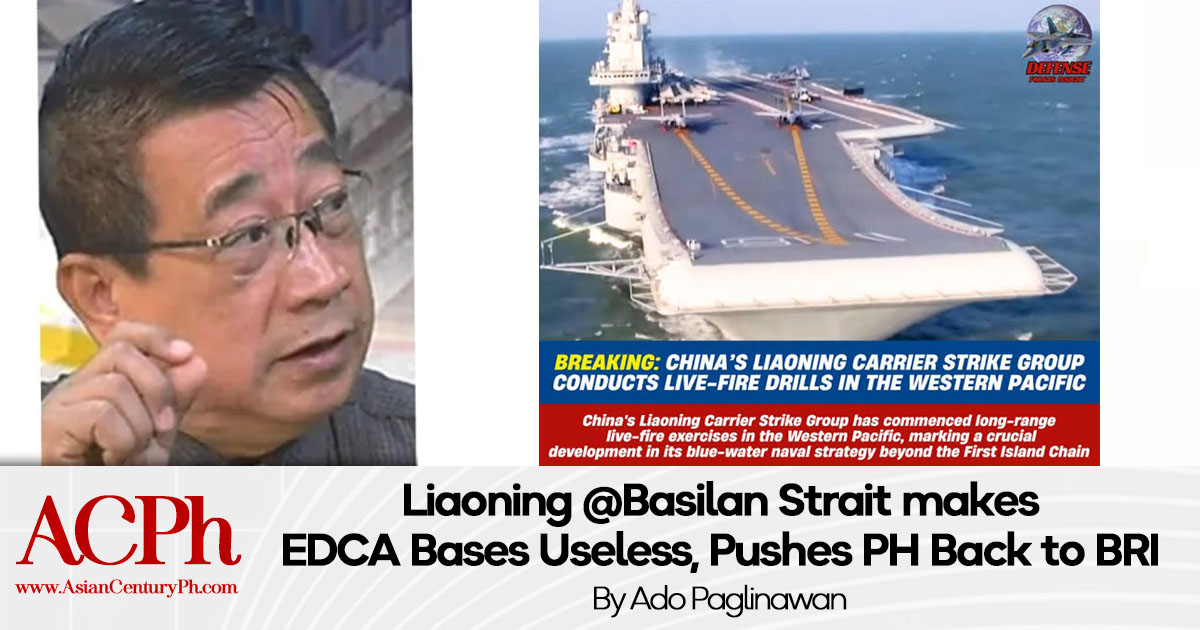
In addition to its rocket arsenal in its mainland and artificial islands in the South China Seas, China recently demonstrated with the circumnavigation of the Philippines by China’s aircraft carrier Liaoning from the Bashi Channel up north and across the Basilan Strait down south, travelling west to east with a minimal attack grouping, that it can neutralize any EDCA sites and pseudo bases within the Philippines in a matter of minutes.
Conclusion
Regardless of what the Philippine government, including the Departments of Foreign Affairs and National Defense or the National Historical Commission now says, this resulted to what is developing to be what in medicine is known as “Sudden Unexpected Nocturnal Death Syndrome” (SUNDS) or what locals are familiar with, as “bangungot”.
In plain English, a haunting bad nightmare.
Secretary Gilberto Teodoro Jr., the Philippines fake defense guru, firmly rejected and debunked the claims of participants from Jinan University, Nanjing University, and the Chinese Academy of Social Sciences as baseless and lacking historical or legal merit
But for me this is already beyond claims for titles to sovereignty. Both China and the US agree that the territorial boundaries of the Philippines fall within the confines of the 1898 Treaty of Paris and the 1900 Treaty of Washington.
It is the United States gunboat diplomacy that confuses the issues and the Philippines’ reliance on the atrophic Mutual Defense Treaty, continuing the American line that befuddles it further.
It is also beyond sovereign rights because China is a signatory to the UN Convention of the Law of the Sea and has in fact extended its arm further by entering into a Declaration of Conduct with ASEAN countries.
It is only the Philippines’ intransigence refusing to return to the bilateral table, and worse unilaterally enforcing its will in the disputed waters that is escalating tension in the South China Seas.
At this stage, the matter is still manageable by diplomacy, this why I am in favor of an open debate on the Batanes issue.
Those who say this is an open and shut case is merely continuing the coverup of the Americans for its historical malfeasances.
Clearly, we do not have a historic title to Batanes vouchsafed by a treaty. It is outside the 20th parallel latitude just like Scarborough was beyond the 118 ° longitude of the 1898 Treaty of Paris
Our effectivités of Batanes might have a strong gravitas, just like what we had with Scarborough, but what happened in 2012?
We succumbed to might is right realpolitik.
My crystal ball illumines danger signs for the Philippines, if we hide Batanes under our pillows just like how President Noynoy Aquino handled close to his chest the Scarborough standoff.
My gutfeel says at the rate Manila has been responding irrationally to China’s challenges at sea, we will also lose Batanes sooner than later, in fact as early as next year 2027, when China pressures its reunification with Taiwan.
I do not mean to engage anyone in legalese about this matter. From 1895 to today, the issue of Batanes will be hard to argue on the basis of titles and effectivités.
But just as the United States took Batanes in 1900s using the gunboat, China can easily make history repeat itself.
The prize that comes with it is near to unthinkable – the full control of the Bashi Channel!
Not even for hegemony, expansionism or greed. But just simply by strengthening its underbelly to not give an inch for a hundred years of humiliation to recur.
In short, China’s preservation of peace as the dominant regional superpower.
But before that, the basic survival of the Philippines!
WATCH VIDEO: What Happens to the Bashi Channel in a Taiwan War With China?


Adolfo Quizon Paglinawan
is former diplomat who served as press attaché and spokesman of the Philippine Embassy in Washington DC and the Philippines’ Permanent Mission to the United Nations in New York from April 1986 to 1993. Presently, he is vice-president for internal affairs of the Asian Century Philippines Institute, a geopolitical analyst, author of books, columnist, a print and broadcast journalist, and a hobby-organic-farmer.
His best sellers, A Problem for Every Solution (2015), a characterization of factors affecting Philippine-China relations, and No Vaccine for a Virus called Racism (2020) a survey of international news attempting to tracing its origins, earned for him an international laureate in the Awards for the Promotion of Philippine-China Understanding in 2021. His third book, The Poverty of Power is now available – a historiography of controversial issues of spanning 36 years leading to the Demise of the Edsa Revolution and the Forthcoming Rise of a Philippine Phoenix.
Today he is anchor for many YouTube Channels, namely Ang Maestro Lectures @Katipunan Channel (Saturdays), Unfinished Revolution (Sundays) and Opinyon Online (Wednesdays) with Ka Mentong Laurel, and Ipa-Rush Kay Paras with former Secretary Jacinto Paras (Tuesdays and Thursdays). His personal vlog is @AdoPaglinawan.

This promo includes free delivery by JRS to anywhere in the Philippines.
Email: contact@asiancenturyph.com
Facebook: https://www.facebook.com/asiancenturyph/
Twitter: https://twitter.com/AsianCenturyPH
Substack:
Also read:




Leave a Reply