

Series 4: Forever peace or forever wars?
Before you read this article, let me warn you up-front that it features an opinion written by Bao Ming, a retired senior colonel of the People’s Liberation Army, who is the first military expert co-created by the Haokan Excellent Creation Alliance. A former professor at a service command academy, he presently serves as a military commentator and content creator on Haokan Video.
So, if you are Sinophobic or McCarthyist, stop here. Or deal with nausea, after.
Previously, I wrote two articles citing three foundational lies spawned by a 2016 arbitral ruling, the canine devotion to which has become key to the collapse of the Marcos governance, and if unremedied, the failure of the Philippine state.
My prognosis, however, centered mainly on exposing manipulation of the mainstream media, resorting to lawfare and infowars, building up to a non-existent arbitral victory as the basis for the erection of ghost sea west of the Philippines. Pretty much, geopolitics.
I made few peripheral references on how the present administration is painting, through World Bank mumbo-jumbo, an illusory macro-economics to hide how such geopolitical hoaxes have cost our daily lives on a micro level.
Mr. Bao did a magnum opus, however, on unraveling true state in terms of geo-economics, in gruesome details, and further how despite it, Marcos’ incompetence is worsening our geopolitical woes.
I don’t usually borrow someone’s work, but since the subject here is another person’s analysis, how can I analyze further? Thus. I decided to present it raw, transcending who he is but affirming the substantives that he brought forward.
On July 1, 2026, Bao wrote a rejoinder to Capital Economics, a British think tank. I am reprinting it in verbatim.
Tiger Turns into Sick Cat! The Philippine Economy is Collapsed; the More It Opposes China, the Poorer It Gets—Is There No One Who Can Save It?
This report has left the Philippine government feeling ashamed. It predicts GDP growth of only 3% this year. If this comes true, it will be the lowest point in the post-pandemic economy.
What does 3% mean? The Philippine government itself just lowered its target to 3.5% to 4.5%. Looking further back, before the Middle East conflict, Manila originally hoped to reach 5% to 6% this year. Dropping from 5%-6% to 3% isn’t just a “downgrade,” it’s a “halving.”
How did a country repeatedly touted by Western media as the “new Asian tiger” suddenly become a “sick cat”? Capital Economics has identified three causes.
The first blow is to infrastructure. The corruption scandal surrounding the 118.5-billion-peso (sic) flood control project is considered the most serious corruption case in the Philippines in years. Since the investigation began last July, government infrastructure spending has declined for nine consecutive months.
From January to April this year, infrastructure and other capital expenditures plummeted 45.6% year-on-year to 189.3 billion pesos; April alone saw a sharp 52% year-on-year decrease, leaving only 41.5 billion pesos.
Infrastructure investment in developing countries has nearly halved, effectively shutting down the engine of economic growth. It’s not that governments don’t want to spend money, but rather that they can’t; stricter review processes have slowed down the disbursement of every fund.
Anti-corruption is certainly a good thing, but when it leads to infrastructure stagnation and economic slowdown, it indicates that the country’s governance system is critically ill.
The second blow comes from the Middle East. The US-Iran conflict has driven up global energy prices, and the Philippines happens to be one of Asia’s most energy-dependent countries. Soaring import costs have directly pushed up inflation, making the Philippines one of Asia’s most inflated economies.
United Overseas Bank has raised its full-year inflation forecast for 2026 to 7.5%, which, if realized, would be the highest price increase since the 2008 global financial crisis. From soaring energy prices to surging inflation to shrinking consumption to a slowing economy, this chain is intricately linked, each link tightening the noose around the necks of the Filipino people.
The third blow is to confidence. Corruption scandals have damaged investor confidence, and inflation has eroded consumer confidence. Capital Economics warns that the economic downturn will worsen further in the second quarter.
First-quarter GDP grew by only 2.8% year-on-year, the lowest growth rate since 2009 (excluding the pandemic period). Once confidence collapses, rebuilding it is incredibly difficult.
With these three blows falling simultaneously, the rate of economic bleeding far exceeds Manila’s expectations.
Logically, the focus should be on development and stable growth.
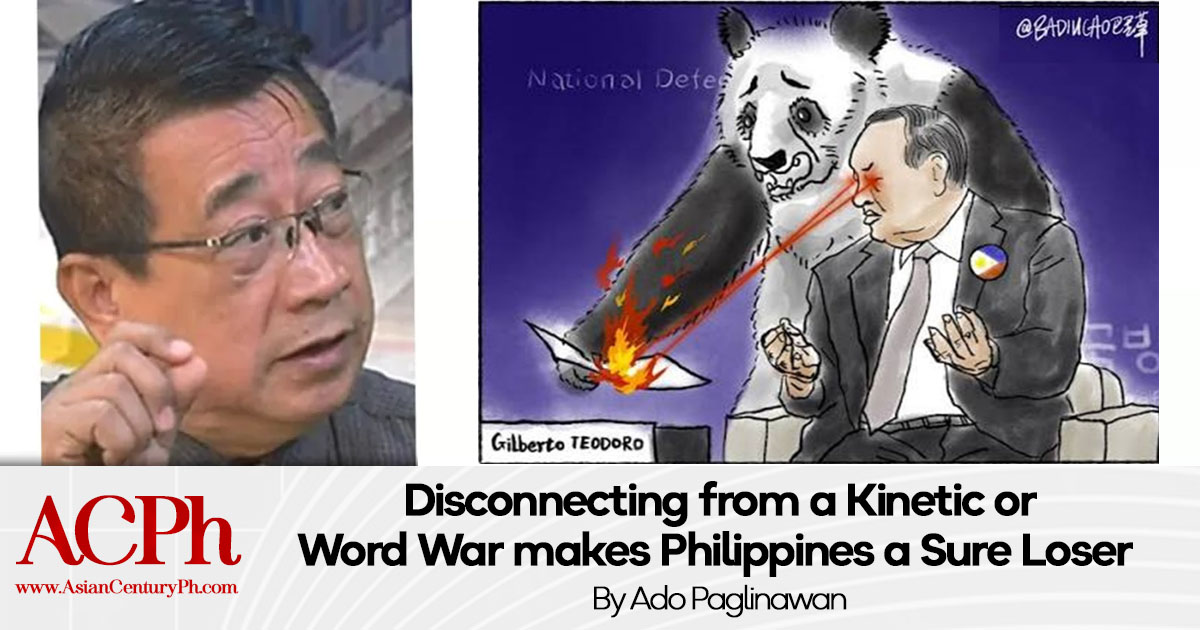
But what is Manila doing? Constantly provoking China on the South China Sea issue, publicly accusing China of being “cunning” at the Shangri-La Dialogue, and continuing to hurl insults by Defense Minister Gilberto Teodoro even after being sanctioned by China.
While requesting imports of urgently needed supplies such as fertilizer from China, it also verbally attacks China on the South China Sea issue. This attempt to “want benefits from China while simultaneously opposing it” exposes a chaotic strategic mindset.
Malaysian scholar Zhang Tiancai pointed out a fatal contradiction in the South China Morning Post. The Philippine economy remains dependent on trade, investment, and supplies from China, but security agencies, influenced by increasingly close military ties with Washington and Tokyo, are taking an increasingly hardline stance towards Beijing.
Security considerations have repeatedly superseded economic pragmatism.
In other words, the Philippines is committing economic suicide to obtain a dubious security guarantee.
China has surpassed the United States and Japan’s the Philippines’ largest trading partner, accounting for more than one-fifth of total trade. Bilateral trade has grown from less than $1 billion in the mid-1990s to approximately $42 billion in 2024.
In this context, confronting China is not “defending sovereignty“, but rather severing its own economic lifeline.
ASEAN paradox?
The Philippines has assumed the ASEAN chairmanship in 2026. This should have been a shining moment for Manila, a time to stand at the center of the regional stage, promote economic integration, and showcase its great power status.
However, the reality is that the Philippines is turning this “shining moment” into a “moment of embarrassment.” The theme, “Sailing Towards a Shared Future,” reflects little of the spirit of “cooperation” in its unilateral alliance with extra-regional powers, (which) is a confrontational stance.
Malaysian scholars warn that the Philippines’ increasing reliance on extra-regional powers to contain China could turn the South China Sea into an arena for great power rivalry, weakening ASEAN’s neutrality and status.
President Marcos previously stated that a “Code of Conduct in the South China Sea” was expected to be reached during the Philippines’ chairmanship. However, at the Shangri-La Dialogue, Defense Secretary Teodoro expressed doubt about the necessity of a “Code of Conduct in the South China Sea.”
The president says talks are needed, the defense secretary says no talks are needed; even the basic stance is inconsistent internally.
So how can the Philippines lead ASEAN?
Other ASEAN countries are not blind. The Philippines’ position runs counter to the pragmatism of other Southeast Asian countries in deepening economic and trade ties with China. While other countries are focused on doing business and building infrastructure with China, the Philippines is playing with fire in the South China Sea, provoking in its air defense identification zone, and engaging in public spats at the Shangri-La Dialogue. It’s clear who the real disruptor of regional stability is.
Triple whammy
Corruption, inflation, and confrontation—linking these three keywords together paints a complete picture of the predicament.
Corruption halts infrastructure construction, which in turn slows growth; inflation shrinks consumption, which in turn slows the economy; and confrontation with China damages trade, which makes recovery hopeless.
These three lines intertwine, creating a vicious cycle: the more confrontation there is, the poorer the country becomes; and the poorer the country becomes, the more confrontation is needed to divert attention from domestic problems.
Capital Economics predicts that GDP growth may rebound to 4.5% next year, but this will still be below the government’s target of 5% to 6%. The report states bluntly: “The Philippines’ economic recovery may be slow and difficult.”
The government recently announced that it will accelerate the disbursement of funds for infrastructure projects in the second half of this year. Capital Economics poured cold water on the situation: even if large-scale infrastructure projects that have been shelved are restarted, fiscal policy will remain tight to curb rising debt ratios.
Wanting to spend money but fearing excessive debt; wanting to stimulate the economy but fearing runaway inflation; wanting to cooperate with China but fearing offending the United States, the Philippine government is trapped in a dead end, each step fraught with difficulty.
While the Defense Minister was proclaiming “archipelagic sentinels” at the Shangri-La Dialogue, infrastructure spending was being halved. While verbally abusing China on the South China Sea issue, inflation was hitting a decade-high.
While busy demanding weapons from the US and Japan, economic growth was plummeting to its lowest point since the pandemic. How can a country that can’t even manage its own economy act as a “sentinel”? How can a government that can embezzle 118.5-billion-pesos (sic) from infrastructure funds “protect freedom”?
This report from the British think tank is not pessimism, but a warning. The 3% GDP growth forecast isn’t a fabricated curse; it’s a mirror reflecting the cost of corruption, the cost of confrontation, and the failure of governance.
The government can continue to act tough on the South China Sea issue, continue to make harsh statements against China at the Shangri-La Dialogue, and continue to pledge loyalty to the United States.
Economic data doesn’t lie, inflation doesn’t lie, and the precipitous drop in infrastructure spending doesn’t lie. When ordinary people can barely afford to eat, who cares what slogans you shout in the South China Sea?
The dream of becoming the “new Asian tiger” should end. If it doesn’t do something meaningful, it won’t even be able to remain a “sick cat.”
END OF QUOTE.
Discordant governance
The state of dissonance among high and significant portfolios of the government only shows that nobody, including the President is in control of the affairs of the nation. The disagreements are not accidental nor sporadic.
Even in the other Cabinet clusters, cacophony rules, especially in the prosecutorial system. But that would be for another day.
Our focus here is how the security sector has mutilated our foreign policy.
When it comes to the China-Asean Code of Conduct, for instance, a north and south variance is an embarrassment to the President. He says it is necessary, our defense minister says it is not.
The inconsistencies of the public statements of Teodoro are not isolated. They form a Sinophobic pattern – seething with prejudice, hatred, hostility, and discrimination directed towards the Chinese government.
It is an awkward but deliberate counterpoise to our Department of Foreign Affairs, that is the primus-inter pares, among Cabinet members:
Diplomacy over Confrontation: DFA Secretary Maria Teresa Lazaro champions preserving “diplomatic space for dialogue” through the Bilateral Consultative Mechanism (BCM), emphasizing that diplomacy is a form of deterrence. Her negotiations were instrumental in achieving a provisional understanding that allowed incident-free rotation and resupply (RORE) missions at Ayungin Shoal.
“How can we negotiate with the Chinese” slams Teodoro, “when they have ‘deficit of trust’.”
ASEAN-China Code of Conduct (COC): United with all ASEAN countries, Lazaro pushes for an expedited, legally binding Code of Conduct . Under her tenure, she has coordinated monthly meetings among ASEAN member states and China to resolve key milestone issues and prevent maritime disputes from escalating into armed conflict.
In the 2026 Shangri-La Dialogue, Teodoro expressed deep skepticism regarding the need for an COC, stressing that explicitly blamed China as the primary obstacle to the pact.
Pragmatic Relations: She adheres to the “One-China policy” while seeking future-oriented economic and cooperative ties with Beijing, such as updating non-sensitive coast guard communication agreements without compromising sovereign rights.
Teodoro actively advocates integrating Taiwan into broader regional deterrence against China and broader cross-strait relations to evolve non-taboo economic and security ties with the separatist province of China.
Retaliatory Sanctions: Following Chinese sanctions on Secretary Teodoro and his family, Lazaro maintained that Manila would not impose counter-sanctions and would continue relying on diplomacy rather than public exchanges that could narrow diplomatic space.
According to the Philippine News Agency, Teodoro regards China’s sanctions on him and his family, as a “usual punishment” for those who speak the truth about Beijing’s deception and aggressive actions in the West Philippine Sea.
Integrity in question
Gilbert Teodoro’s behavior exposes his spousing a back-seat driver, powerful enough to countermand the direction of his commander-in-chief. If he overrides openly our expressed foreign policy, who is he and what is he representing?

Several lawyers recently filed criminal and administrative complaints against Teodoro at the Pasay City Prosecutor’s Office. The lawyers alleged that he violated the Philippine Passport Act and falsified documents by supposedly maintaining a valid Maltese passport and citizenship.
Teodoro has claimed earlier that when filed to run for Senator in 2022, and accepted appointment to public office in 2023, he had already renounced his Maltese citizenship and returned his passport to Malta, and “reacquired” Filipino citizenship.
Philippine jurisprudence emphasizes that Republic Act 9225 or the Dual Citizenship Act, applies solely to dual citizens by choice (eq. natural born Filipino who are naturalized as a foreign citizen) who seek to retain or reacquire Philippine citizenship and/or hold public office.
In Compliance with the requirements of RA 9225, especially under Section 5, is mandatory, and the citizen in question has the burden of proving compliance by competent evidence. David v. SET, 795 Phil. 529 –(2016)
Mere allegation without documentary support is not enough; moreover, documentation in the form other than as prescribed by Section 5 is not sufficient. Reyes v. Comelec, 712 Phil. 192 (2013). The Supreme Court held that oath of allegiance made by Reyes as provincial administrator is not a substitute for the oath of allegiance required under RA 9225 even if they are similarly worded.
An oath of allegiance to the Philippines is enough for mere reacquisition or retention of citizenship but it not enough for holding public office, as RA 9225 additionally requires proof of renunciation of foreign citizenship. Chua v. Comelec, 783 Phil. 876 (2016)
Section 5 prescribes that renunciation of foreign citizenship must be personal and under oath Condon v. Comelec, 692 Phil. 407 (2012) and not a mere statement, even if made before a public officer. Lopez v. Comelec, 581 Phil. 657 (2008).
Moreover, the oath of allegiance required under Section 5 is in addition to the oath of allegiance found in a certificate of candidacy, even if they are similarly worded. Jacot v. Dal, 592 Phil. 661 (2008)
Any lack of or defect in these documentary requirements is cause for reversion to dual citizenship by choice and disqualification from holding public office. Tan v. Crisologo, 820 Phil. 611 (2018
Finally, compliance must be continuous if after renouncing foreign citizenship a person resumes using the passport of said foreign country, they are deemed to have reverted to dual citizenship by choice and therefore disqualified from holding public office. Agustin v. Comelec, 772 Phil 593 (2015); Arnado v. Comelec, 767 Phil. 51 (2015); Maquiling v. Comelec, 709 Phil. 408 (2013).
For the past two years, we have been requesting Teodoro to come clean and present, not in executive sessions and in private conferences, but for public scrutiny, genuine and proper documents required by Section 5 of RA 9225.
The public official, high in the ladder of government service and holding a very sensitive job dealing with national security, who has the gall to demand others to hurdle any “deficit of trust” just ignored our pleas.
What right, over and above the National Security Council, does Teodoro has going to town accusing others of being spies to foreign interests, when he cannot even present guarantees that he is a Filipino citizen?
What power foreign to the national interests of the Philippine Republics does Teodoro possess, that can even override the President of the Philippines?
What impunity does Teodoro enjoy, that he can freely demonize other countries contributing to the collapse of the Philippine economy?
Shouldn’t we have listened to his aunt, Gretchen Cojuangco, when she said, “Anybody but Gibo?”

Adolfo Quizon Paglinawan
is former diplomat who served as press attaché and spokesman of the Philippine Embassy in Washington DC and the Philippines’ Permanent Mission to the United Nations in New York from April 1986 to 1993. Presently, he is vice-president for internal affairs of the Asian Century Philippines Institute, a geopolitical analyst, author of books, columnist, a print and broadcast journalist, and a hobby-organic-farmer.
His best sellers, A Problem for Every Solution (2015), a characterization of factors affecting Philippine-China relations, and No Vaccine for a Virus called Racism (2020) a survey of international news attempting to tracing its origins, earned for him an international laureate in the Awards for the Promotion of Philippine-China Understanding in 2021. His third book, The Poverty of Power is now available – a historiography of controversial issues of spanning 36 years leading to the Demise of the Edsa Revolution and the Forthcoming Rise of a Philippine Phoenix.
Today he is anchor for many YouTube Channels, namely Ang Maestro Lectures @Katipunan Channel (Saturdays), Unfinished Revolution (Sundays) and Opinyon Online (Wednesdays) with Ka Mentong Laurel, and Ipa-Rush Kay Paras with former Secretary Jacinto Paras (Tuesdays and Thursdays). His personal vlog is @AdoPaglinawan.

This promo includes free delivery by JRS to anywhere in the Philippines.
Email: contact@asiancenturyph.com
Facebook: https://www.facebook.com/asiancenturyph/
Twitter: https://twitter.com/AsianCenturyPH
Substack:
Also read:




Leave a Reply