

Series 2 on Forever Wars or Forever Peace?
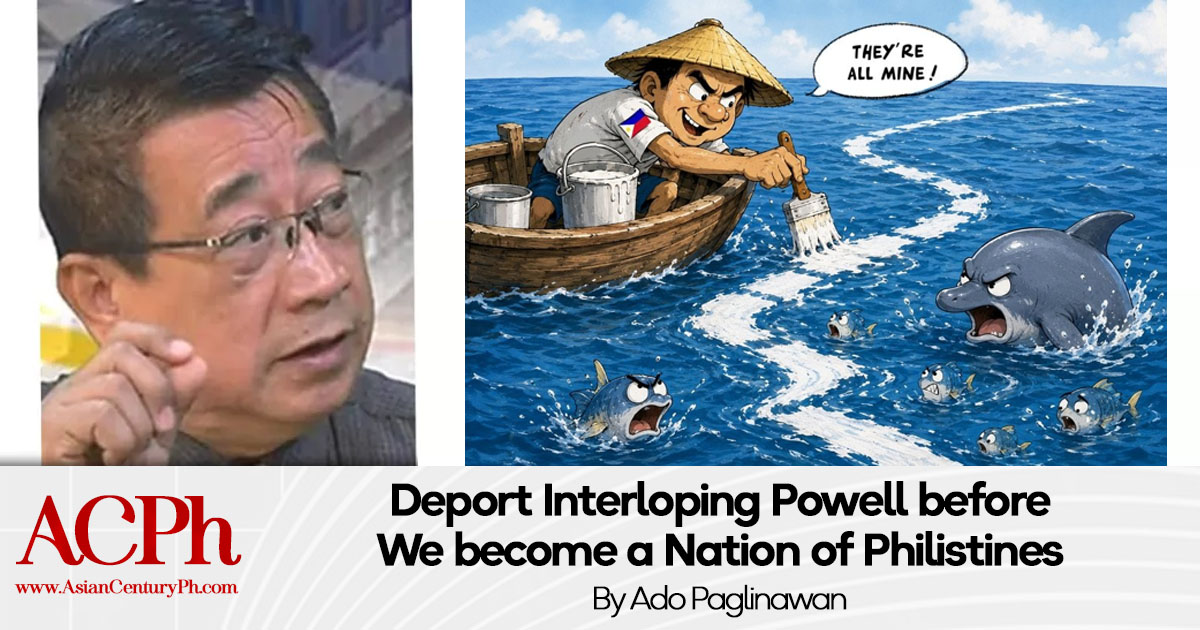
The 2016 Arbitral Award is binding only to the Philippines and did not become part of international law. It could not and did not kick out China from the South China Sea. The Arbitral Award did not allow any West Philippine Sea.
If the 2013 Arbitration filed by the Philippines was under the mandatory provisions of the UN Convention of the Laws of the Sea, why was it not submitted to the International Tribunal for the Law of the Sea (ITLOS). Truth to tell, it was a voluntary arbitration with the Permanent Court of Arbitration only as registry.
Voluntary or compulsory
The word voluntary here is pivotal, according to Senior Diplomat Rosario Manalo. She even dismissed it as non-binding.
Ex-Associate Justice Antonio Carpio disagreed alleging the Philippines did not opt out and accepted compulsory arbitration but as a former magistrate, he should know that voluntary arbitration agreements do not become a binding part of general international law, even if they do establish specific, legally enforceable obligations for the parties involved.
How does voluntary arbitration interact with international law?
- Consent as the Foundation: International arbitration requires mutual consent . States or international parties agree via treaties or private contracts (compromis) to submit specific disputes to a neutral tribunal
- Public International Law: In cases involving sovereign states, tribunals may look to customary international law or treaties to evaluate the state’s conduct, but the arbitration itself functions as an autonomous mechanism rather than standard international law
Thus, as sine qua non this 2013 arbitration does not alter the fact that the legitimate process must involve at least two parties. China rejected the ruling as “null and void”, asserting no arbitration is possible without the explicit consent of the other state.

READ: https://globalnation.inquirer.net/141125/arbitral-court-not-a-un-agency
This what Stephane Dujarric, spokesman for UN Secretary-General Ban Ki-moon, said when asked about the Arbitral Tribunal’s July 12, 2016 ruling on Philippine submissions
Compulsory arbitration also does not inherently become a broad, universal rule of international law .
While it exists within specific treaties and legal regimes such as the UNCLOS, again, states only become bound to it when they voluntarily consent to those specific agreements as traditional public international law is rooted in state sovereignty. Because there is no world government, states cannot be forced into arbitration unless they have pre-approved it in a written agreement or treaty.
China opted out of UNCLOS compulsory arbitration by exercising its rights under Article 298 of the treaty . In August 2006, a good seven years before the Philippines submitted its application for arbitration, Beijing formally submitted a declaration exempting itself from disputes concerning maritime boundary delimitations, military activities, and historic titles from compulsory third-party dispute settlement procedures, and expressing acceptance only for bilateral negotiations.
Another important aspect in this discussion is while arbitral awards are legally binding and final for the specific parties involved, they do not create “international legislation”. Thus, because international law lacks a formal system of binding precedent (like domestic courts), an arbitration tribunal’s ruling on a specific issue does not automatically become universal law for all other nations .
These decisions do, however, contribute to the development of “customary international law” by clarifying how existing laws and treaties are interpreted over time
Yet, the primary limitation of compulsory arbitration in international law is enforcement. Because states maintain sovereignty, there is no global sheriff to enforce an arbitral tribunal’s decision. If a state refuses to comply with an arbitration award, the winning party’s options are limited to diplomatic pressure, countermeasures (like trade sanctions), or taking the matter to the UN Security Council .
International law vs RBO
This is why while international law provides a legal framework for states to interact with one another, some states resort to “rules-based order” (RBO) that goes beyond international legal obligations to include informal norms and practices that shape the behavior of states.
International law, defined, refers to a set of rules and principles that govern the conduct of states in their relations with one another. It is a system of rules that are binding on states and are designed to promote peace, security, and cooperation among nations.

According to Foundation of the Leiden University Journal of International Law, RBO is the “United States’ alternative to international law, an order that encapsulates international law as interpreted by the United States to accord with its self-interests, “a chimera – meaning whatever the US and its followers want it to mean at any given time”.
Judging from the statements of the Philippine government under Marcos, the Philippines freely uses “international law” in its arguments but its behavior is more evident as observing rules-based order and the zero-sum evil that it spawns, that has shooed away foreign investments subsequently weakening production and damaging the Philippine economy.
For instance, Paragraph 278 of the Arbitral Award declaring that the “nine-dash line has no legal basis” has been bruited about to be the end-all, be-all of the entire arbitration.
This is misleading, first because the basis for China’s claims is its inherent rights borne out of a process through time and history, that started with how it slowly lost the affected territories towards reconstructing its eventual recovery through a series of consensus-by the Allied Powers, culminating into crucial treaties after the Second World War.
Second, the nine-dash line having no legal basis is based only under “UNCLOS”, a single treaty that does not embody the entire international law, and an argument that cannot be taken in isolation of a long preface that starts with Paragraph 272of the same award:
Finally, because the Tribunal considers the question of historic rights with respect to maritime areas to be entirely distinct from that of historic rights to land, the Tribunal considers it opportune to note that certain claims remain unaffected by this decision.”
‘In particular, the Tribunal emphasises that nothing in this Award should be understood to comment in any way on China’s historic claim to the islands of the South China Sea.”
Thus, the story that hawks are peddling that the Arbitral Award invalidated China’s historic rights is a dangerous fake news, a prevarication that the US military industrial complex has polluted the world to depict the South China Sea as fair game for its freedom of navigation operations (FONOPs).
What is true is at the same time, it did not preclude China from pursuing maritime rights under UNCLOS.
(Paragraph 272, continuation) “Nor does the Tribunal’s decision that a claim of historic rights to living and non-living resources is not compatible with the Convention limit China’s ability to claim maritime zones in accordance with the Convention, on the basis of such islands.”
The American-inspired Philippine lawfare backfired. This continuation was used by China to its benefit besides historic rights, to bolster its claim to the territorial sea 12 nautical miles of Bajo de Masinloc in its submission of coordinates, charts and supporting documents to the UN Secretary General last December 2024, as an extension of its land sovereignty over what the Arbitral Award clarified as a “rock”.
Historic Rights
Where did China acquire its historic rights to the South China Sea?
China started losing territories to Japan, as an offshoot of the First Sino-Japanese War of 1895. In the Treaty of Shimonoseki, it was forced to cede Taiwan, the Penghu (Pescadores) Islands, and the Liaodong Peninsula in Chinese Manchuria.
Following the Marco Polo Bridge Incident in July 1937 (which marked the start of the Second Sino-Japanese War) , the Japanese Imperial Navy landed on and occupied the Pratas Islands (Dongsha Islands). Japan used this position to solidify exclusive rights over several regional archipelagos.
Japanese forces officially invaded the Spratly Islands (Nansha Islands) on February 17, 1939, declared their annexation on March 30, 1939, renamed the archipelago Shinnan Shoto (New Southern Islands) placing them under the administration of Japanese-occupied Taiwan. They were subsequently developed for strategic use as submarine and naval bases to control Southeast Asia.
Expanding their footprint in the region during the ongoing war with China, Japanese troops invaded the Paracel Islands (Xisha Islands), claiming the additional features as a protectorate, and by 1941, also placing it under Taiwan.

On the Allied front, the Cairo Conference, also known as the First Conference of fourteen summit meetings during World War II was held on November 22 to 26, 1943, in Egypt between China, the United Kingdom, and the United States, President Franklin Delano Roosevelt, Generalissimo Chiang Kai-Shek and Prime Minister Churchill, together with their respective military and diplomatic advisers, issued a declaration, the relevant part of which read:
“It is their purpose that Japan shall be stripped of all the islands in the Pacific which she has seized or occupied since the beginning of the first World War in 1914, and that all the territories Japan has stolen from the Chinese, such as Manchuria, Formosa, and the Pescadores, shall be restored to the Republic of China. Japan will also be expelled from all other territories which she has taken by violence and greed.”
(It is to be noted here that former magistrate Antonio Carpio, who claims to be an expert in international law, maliciously and selectively limits “all the territories” here to include only Manchuria, Formosa and the Pescadores.)
On July 26, 1945, President Harry Truman, China President Chiang Kai-shek and Prime Minister Winston Churchhill issued the Proclamation Defining Terms for Japanese Surrender, known as the Potsdam Declaration, whose Section 8, read:
“The terms of the Cairo Declaration shall be carried out and Japanese sovereignty shall be limited to the islands of Honshu, Hokkaido, Kyushu, Shikoku and such minor islands as we determine.”
Upon Japan’s formal surrender on September 2, 1945, the Allied powers assigned the Republic of China (ROC) to receive Japanese surrenders in the South China Sea. In late 1946, the ROC officially started garrisoning islands such as Itu Aba (Taiping Dao) and Thitu (Zhongye Qunjiao) in the Spratly (Nansha Qundao) archipelago, Woody (Yongxing) in the Paracels (Xisha) chain and the Pratas group (Dongsha).
(The ROC was forced out of Woody by PROC in 1950. South Vietnam tried to take it in 1974 but failed after a naval battle. When a powerful typhoon forced Thitu’s governing Taiwanese garrison to temporarily evacuate, the Philippines quickly seized the opportunity, organized a troop landing, occupying the island in 1971 renaming it “Pagasa” belying the rationale of Presidential Decree 1596 annexing the island and some others in 1978 on the basis of “terra nullius”.)
Japan later officially renounced all rights, titles, and claims to the territories in the 1951 San Francisco Treaty and transferred the same to the ROC the 1952 Sino-Japanese Peace Treaty.
“ARTICLE II. It is recognized that under Article 2 of the Treaty of Peace with Japan signed at the city of San Francisco in the United States of America on September 8, 1951 (hereinafter referred to as the San Francisco Treaty), Japan has renounced all rights, title and claim to Taiwan (Formosa) and Penghu (the Pescadores) as well as the Spratly Islands and the Paracel Islands.
“ARTICLE IV. It is recognized that all treaties, conventions and agreements concluded before December 9, 1941, between Japan and China have become null and void as a consequence of the war.”
In 1972, one year after the United Nations recognized the Peoples Republic of China as the only legitimate government of a One China, Japan and China issued a Joint Communique officially enabling PROC as successor-in-interest to ROC.
“ 2. The Government of Japan recognizes that Government of the People’s Republic of China as the sole legal Government of China.
“3. The Government of the People’s Republic of China reiterates that Taiwan is an inalienable part of the territory of the People’s Republic of China. The Government of Japan fully understands and respects this stand of the Government of the People’s Republic of China, and it firmly maintains its stand under Article 8 of the Potsdam Proclamation.”
It is crystal clear from these provisions that Japan surrendered all its acquired rights by treaty or occupation of all land territories in the South China Seas, ultimately to the Peoples Republic of China.
Not to French Indo-China, successor Vietnam. Not to Great Britain, successor Malaysia. Not to the United States, successor the Philippines.
But to the Republic of China, successor the Peoples Republic of China.
To be continued.


The Joint Communique of the Government of Japan and the Government of the People’s Republic of China was signed on September 29, 1972, in Beijing . It established formal diplomatic relations between the two nations and ended the abnormal state of war that had persisted since the conclusion of World War II.

Adolfo Quizon Paglinawan
is former diplomat who served as press attaché and spokesman of the Philippine Embassy in Washington DC and the Philippines’ Permanent Mission to the United Nations in New York from April 1986 to 1993. Presently, he is vice-president for internal affairs of the Asian Century Philippines Institute, a geopolitical analyst, author of books, columnist, a print and broadcast journalist, and a hobby-organic-farmer.
His best sellers, A Problem for Every Solution (2015), a characterization of factors affecting Philippine-China relations, and No Vaccine for a Virus called Racism (2020) a survey of international news attempting to tracing its origins, earned for him an international laureate in the Awards for the Promotion of Philippine-China Understanding in 2021. His third book, The Poverty of Power is now available – a historiography of controversial issues of spanning 36 years leading to the Demise of the Edsa Revolution and the Forthcoming Rise of a Philippine Phoenix.
Today he is anchor for many YouTube Channels, namely Ang Maestro Lectures @Katipunan Channel (Saturdays), Unfinished Revolution (Sundays) and Opinyon Online (Wednesdays) with Ka Mentong Laurel, and Ipa-Rush Kay Paras with former Secretary Jacinto Paras (Tuesdays and Thursdays). His personal vlog is @AdoPaglinawan.

This promo includes free delivery by JRS to anywhere in the Philippines.
Email: contact@asiancenturyph.com
Facebook: https://www.facebook.com/asiancenturyph/
Twitter: https://twitter.com/AsianCenturyPH
Substack:
Also read:



Leave a Reply