

Part 1: Forever peace or forever war?
“Pointless phalluses” frequently refers to the sudden, absurd ubiquity of penis motifs in modern culture, historically useless architectural features, or ancient fertility symbols.
In modern art,everything from guns to tools is deliberately drawn as a phallus to mock society’s over-fixation on masculine power symbols. Journals like Kunstkritikk of Scandinavian, frequently examines phallic symbols as tools for cultural critique rather than mere representations of anatomy, deconstructed to interrogate phallocentric power structures, American aggression, and the duality of violence and sexuality in art.
Its writers, such as Ferdinand Ahm Krag, have explored how artists like Lee Lozano use the phallus motif to expose a “phallic theatre of the absurd”. In this view, everyday objects—tools, guns, and baseball bats—are caricatured as “pseudo-phalluses” that equate American cultural norms with mute, aggressive dominance
The journal also analyzes the phallus in the context of power dynamics and historical monuments . Whether examining monumental, missile-like bronze sculptures in the work of Matthew Barney or reviewing exhibitions of feminist art that challenge the patriarchy, the phallus is framed as a visual tic representing societal control and the violation of space .
Beyond Kunstkritikk, these critiques go over psychoanalysis to address the broader societal narratives surrounding these symbols. Critics dissect how masculine, thrusting forms in classical and contemporary paintings—such as rigid spears in historical battles—are utilized to convey themes of violence, imperialism, and conquest.
The affective crescendo of struggle reaches its apotheosis with a painting of men holding a burning American flag against a cheery blue sky marred by smoke.
East Asian geopolitics
Today in East Asia – Korea’s kill web, Japan’s maritime delimitation and the Philippine EDCA bases are manifestation of the United States phallocentric but dying ambitions of maintaining its status of a sole superpower.
The most important and long-term political outcome of Donald Trump’s visit to Beijing was the establishment of a new framing a constructive and strategically stable bilateral ties. and here comes U.S. Army Gen. Xavier Brunson, head of U.S. Forces Korea announcing on April 2026 ahead of the Xi-Trump summit, a new concept to potentially link the military capabilities of South Korea, Japan and possibly the Philippines into a “kill web” as a way of enabling a more coordinated response to mounting security challenges from North Korea, China and Russia.
This scenario reduces to mere rhetoric Donald Trump’s admonition to Taiwan to tarry its aspirations for independence and his remark that “the last thing we need right now is a war that’s 9,500 miles away”.
But, on second thought, it precisely puts in place Korea, Japan and Philippines as the American surrogates delegating the killing of Asians to Asians as proxies to the United States.

Brunson’s strategy seeks to fuse the strengths of Washington’s regional treaty allies into a single, networked system coordinating across land, sea and air as well as the space, cyber and electromagnetic arenas.
A kill web is a concept aimed at creating a faster and more flexible system to identify and strike targets. It relies on a network in which any sensor — such as a satellite, drone or soldier — can pass real-time data to any shooter, including aircraft, ships or missile systems, giving commanders multiple ways to respond to a threat. For example, space-based sensors from one partner might detect an adversary’s vessel, a terrestrial radar station could track its movement and another partner could be tasked to respond to it.
This eventuality was telegraphed by Asian Century Philippines Institute as early as April 2024 when the US landed the Typhon Weapon System in Northern Luzon, capable of launching either SM6 defensive or Tomahawk offensive missiles.
In practical multi-mission scenarios, analysts and the U.S. Navy estimate its true maximum kinematic range and intercept envelope to be between 240 and 460 kilometers depending on the specific profile. On the other hand, the Tomahawk reaches1,500 kilometers for standard conventional versions to roughly 2,500 for older long-range nuclear-capable models.
Each shot of these missiles burns at least 2 million US dollars. A perceptive analyst can readily sniff that something is rotten in Denmark because the Philippines can ill afford the missiles that are launched by this equipment.
A mentee of mine reminded me – we don’t need to because Japan has already 400 Tomahawks, inter-operability all they need is fire the demon and our joystick takes over to guide where in China they want to land it. We don’t have to have missiles, the Typhon system is already here.
Brunson underscores a broader shift in how the Pentagon views the region. Rather than treating the Korean Peninsula as a stand-alone arena focused on deterring North Korea, it is now seen as a critical hub in a wider defense network across the “first island chain,” which stretches from Japan to Borneo.
“None of these (U.S.) alliances can afford to exist in isolation,” Brunson said. “When you connect them, you create overlapping strengths that leave no single axis for an adversary to plan against. You realize we — including the 28,500 U.S. troops stationed in South Korea — are already operating inside the first island chain, right inside our adversaries’ anti-access and area-denial bubble, and on the Asian continent.”
Under this vision, South Korea sits at the center, leveraging what Brunson called a “positional advantage no other U.S. ally can replicate.” Its large, combat-ready ground forces provide deterrent power, while the country’s advanced defense industry positions it as a potential regional hub to sustain and resupply equipment.
Japan, which hosts fifth-generation fighter aircraft and serves as a base for key U.S. forces such as the 7th Fleet and III Marine Expeditionary Force, can contribute advanced combat and surveillance capabilities and control over key maritime choke points.
The Philippines, meanwhile, provides strategic access linking the Pacific and Indian Oceans. From locations such as Luzon, land-based systems such as the Typhon and NMESIS anti-ship missiles could allow forces to hold adversary ships at risk from shore — a “strategically decisive contribution,” Brunson said.
Maritime delimitation
So it is not coincidental that in September 2025 the Philippines and Japan entered into a Reciprocal Access Agreement (RAA) between the Philippines and Japan, and less than two weeks from the Xi-Trump summit, Philippine President Ferdinand R. Marcos Jr. and Japanese Prime Minister Sanae Takaichi officially elevated our diplomatic ties to a Comprehensive Strategic Partnership on May 28, 2026 in Tokyo.
Among the agenda taken up were on defense and maritime security, notably the delimitation of maritime borders – Japan and the Philippines formally initiated negotiations to delimit their “overlapping” Exclusive Economic Zones (EEZs) and extended continental shelves in waters east of Taiwan. The two countries share no traditional land border but seek to establish defined maritime boundaries by using their rules-based twist of the UN Convention on the Law of the Sea.
In helping clarify or be-muddle the issue, the Philippine News Agency relied on Makoto Seta, who they said was an expert on the law of the sea and professor at Japan’s Waseda University.
The distance between Yonaguni and Hateruma islands in Okinawa Prefecture, southern Japan, and Mavulis Island in the northern part of the Philippines is less than 400 nautical miles. Seta claims that the EEZs of Japan and the Philippines overlap off eastern Taiwan, suggesting that the boundary may be drawn within Taiwan’s EEZ.”

The maritime border discussions have met with strong opposition from Beijing, claiming that Beijing’s participation is essential because Taiwan part of its territory. China claims sovereign rights over the waters east of Taiwan and has labeled the negotiations illegal, prompting Chinese coast guard enforcement patrols in the area.
PNA expert Seta in an interview with Jiji Press, said China’s criticism that such talks are illegal was based on flimsy legal grounds “in terms of international law”.
Taiwan is not a member of the United Nations and not a signatory to UNCLOS, but it has also requested consultations with both Japan and the Philippines , aiming to ensure that the delimitation process does not undermine its existing sovereign rights or established fisheries agreements in the region.
Judge for yourself, whether logic is on the side of Seta, based on this direct quote from UNCLOS:
Under this provision, the Philippines and Japan must first negotiate any common grounds with China, before they negotiate with each other. Thus, under the international law that applies here – the Japan-Philippine delimitation is impossible without China.
Seta is delusional if he cannot see this with his chinky eyes.
But of course when using Uncle Sam’s rules-based order, anything is possible because it is his way or the highway.
The US intentions here is the same as what it is doing in the South China Seas – fishing for false starts. Remember that America’s main industry is war, so the more conflict the more the arms sales.
Ryuku Islands
This why China is not even entertaining any negotiations. Besides, this delimitation would give Japanese militarism more elbow room in the area. Remember its occupation of Ryukyu Islands has also been controversial.
The indigenous Ryukyuan people are the original inhabitants of the Ryukyu Islands (which include Okinawa) . Genetically and culturally distinct from mainland Japan, they are descendants of ancient Jomon-related populations. Throughout history, the islands’ ownership has transitioned through several distinct phases:
- The Ryukyu Kingdom (1429–1879): The islands originally formed an independent, sovereign nation with strong maritime trade ties and a tributary relationship with China’s Ming and Qing dynasties.
- Japanese Annexation (1879–1945): In 1609, Japan’s Satsuma Domain invaded the islands, subjecting the kingdom to dual-tributary status. In 1879, the Meiji government fully abolished the kingdom and annexed the region as Okinawa Prefecture.
- United States Administration (1945–1972): Following World War II and the Battle of Okinawa, the islands were placed under U.S. administration by Article 3 of the 1951 San Francisco Peace Treaty.
- Return to Japan (1972–Present): Under the 1971 Okinawa Reversion Agreement, the United States returned the administrative rights to Japan. Today, the islands are internationally recognized as Japanese territory, although native Ryukyuan cultural identity and local political tensions regarding the U.S. military presence remain major factors in the region.

Frankly speaking while the geopolitical discussion is on this issue, the Ryukyuan people must seize the opportunity to seek self-determination under Article 1, Paragraph 2, and Article 55 and pursue its decolonization from Japan and the United States, after all the tender of sovereignty by pertinent treaties is only administrative.
China way ahead
The kill web strategy combined with the attempt for a delimitation gambit, and the expansion of forward operating EDCA bases in the Philippines, are so after Chinese preparations that could have been going on for the past two decades.
The South China Morning Post (SCMP) that a research team led by Associate Professor Gao Tianyun from China’s National University of Defense Technology published a peer-reviewed paper detailing a step-by-step strategy to destroy dispersed US carrier groups from 3,000 kilometers away, targeting assets as far as Guam.
This is already prep-works good for the third island chain with Guam as the doorstep, as China expresses confidence it already has operational supremacy in the first and second island chains.
Published in the defense journal Tactical Missile Technology, the study addresses the US Department of Defense’s (DoD) Distributed Maritime Operations (DMO) concept, which scatters naval formations to mitigate regional vulnerability.
To counter this layered defense, the Chinese researchers propose an initial surprise strike using submarines to launch hypersonic anti-ship missiles at forward-deployed US Aegis destroyers. This tactic aims to crack the outer mid-course missile shield, exposing the aircraft carrier to subsequent salvos.
The plan then employs an orchestrated, multi-directional “firepower package” that combines cheap decoy drones, low-cost cruise missiles, and wave-skimming subsonic stealth missiles to deplete defense ammunition and saturate radar tracking.
Notably, the swarm uses a “leader-follower” mode in which a designated scout missile relays data to low-flying missiles, dynamically adjusting if the leader is intercepted. The authors argue that these mass-swarm tactics capitalize on China’s massive shipbuilding and missile manufacturing capacities relative to US deindustrialization.
Yet the effectiveness of any missile swarm depends on more than the number of missiles launched. To strike a moving carrier 3,000 kilometers away, China must first maintain an unbroken kill chain capable of finding, tracking and targeting the fleet despite US efforts to disrupt it.
As we speak, China already has the single “carrier killer” DF-27 hypersonic missile for many years, and now a coordinated swarm designed to overwhelm defenses through sheer scale, speed and complexity, transform naval warfare and securing the fragile kill chains for long-range precision strikes.
Conclusion
The Philippine scenario is replete with concerns of national security that need to be rectified by clear and unequivocal policy in order to fortify the rule of law. This may wait for the next administration as today’s government is in the brink of a failed state. But it must be accomplished as soon as possible through remedial legislations or self-correction by the Supreme Court.
The first one deals with the ambiguity sliced by the Supreme Court’s ruling on the non-unconstitutionality of the Enhance Defense Cooperation Agreement.
The linchpin of the Philippine Supreme Court’s decision was its ruling that the Enhanced Defense Cooperation Agreement (EDCA) is merely an implementing executive agreement rather than a new treaty. The Court determined it did not require Senate concurrence because it fell within the framework of existing, validly ratified treaties like the 1951 Mutual Defense Treaty and the 1999 Visiting Forces Agreement (VFA).
Because EDCA did not establish new foreign military bases, but rather allowed rotational access to existing Philippine facilities for activities authorized by prior agreements, the President was legally permitted to enact it via executive action.
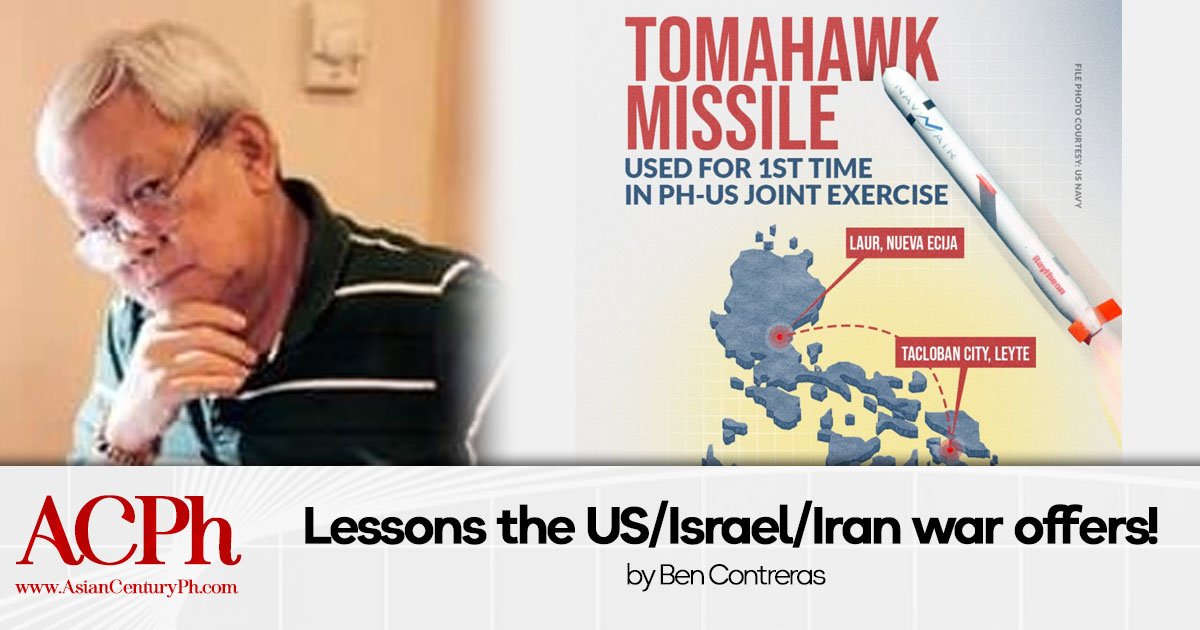
The firing of a Tomahawk missile by a Typhon Weapon System from Tacloban, Leyte to an EDCA site in Laur, Nueva Ecija, has irrevocably changed the realities on the ground. It is the first use of an offensive missile that can go from a conventional range of 1500 kilometers to its earlier version carrying nuclear arms up to 2500 kilometers, makes definitely an instrument of war which is renounced by the 1987 Constitution, which exposes a shift in the doctrine of the Armed Forces of the Philippines from deterrence to aggression.
The Supreme Court may not have seen the danger of ambivalent articles and sections of the Agreement at that time, but in the light of the fast changing realities in the South China Sea conflicts, the US surrogation of Japan to guard its hegemony in Asia, and frequent war exercises , and now Brunson’s kill-web, have definitely brought the Philippines in the axis of an unintended war against China, maybe even North Korea and Russia.
Vladimir Putin, as early as the Typhon’s arrival in two years ago, did not mince words – he said we have put the Philippines in the crosshairs of Russia and rushed a mutual defense treaty with Kin Jong-Un of North Korea. If our defense community took it lightly then, it had better recalibrate a possible Russian. North Korean or Chinese invocation of Article 51 of the UN Charter that entitles them to a preemptive strike.
- Anticipatory Self-Defense: The argument that self-defense can be used to prevent an attack that is imminent rather than waiting for it to physically occur. Note that the United States has repeatedly used this to shield the American president from censure by the US Congress, most notable in the US invasion of Iraq. Russia also invoked the same in its invasion of Ukraine.
- Action Against Non-State Actors: The “unwilling or unable” doctrine asserts that states can use force against non-state actors operating inside another host country if that host government cannot or will not stop them used also by the Americans in justifying the bombing of the Chinese embassy in Belgrade and its assassination of Middle Eastern leaders through use of drones.
Our solution here cannot be just be the termination by the President of EDCA, but the abrogation of the Mutual Defense Treaty which has made ridiculous and absurd our signing the ASEAN neutrality and non-nuclear proliferation treaties. The MDT has spawned a canine, nay phallocentric, devotion of our military leaders to the US regardless of its record of unbroken promises for our defense whenever it only serves our interests and not theirs.
The rationale for the treaty has outlived its usefulness, as the United States and its rule-base order has become the adversary of the people, a magnet for self-destruction, instead of its shield.
An enemy within.

Adolfo Quizon Paglinawan
is former diplomat who served as press attaché and spokesman of the Philippine Embassy in Washington DC and the Philippines’ Permanent Mission to the United Nations in New York from April 1986 to 1993. Presently, he is vice-president for international affairs of the Asian Century Philippines Institute, a geopolitical analyst, author of books, columnist, a print and broadcast journalist, and a hobby-organic-farmer.
His best sellers, A Problem for Every Solution (2015), a characterization of factors affecting Philippine-China relations, and No Vaccine for a Virus called Racism (2020) a survey of international news attempting to tracing its origins, earned for him an international laureate in the Awards for the Promotion of Philippine-China Understanding in 2021. His third book, The Poverty of Power is now available – a historiography of controversial issues of spanning 36 years leading to the Demise of the Edsa Revolution and the Forthcoming Rise of a Philippine Phoenix.
Today he is anchor for many YouTube Channels, namely Ang Maestro Lectures @Katipunan Channel (Saturdays), Unfinished Revolution (Sundays) and Opinyon Online (Wednesdays) with Ka Mentong Laurel, and Ipa-Rush Kay Paras with former Secretary Jacinto Paras (Tuesdays and Thursdays). His personal vlog is @AdoPaglinawan.

This promo includes free delivery by JRS to anywhere in the Philippines.
Email: contact@asiancenturyph.com
Facebook: https://www.facebook.com/asiancenturyph/
Twitter: https://twitter.com/AsianCenturyPH
Substack:
Also read:




Leave a Reply