

Series 3 on Forever Wars or Forever Peace?
In our last episode, we discussed that the 2016 Arbitral Award is binding only to the Philippines and did not become part of international law. It could not and did not kick out China from the South China Sea.
Today, we will expose that the 2016 Arbitral Award did not create the West Philippine Sea, but it definitely created ambiguities that motivated an unfortunate internal law Republic Act 12064 or the Philippine Maritime Zones Act into birthing it.
Closer to reality, it has also alluded to provisions of UNCLOS that makes it impossible to enforce without resorting into a circus of provocations. These provisions, the Philippine government choses to ignore.
- China’s Nine-Dash Line
As earlier said, while it may be granted that the Award rendered the “nine-dash line” is without lawful effect (Para 278), the award prefaced it lengthily that it did not rule on China’s historic rights in the South China Sea (Para 272).
“‘In particular, the Tribunal emphasises that nothing in this Award should be understood to comment in any way on China’s historic claim to the islands of the South China Sea.”
What are we saying? China cannot draw a “Nine-Dash Line”, but we can sketch our own phantom “West Philippine Sea”?
- Exclusive Economic Zones (EEZ)
The Award clarified that the Philippines is entitled to a 200 nautical mile EEZ.
In fact, the Philippines did better in its eastern side for submissions accomplished before the May 2009 UN deadline for 120 nautical miles of extended continental shelf and 200 nautical miles of EEZ beyond at Benham Rise.
The UN formally validated this claim on April 12, 2012, adding an expansive 135,506 square kilometers of seabed
But when the Philippines through its National Mapping and Resource Information Agency (NAMRIA) submitted comprehensive geological and geodetic data for an claim in the West Palawan Region on June 15, 2024 to establish that it has an extended continental shelf of 150 nautical miles on top of the standard 200-nautical-mile EEZ, resulting in the claim for a total natural prolongation of 350-nautical-mile outer limit, we hit a dead end.
The Chinese immediately lodged a protest with the UN asserting indisputable sovereignty and claiming the Philippine submission infringes upon their rights. As discussed earlier, what Japan surrendered to China was the entire South China Sea.
There is no denying that the sovereign rights accorded by UNCLOS are inherent and may even be asserted, as former Justice Antonio Carpio asserts, as “automatic” but not when disputed by other claimant states, as Article 74 of UNCLOS steps in.
“Delimitation of the exclusive economic zone between States with opposite or adjacent coasts
“1. The delimitation of the exclusive economic zone between States with opposite or adjacent coasts shall be effected by agreement on the basis of international law, as referred to in Article 38 of the Statute of the International Court of Justice, in order to achieve an equitable solution.
“2. If no agreement can be reached within a reasonable period of time, the States concerned shall resort to the procedures provided for in Part XV.
“3. Pending agreement as provided for in paragraph 1, the States concerned, in a spirit of understanding and cooperation, shall make every effort to enter into provisional arrangements of a practical nature and, during this transitional period, not to jeopardize or hamper the reaching of the final agreement. Such arrangements shall be without prejudice to the final delimitation.
“4. Where there is an agreement in force between the States concerned, questions relating to the delimitation of the exclusive economic zone shall be determined in accordance with the provisions of that agreement.”
A local expert on geopolitics threw a smart-alecky jab at me, “But this involves claims between EEZ of one state to the EEZ of another. The objection of China involves sovereignty while that of the Philippines is on sovereign rights.”
I told him, sure there is an asymmetry. But the rights claims by China is superior to that of the Philippines, so I hope you are not implying that sovereignty must give way to sovereign rights and allow maritime entitlement to overpower land and sea territory? Therefore, the afortiori argument applies here, with more reason there has to be a conflict resolution first before any enforcement is allowed. The phrase “in the spirit of understanding and cooperation” in Section 3 is the overpowering factor towards any peaceful conclusion.
The inescapable truth is we have no valid EEZ claims west of the Philippines, unless we first resolve the matter with any disputing party under the letter and in the spirit of Article 74. We will only continue to escalate tensions and provoke China’s use of non-lethal weapons if we insist on asserting acrobatic claims.

Amended Rules. The Philippine Maritime Zones Act signed by Marcos last November 2024 presented three examples whose realities on the ground and covering internal laws have already changed, making enforcement near to impossible.
- Bajo de Masinloc, or Scarborough Shoal and its 12 nautical mile territorial sea has already been under the effective control of China since after the 2012 stand-off. Legislation cannot arrogate territories that are already under another country’s sovereignty.
- Luzon Sea has disappeared because another law (Republic Act 9522) and a Supreme Court decision (GR187167) has already omitted the territorial sea limits we acquired hy historic rights under the 1898 Treaty of Paris, the 1900 Treaty of Washington, and the 1930 Convention Treaty between the US and Great Britain. We redrew our archipelagic baselines closest to our coastal lines and internal waters in favor of complying with the basis for territorial sea and exclusive economic zones delimitation under UNCLOS.
This is unfortunate because we exchanged more than 830,000 square kilometers of sovereignty out of our delusion, we can exchange it for more than a million square kilometers of EEZ and possible extended continental shelf (ECS).
- Kalayaan Island Group which violates UNCLOS Article 47 new definition of an archipelago has also been modified to constitute a regime of islands conforming to Article 121(3). This abolished the archipelagic box or polygon drawn by coordinates stipulated in what Presidential Decree 1596 created which accounted for a loss of about 70,000 kilometers of territorial sea.
Today also under Republic Act 9522 and GR 187167, and as per the Arbitral Award, our delimitation is only good for the 12 nautical miles for the high-tide elevations or rocks that we have occupied under the erstwhile KIG which are too far from each other to connect as an archipelago.
Suffice it to say, it was former Justice Carpio, who served as ponente for GR 187167.
Toll to the people
We would actually be better off if we did not make exaggerated enforcement over our expansive claims fueled by a single argument that the Arbitral Award abolished the nine-dash line and outside forces whispering into the ears of our President that when intermingled with the US rules-based order, we can scare China away.
Our situation in the South China Seas, today, is worse off than what Rodrigo Duterte inherited from BS Aquino III. The mayor from Davao was able to romance the Chinese onto economic, social and security benefits from China.
The Chinese, however, knows that Ferdinand Marcos Jr. is wed to the Americans with the Mutual Defense Treaty as pointless phallus.
If he would just read Henry Kissinger’s memorandum to William Sullivan in 1975, he would know that the South China Sea was not included by the framers of the treaty to be part of any of the categories it covers, except in the broad scenario of an armed attack. It is just unfortunate to the hawks in our defense community that China has been professional in allowing its civilian coast guard front law enforcement activities using non-lethal weapons to its maximum effectivity when policing the waters.
China has already extended an arm and a leg by allowing counterclaimants from the weakest (the Philippines) to the strongest (Vietnam) halfway protocol by signing the 2002 Declaration of Conduct (DOC) with the ASEAN countries, but it is only the Philippines that uses phallocentric strategies to attempt at false starts through lawfare and info wars that have instead painted the Philippines as the next Ukraine.
Which foreign country will invest in such a hotspot?
Even Laos in ASEAN has already overtaken us.

A recent report in Capital Economics’ Asia Economic Outlook predicts that the Philippines’ GDP growth rate this year will be 3%. The Manila Bulletin reported that if this forecast comes true, it will be the lowest level of economic growth in the country since the pandemic.
Illusions of progress
Our problems can no longer be solved by public relations.
Anthony Ludalvi Vista reports a recent reclassification of the Philippines by the World Bank as an upper-middle-income economy has been welcomed by some as a sign of progress. But he dismisses this as economic labels and technical computations, not complete reflections of economic reality.
He said that the World Bank classification is based on Gross National Income (GNI) per capita, a formula that divides the total national income by the total population. It is a mathematical average that can be accurate while still hiding inequality. If ten people collectively own ₱100, the average income is ₱10 each. But if one person owns ₱70 and the remaining nine divide ₱30, the average remains ₱10.
What makes this reclassification even more telling is that the World Bank itself, in its June 2026 Philippine Economic Update, admitted that 27 to 28 percent of Filipinos remain vulnerable to falling back into poverty, while only around 1/4 of the population belongs to what the World Bank calls the “secure middle class.” This means that 3/4 of Filipinos still do not have stable economic security, showing that the country’s income upgrade does not fully reflect the economic reality of most Filipinos.
Vista traces the misleading impression of a rise in national income as coming from specific sectors: overseas remittances, business process outsourcing, corporate profits, and urban-centered investments, that raise the average. But these gains are not equally spread:
“A farmer in the provinces, a fisherman, a factory worker, or a transport driver may not experience the benefits reflected in these national figures. For the great majority of Filipinos, life remains difficult. Food prices continue to increase. Fuel and electricity remain expensive. Housing is becoming less affordable. Transportation is inefficient. Wages struggle to keep up with inflation. Many households survive through debt, side jobs, or remittances sent by relatives working abroad.”
Vista rightfully concludes that growth without fair distribution creates impressive statistics but incomplete progress. A nation cannot fully claim advancement if millions remain vulnerable while only a small segment enjoys the benefits of expansion.
You don’t have to be an Einstein to appreciate this. Look at your Meralco bill and explain to me how Manny Pangilinan made almost P50 billion in net profits last year.
Conclusion
This is not why a great majority of the people elected the sitting president. How many of us still remember that he ran on a platform of continuity of the governance platform of the past administration, from Duterte’s Build Build Build program to Marcos’ Build, Build More (BBM)?
But does this president have a single infrastructure project worth wowing about?
Would we have the same gloomy scenario, if on February 2023 he did not authorize four additional sites to the Enhanced Defense Cooperation Agreement, a booby-trap that has held him hostage to a declining superpower?
That EDCA signing had only been a few days since he returned from Beijing, receiving an investment package of $23 billion from Xi Jingpin, in addition to some $17 billion yet unfinished Chinese projects in the pipeline.
The moment I saw Bongbong hitched a lift on an FA-50 trainer jet; I had a strange tingle on my spine that this toy soldier will take us to our own joyride. I have come to the conclusion that Uncle Sam’s zero-sum rules-based order shanghaied the president into a Chinese embargo.
The Philippine National Railway that Arthur Tugade labored to revive taking passengers from Tutuban to Alabang to Calamba is lying barricaded from the public for the past four years. The rail projects in Mindanao and from Clark to Subic, and the completion of the Clark/Malolos to Tutuban have been cancelled to be rebidded. At least three landmark bridges, one linking Bataan to Cavite, have been shelved. These were infrastructures tied to Chinese funding, which the government hoped the Americans and its Japanese and European allies would take over.
But nobody bought the ticket!
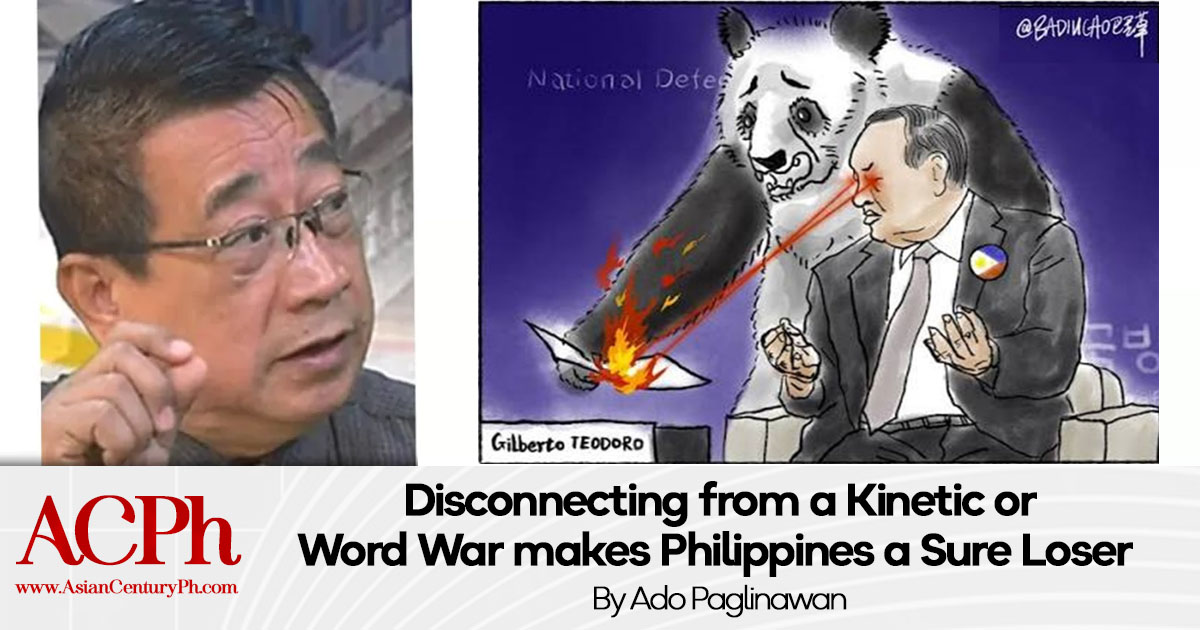
Instead, the Department of National Defense took the foreign policy joystick from the Department of Foreign Affairs, to relaunch playing cat-and-mouse with the Chinese Coast Guard in the South China Seas over imagined expansions we can ill-defend, mostly based on Gibo Teodoro’s amateur lawyering with Jay Tarriela as mascot.
That is how we became a hotspot, perceived as the next Ukraine, with incoming tourism is only performing 70% of targets already reduced to the 2017 levels. For a country that welcomed 4 million Chinese tourists from 2017 to 2019, for an even three-year period we could not even top 1 million from 2023 to 2025.
For a government grappling with a severe governance crisis, catastrophic public approval ratings, and legislative paralysis, largely stemming from a massive public infrastructure and flood-control corruption plunder, the result is not only fatal to our economic growth but is fanning the flames of desperation among the people
As of this writing, Marcos was due to fly to Canada for another joyride.
With the State on the brink of collapse, I hope he no longer returns.
Every Filipino deserves a goodnight sleep.


Adolfo Quizon Paglinawan
is former diplomat who served as press attaché and spokesman of the Philippine Embassy in Washington DC and the Philippines’ Permanent Mission to the United Nations in New York from April 1986 to 1993. Presently, he is vice-president for internal affairs of the Asian Century Philippines Institute, a geopolitical analyst, author of books, columnist, a print and broadcast journalist, and a hobby-organic-farmer.
His best sellers, A Problem for Every Solution (2015), a characterization of factors affecting Philippine-China relations, and No Vaccine for a Virus called Racism (2020) a survey of international news attempting to tracing its origins, earned for him an international laureate in the Awards for the Promotion of Philippine-China Understanding in 2021. His third book, The Poverty of Power is now available – a historiography of controversial issues of spanning 36 years leading to the Demise of the Edsa Revolution and the Forthcoming Rise of a Philippine Phoenix.
Today he is anchor for many YouTube Channels, namely Ang Maestro Lectures @Katipunan Channel (Saturdays), Unfinished Revolution (Sundays) and Opinyon Online (Wednesdays) with Ka Mentong Laurel, and Ipa-Rush Kay Paras with former Secretary Jacinto Paras (Tuesdays and Thursdays). His personal vlog is @AdoPaglinawan.

This promo includes free delivery by JRS to anywhere in the Philippines.
Email: contact@asiancenturyph.com
Facebook: https://www.facebook.com/asiancenturyph/
Twitter: https://twitter.com/AsianCenturyPH
Substack:
Also read:





Leave a Reply