

Part Two: A nation with many strange voices
Teodoro, Pangilinan, Tarriela and if I may add Philippine Navy Rear Admiral Roy Vincent Trinidad, deliberately mislead the Filipino people using a phantom body of water narrative based on Republic Act 12064, our Philippine [or National] Maritime Zones Act, signed by President Marcos Jr. in November 2024.
The fraud is subtle but deliberate. Our president has chosen US rules-based order and zero-sum strategy when it defaulted foreign policy to the military and the coast guard and not to the Department of Foreign Affairs. So, when there is potential conflict, the military and its extensions magnet hostility on the ground. Contrarily, diplomats pursue international law to seek common grounds and peaceful solutions.
I see this clearly because when I was assigned to Washington DC, the political capital of the world, I served under a sharp intellectual where I was only good up to my last best performance. Ambassador Emmanuel Pelaez was master of that classroom for six years on integrity in international relations and tangible results in development diplomacy, punctuated by literally walking both sides of Capitol Hill to lobby for Philippine concerns.
On top of postgraduate programs at the George Washington University offered by John Reed of the Public Relations Society of America, the death of Ambassador Claudio Teehankee provided me almost two years practicum in the United Nations in New York, as Pelaez concurrently served as our permanent representative to the international body.
The icing on the cake was that at the Embassy, I shared an office with Veterans Affairs Officer Nicanor Jimenez, former ambassador to South Korea and general manager of the Philippine National Railroad who led the 14 Battalion Combat Team of the Philippine Expeditionary Force to Korea (PEFTOK) during the Korean War. Our long conversations served as my minor subject in East Asian affairs.
But it was more than 20 years after, that I would meet Ambassador Albert Encomienda who was our former chief of mission to Greece, Malaysia and Singapore. His career specialization is Oceans Law and Policy with LLM degrees from the University of London and Columbia University, so it was more than fitting that his last assignment in the DFA was executive director of the Center for Archipelagic and Regional Seas Law and Policy Studies.
For seven years before his untimely demise on December 2021, he opened his data base to me, becoming a tutee of his nuanced expertise and institutional memory that stretched far back into our participation in the first conference of Law of the Sea in 1958 (UNCLOS I) led by luminaries Carlos P. Romulo and Senator Arturo Tolentino.
Encomienda did not only leave me the history and template of the three conferences that morphed the determination of the final text of the United Nations Convention of the Law of the Sea (UNCLOS), but how shrewdly the United States played its card.
The Americans have been lobbying our policy makers since 1961, to shape our jurisprudence favoring more its hegemonic ambitions and protecting its own turf rather than Philippine bottom lines.
At the end of the day, however, they did sign the treaty but never ratified it. Yes, you read it right, the United States is not a member of UNCLOS.
Trojan horse
The convergent point today, is Senate Bill No. 2492 filed by Majority Floor Leader Francis Tolentino, who claims to be a distant relative of the late Arturo Tolentino, a consanguinity or affinity that has not been verified.
The senator filed a bill on January 31, 2024; it passed three readings on August 19, 2024. Despite its complexity and volatility, Congress failed to subject it to comprehensive public debate. It’s consolidation with House Bill 7819 was railroaded so that the president could sign it on November 7, 2024.
Any of the works Ambassador Encomienda left behind, was not part of the consultations and hearings connected with this legislation. The bill was a cut and paste rehash of a “maneuver” that President Marcos Jr. could present to the Americans to cure his losing face when a Philippine Navy (PN) seaman, Jeffrey Facundo (military personnel) lost his right thumb during a high-speed ramming incident, and near violent confrontation with the China Coast Guard (civilian law enforcer) on June 17, 2024, at Ayungin Shoal in the South China Sea.
The clash pressured Manila to seek an immediate “provisional understanding” that would govern resupply missions to the BRP Sierra Madre, without which the Chinese could blockade any and all access to grounded Philippine junk that houses a detachment of 12 to 28 Philippine Navy troopers.
This protocol was formalized during the 10th Bilateral Consultation Mechanism (BCM) on the South China Sea on January 16, 2025.

Forked tongue
But what diplomacy set as a balm to ease tension and prevent escalation at Ayungin Shoal, our defense department and coast guard now use the National Maritime Zones Act as “trojan horse” fishing for false starts elsewhere in the South China Sea.
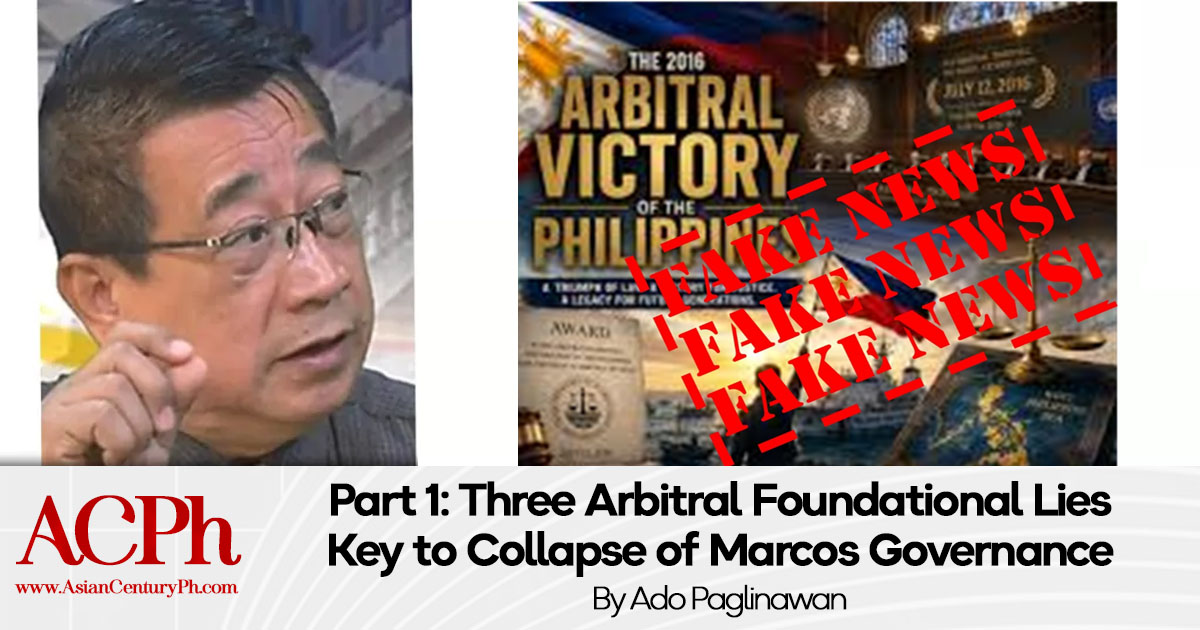
Isn’t it hypocritical, ridiculous and stupid that we celebrate claiming victory that an Arbitral Tribunal ruled that China’s nine-dash line has no legal basis in UNCLOS, and yet here we are carving our own “West Philippine Sea” in the same waters, fooling the Filipino people and the whole international community just to sow discord with a neighboring country?
It now appears that Senator Tolentino served as the fifth column planted by foreign intervenors to discombobulate South China Sea debates. It could only be an alien influence because the Act distorts our legal system, blocks constructive diplomacy moving forward and contradicts our national interest.
It also appears that he could have been laughing all the way to the bank for a “job well done”. According a post by broadcaster Anthony Taberna, he got the second biggest allocation Php6.3 billion for insertions in the 2025 General Appropriations Act not yet including whatever his loot was from the 2023 and 2024 national budgets.

The planted inconsistencies in the maritime Act would have been clarified when HOR Tricom summoned me on June 5, 2025, for calling the Republic Act 12064 – a “stupid law”.
But what became more obvious was that Speaker Martin Romualdez would not tolerate any challenge to the law to coverup conspiracies between the legislative and executive arms of government.
I began my testimony by quoting Section 2 of the Act:
“The maritime zones of the Philippines on the western side of the Philippine archipelago, including the Luzon Sea and the territorial seas of Bajo de Masinloc and the maritime features of the Kalayaan Island Group, shall be collectively called the West Philippine Sea.”
The committee members namely Dan Fernandez, the late Romeo Acop, and specifically Ace Barbers and Ben Abante, were more concerned, however, about insulting me than hearing the substance of what I had to say.
Today, I take this occasion to explain where I was coming from.
Firstly, I called the law “stupid” because its Section 14 also included as part of the Act, the multilateral UN Convention on the Laws of the Seas and the unilateral 2016 Arbitral Award, thereby codifying the two instruments as part of our domestic law:
SECTION 14. Other Maritime Rights and Jurisdictions.– The Philippines shall exercise all other maritime rights and jurisdictions in accordance with the UNCLOS, the South China Sea Arbitration (PCA Case No. 2013-19), international law, and other pertinent laws and regulations of the Philippines.
This means that the law must essentially conform to UNCLOS, the rulings of the Arbitral Tribunal in particular and to international law in general.
We boxed ourselves in, leaving no ambivalence or space for disavowal, and yet the Act presents various violations and contradictions of these platforms.
Bajo de Masinloc
Secondly but first to specify, the territorial sea of Bajo de Masinloc cannot be a subject of internal or domestic legislation. Territorial seas are determined by “land sovereignty” (UNCLOS Part II)
- Sovereignty and Extent: Article 2 & 3 provide that a coastal State’s sovereignty extends to its territorial sea, a belt of sea up to 12 nautical miles from its baselines, including the air space above, seabed, and subsoil.
- Baselines: Article 5 says the territorial sea is measured from normal baselines (low-water line) or straight baselines in specific geographical situations (e.g., deeply indented coastlines).
- Innocent Passage: Article 17 to32 – Foreign vessels (including warships, under specific conditions) have the right to pass through the territorial sea, provided the passage is “innocent,” meaning it’s continuous, expeditious, and not prejudicial to the peace, good order, or security of the coastal State.
- Coastal State Jurisdiction: The coastal State can legislate and enforce laws within its territorial sea, but must respect innocent passage rights, as outlined in the Convention.
Simply stated, the ownership of the territorial sea extending from the baselines, belongs to whoever exercises sovereignty over the land feature (in this case a rock).
China is in possession of and exercises sovereignty and effective control over Bajo de Masinloc (Scarborough Shoal) since the Philippines abandoned it in 2012 after the Scarborough standoff.
Being the coastal state in effective control of the pertinent land sovereignty, the 12 nm territorial sea of Bajo de Masinloc belongs to China. So how can Congress legislate this same feature as belonging to the Philippines?
This provision clearly violates the international law, specifically the provisions of UNCLOS which it codified.
PCG Tarriela: China has effective control of Bajo de Masinloc.
Luzon Sea
Thirdly, the Act also declared a certain Luzon Sea as part of our maritime zone without any basis in fact and law.
The prospective sea is beyond our 12 nm territorial sea which has been delimited by our updated baselines law, Republic Act 9522.
So, what is the basis of a Luzon Sea?
The only available reason would have been the treaty limits established by the 1898 Treaty of Paris transferred by purchase by Spain to the United States with the extent specified up to 118 degrees East longitude.
When 2009 Republic Act 9522 drew the country’s baselines as close as possible to our coastlines and bounds of internal waters, this precedent “stupid law” to the stupid National Maritime Zones Act, however, disregarded and superseded our inherited treaty limits of the Philippine archipelago.
While our national interest and history, ipso facto, historic rights support it, the ignorami in the Department of Foreign Affairs and Congress chose the zero-sum approach of pitching for 200 nautical miles of exclusive economic zone instead of an ambivalent strategy preserving the treaty limits despite the Solomonic wisdom of the opposition to Republic Act 9522 led by legal luminary Merlin Magallona of the University of the Philippines.
Under Article III of the Treaty of Paris, the territorial limits of the Philippine Islands were delineated as such:
“A line running from west to east along or near the twentieth parallel of north latitude, and through the middle of the navigable channel of Bachi, from the one hundred and eighteenth (118th) to the one hundred and twenty-seventh (127th) degree meridian of longitude east of Greenwich…”
Would you believe China recognizes this demarcation by historic right because a treaty created it and thus, it has become part of conventional international law.
So, what was on top of the UN deadline that provoked the Philippines to drop the preeminence of these treaty limits, and default to just the provisions of UNCLOS.
The Second Conference on the Law of the Sea (UNCLOS II) was held in Geneva in 1960 to resolve issues left from the first conference, primarily the breadth of the territorial sea and fishery limits, but again the parties failed to reach agreement.
One of the four sticky issues was the Philippines claim that waters within the limits set out in Article III of the Treaty of Paris between the United States and Spain of December 10, 1898, as internal waters that are part of the Philippine territory.
Guess who protested against the Philippine claim on May 1961?
The Unites States, but there was no final determination made.
The text of the convention was finally adopted at the 182nd plenary meeting during the eleventh session on April 30, 1982 of the third conference (UNCLOS III) , with a recorded vote of 130 in favor, 4 against, and 17 abstentions. It was then opened for signature in Montego Bay, Jamaica, on December 10, 1982.
On May 8, 1984, the Philippines deposited with its instrument of ratification of UNCLOS a declaration reaffirming among other things that such signing shall not in any manner affect the rights of the Republic of the Philippines as successor of the United States of America, under and arising out of the Treaty of Paris between Spain and the United States of America of December 10, 1898, the Treaty of Washington of November 7, 1900 and the Convention Treaty between the United States of America and Great Britain of January 2, 1930.
In January 1986, the United States protested this declaration, stating that the United States does not share its view concerning the proper interpretation of the provisions of those treaties.
“The Government of the United States continues to be of the opinion that neither those treaties, nor subsequent practice, has conferred upon the United States, nor upon the Philippines as successor to the United States, greater rights in the waters surrounding the Philippine Islands than are otherwise recognized in customary international law.”
You can read this in Page 50 of the document “Limits in the Seas”, No. 112 issued March 9, 1992 as part of “United States Responses to Excessive National Maritime Claims” issued by the US Department of State, with subsequent analysis by J. Ashley Roach and Robert W. Smith, in1996. http://library.law.fsu.edu/Digital-Collections/LimitsinSeas/pdf/ls112.pdf
Conclusion
We have so far demolished two out of four major inclusions of the stupid National Maritime Zones Act.
The third of this series will deal on implications of the ghost West Philippine Sea and what happened to the Kalayaan Island Group.
Further to that we would pry on why the United States continues to egg us on to escalating tensions against China in the South China Sea.
The scheme is so devious but so shallow and unprofessional that the ordinary Filipino has taken it with a grain of salt as evidenced by only 4% of those surveyed by Pulse Asia regard protecting the territorial integrity as an urgent concern.
In fact, the truth is the reverse.
We have substantially lost sovereignty and lost territories under Marcos.
Next part: Sovereignty and Territories We Are Losing under Marcos

Adolfo Quizon Paglinawan
is former diplomat who served as press attaché and spokesman of the Philippine Embassy in Washington DC and the Philippines’ Permanent Mission to the United Nations in New York from April 1986 to 1993. Presently, he is vice-president for international affairs of the Asian Century Philippines Institute, a geopolitical analyst, author of books, columnist, a print and broadcast journalist, and a hobby-organic-farmer.
His best sellers, A Problem for Every Solution (2015), a characterization of factors affecting Philippine-China relations, and No Vaccine for a Virus called Racism (2020) a survey of international news attempting to tracing its origins, earned for him an international laureate in the Awards for the Promotion of Philippine-China Understanding in 2021. His third book, The Poverty of Power is now available – a historiography of controversial issues of spanning 36 years leading to the Demise of the Edsa Revolution and the Forthcoming Rise of a Philippine Phoenix.
Today he is anchor for many YouTube Channels, namely Ang Maestro Lectures @Katipunan Channel (Saturdays), Unfinished Revolution (Sundays) and Opinyon Online (Wednesdays) with Ka Mentong Laurel, and Ipa-Rush Kay Paras with former Secretary Jacinto Paras (Tuesdays and Thursdays). His personal vlog is @AdoPaglinawan.

This promo includes free delivery by JRS to anywhere in the Philippines.
Email: contact@asiancenturyph.com
Facebook: https://www.facebook.com/asiancenturyph/
Twitter: https://twitter.com/AsianCenturyPH
Substack:
Also read:




Leave a Reply