

Part 37: Where the Philippines seeks War, China see Diplomacy.
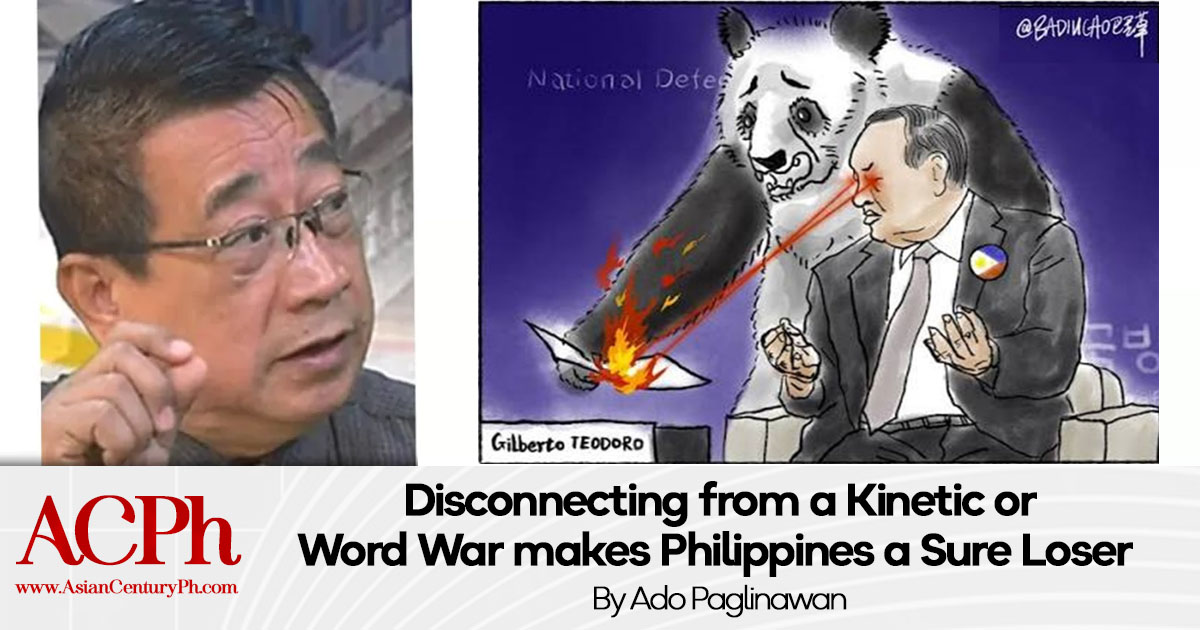
The statement of Defense Secretary Gilbert Teodoro on accusations of targeting by China of a Japan Air Self-Defense Force aircraft over international waters near the Okinawa Prefecture is uncalled for, reeks of detachment from geopolitical realism and technological ignorance.
His rejoinder that the Philippines stands with Japan is inappropriate because he is neither the President who is the chief architect of our foreign policy, or primus inter pares in the cabinet in charge of foreign affairs.
What Teodoro said, “China’s latest unsafe and escalatory actions underscore a pattern of reckless behavior that threatens regional stability, undermines established norms, and threatens states conducting lawful and responsible operations” is not supported by facts on the ground.
To correct Teodoro and put him in his proper place, it is China, not Japan, who has chosen “transparency, restraint, and adherence to international law over intimidation and provocation.”
He is the secretary of defense, not of Japan but the Philippines. He has no business sucking up to Sanae Takaichi, who is a militarist.
Turn of events
Japan’s narrative keeps on getting worse because new details released by Japanese media itself are slowly exposing what Japan’s Defense Ministry initially tried to hide.
First, China did issue advance notification before the incident.
But in a recent presser, Japanese Defense Minister Shinjiro Koizumi denied receiving sufficient prior notification from China regarding naval military training activities near Okinawa.
China, in turn, released audio recordings it claimed showed a Japanese warship acknowledging advance alerts.
CN: “This is China Navy warship 101. Our formation organizes shipborne aircraft flight training as planned. Over.”
JP: “Chinese warship 101, this is Japan warship 116. I copied your message.”
This video tells the truth better than any press conference.
Japan knew exactly what China was doing and still staged a political drama claiming dangerous actions.
China spokesman Guo Jiakun, said “The core issue of this incident is that Japanese fighter jets arbitrarily intruded into China’s training zone, conducting close reconnaissance and obstructing Chinese military activities.”
Japanese US F-15 fighters closed in to about 50km from Chinese aircrafts. A deliberate provocation that unnecessarily increased risks and disrupted normal exercises.
Guo added: “The wrongdoer is first exaggerating the so-called ‘radar survey’ issue, reversing black and white, shifting blame, and misleading the international community.”
After knowingly intruding into China’s pre-declared training zone, Tokyo turned around and hyped a “radar illumination” issue, deliberately twisting a professional defensive action into a political accusation. By sensationalizing this, Japan isn’t protecting security. It’s covering up its own intrusion and misleading international audiences.
Koizumi’s late-night press conference last December 10 didn’t give Japan credibility. It only exposed how deeply this narrative manipulation runs and how far some politicians are willing to play victim while provoking China.
China’s radar superiority
Of Japan media’s report that a China’s J-15 carrier-based Flying Shark fighter radar-illuminated Japanese F-15Js twice: first at 52 km and second at 148 km – that second distance is the key.
Japanese strategic analyst Kenji Minemura, a Senior Research Fellow at Tokyo’s Canon Institute for Global Studies, admitted the F-15J likely didn’t even realize it was being illuminated at first and may have already been tracked or locked before its sensors noticed anything.
“Considering that the F-15J radar detection range is 100 kms, while the upgraded Chinese J-15 radar detection exceeds 170 kms, the J-15 could see the F-15J clearly during the second illumination, the while the F-15J didn’t see the J-15 at all.”

Radar illumination range comparison
That’s not a “near miss” but one-sided superiority in favor of China’s detection technology.
Koizumi claim that detection by Japan’s onboard sensors that the second radar illumination lasted around 30 minutes, is catastrophic in real air combat terms.
In modern beyond visual range (BVR) missile warfare, earlier detection means sudden death. Not in 30 minutes but in seconds. Minemura explained further: “If the F-15J only realized it was being illuminated after 30 minutes, then the real exposure time was likely far longer and the J-15 may already have been in a full fire-control lock.”
If this had been war, the Japan’s F-15J and its pilot would not exist long enough to file a complaint.
No escape
But why did the F-15J not disengage?
There are only two possibilities: One, the pilot chose to sit inside hostile radar for half an hour, or two, he tried to escape but could not as he had already been locked in for a missile fire, trapped inside the J-15 envelope.
Experienced pilots don’t tolerate prolonged radar exposure; it induces genuine fear. The human factor alone rules out the first option as extremely unlikely.
James Wood, a British-Australian blogger in China reminds us: “We’ve seen this before. Last May, the Pakistani Air Force claimed its JF17 Thunders, derivative of China’s FC-1 Xiaolong or Fierce Dragon, had shot down five Indian Rafale fighter jets without detecting a lock.”
Those French-made jets are far more advanced than the US F-15J. Indian media highlighted that Rafale’s sensors already rival fifth-generation standards.
“Which is to say that if Rafales can be blindsided, an ageing F-15J stands no chance,” Wood quipped.
Japan’s narrative backfires
Japanese officials accused China of “unprofessional behavior”. But it was a Japanese aircraft that was tracking and harassing the Liaoning carrier group, a floating sovereign asset, inside a publicly declared exercise zone in international waters. That’s a serious security threat.
If the Chinese pilots had wanted to make the point more brutal, the F-15J would never have realized it was being tracked at all.
China’s J-15’s response, therefore, was not reckless but restrained.
Japan’s attempt to cry victim has achieved the opposite effect as more details emerge, it is now clear that Japan received but ignored warnings; Japan initiated the confrontation; Japan exposed its own air force’s vulnerability and Japan demonstrated how outmatched its aircraft are near a Chinese carrier group.
Tracking and shadowing a Chinese aircraft carrier are not harmless observation. It’s a direct military provocation.
Tokyo tried to blame China and ended up humiliating itself.
The radar illumination wasn’t aggression. It was a final warning that a repetition of this behavior by Japan won’t be met by a mere radar lock.
Next time, it might just be a final “sayonara” or “bai-bai”.

Diplomatic Implications:
The incident escalates existing friction, with Japan viewing China’s actions as “unsafe and escalatory,” undermining regional stability. I see increased mistrust and tensions with Japan hitting the ground running as the top proxy of the United States in East Asia, meanwhile that Donald Trump is preparing for his visit to Beijing in April 2026.
This issue will also engender actual diplomatic exchanges. Japan’s Ministry of Foreign Affairs already summoned China’s ambassador, while China lodged counter-protests, showing a hardening diplomatic stance.
Japan might think this should strengthen Japan-US-Philippines alignment as what Teodoro seems to be aspiring for as he already voiced support for Japan. But Philippine foreign policy under President Marcos is now confronting a bigger challenge as the Senate has admonished the executive department to pursue an independent foreign policy.
The Western slogan appeal for shared commitment to international law against Chinese intimidation, has received only 4% support from Filipinos in a recent survey by Pulse Asia on protective sovereignty over national territory. It has now become evident to the ordinary citizen that the present administration is instead pursuing rules-based order of the United States and as a backlash the popular clamor in solidifying regional partnerships should be based on economic sustainability (56%) and combatting corruption (51%).

The blame China narrative that has failed in the South China Sea, is of course intended to fueling Japan’s security posture The expectation setting is that this will reinforce Japan’s efforts to strengthen surveillance and defense, aligning with Prime Minister Takaichi’s hawkish stance and Taiwan emergency” rhetoric.
I am afraid this has to be analyzed alongside Takaichi’s October 2025 ratings from 71% to 82% depending on the pollster, dropping to December 2025’S slight dip to 60%–72%. A Jiji Press poll this December 2025 found that 39.5% of respondents considered her remarks on a potential Taiwan contingency “appropriate,” while 25.4% found them “inappropriate,” with a large number of 35.1 remaining undecided.
These numbers are still expected to drop dramatically when the effects of the tremendous absence of tourists from China this Christmas and the Chinese ban of seafood imports from 37 out 47 prefectures in Japan, finally sinks into the consciousness Japanese people.
Japan frames these incidents as threats to regional peace and stability but this is sentiment not shared by the South Koreans. President Lee Jae-myung has explicitly stated Seoul will remain neutral in the recent Japan-China spat, aiming to be a mediator, not a participant, despite the US encouraging a united front and ongoing complex dynamics between Seoul, Tokyo, and Beijing.
It’s unlikely South Korea would join Japan in a war against China over Taiwan, as Seoul prioritizes neutrality, economic ties with China, and stability on the Korean Peninsula. If the Filipinos have forgotten the atrocities of the Japanese Imperial Army during World War II.
The Philippines was occupied by Japan from Masaharu Homma’s landing to Douglas MacArthur’s liberation for almost four years, but Japan occupied Korea for 35 years, from establishing it as a protectorate in 1905, leading to full annexation by the Japan-Korea Annexation Treaty of 1910 until the termination of World War II.
Younger generations have much concessional views, largely influenced by cultural exchanges (K-pop, anime) and less direct connection to the historical trauma, as for this age group cultural appreciation often exists separately from historical politics.
But older generations often retain deep-seated negative feelings due to familial experiences of Japan’s 1910-1945 colonial rule, including issues like “comfort women” and forced labor. Many in this group feel that Japan has not yet offered a sufficient or sincere apology.
Two factors to consider are the temperature settings in Pyongyang, which means North Korea, as it pays to be aware that only an armistice holds the peace between north and south and the border that Korea shares with the Russian Federation.
The reunification of Taiwan to China has also received a boost with the prospect of the KMT (Nationalist Party) winning the next parliamentary election in Taipei. President Ching Lai-te holds his leadership by only one vote in the Legislative Yuan.
Cheng Li-Wun took office in November 1, 2025, aiming to unify the party, revive its electoral fortunes, and promote “cross-strait peace” through dialogue, positioning the KMT to challenge for power in upcoming elections. Needless to say, if the KMT wins the next ballot in January, 2028, the road to reunification becomes faster and peacefully at that.
The next national elections in the Philippines, is also slated in May 2028, and by all indications, Sara Duterte, who won her vice presidency in 2022 with the highest majority in Philippine history, will win the presidency with an even greater landslide, marking an end to American dominance in Manila politics and more productive ties with China.
But what could be the unintended consequence of Japanese militarism is the rebirth of Ryukyu nationalism and the rebirth of its once illustrious Kingdom (US Okinawa, JP Senkaku, CN Diaoyu) under which the US anomalously turnover to Japan.
Japan has nothing to win, everything to lose.
To be continued.

Secretary Teodoro humiliates himself a second time fanning flames projecting China as aggressor against actual photos of armed operatives posing as fishermen, this time at Sabina (Escoda) Shoal using a propped-up fishing expedition for a false start by the Philippine government.

Adolfo Quizon Paglinawan
is former diplomat who served as press attaché and spokesman of the Philippine Embassy in Washington DC and the Philippines’ Permanent Mission to the United Nations in New York from April 1986 to 1993. Presently, he is vice-president for internal affairs of the Asian Century Philippines Institute, a geopolitical analyst, author of books, columnist, a print and broadcast journalist, and a hobby-organic-farmer.
His best sellers, A Problem for Every Solution (2015), a characterization of factors affecting Philippine-China relations, and No Vaccine for a Virus called Racism (2020) a survey of international news attempting to tracing its origins, earned for him an international laureate in the Awards for the Promotion of Philippine-China Understanding in 2021. His third book, The Poverty of Power is now available – a historiography of controversial issues of spanning 36 years leading to the Demise of the Edsa Revolution and the Forthcoming Rise of a Philippine Phoenix.
Today he is anchor for many YouTube Channels, namely Ang Maestro Lectures @Katipunan Channel (Saturdays), Unfinished Revolution (Sundays) and Opinyon Online (Wednesdays) with Ka Mentong Laurel, and Ipa-Rush Kay Paras with former Secretary Jacinto Paras (Tuesdays and Thursdays). His personal vlog is @AdoPaglinawan.

This promo includes free delivery by JRS to anywhere in the Philippines.
Email: contact@asiancenturyph.com
Facebook: https://www.facebook.com/asiancenturyph/
Twitter: https://twitter.com/AsianCenturyPH
Substack:
Also read:





Leave a Reply