

Part 34: Where the Philippines seeks War, China sees Diplomacy
A Turkish proverb adaptation that I have often used, says — when a clown enters into a palace; he doesn’t become a king. Malacañang becomes a circus. I did not know it will happen in my lifetime.
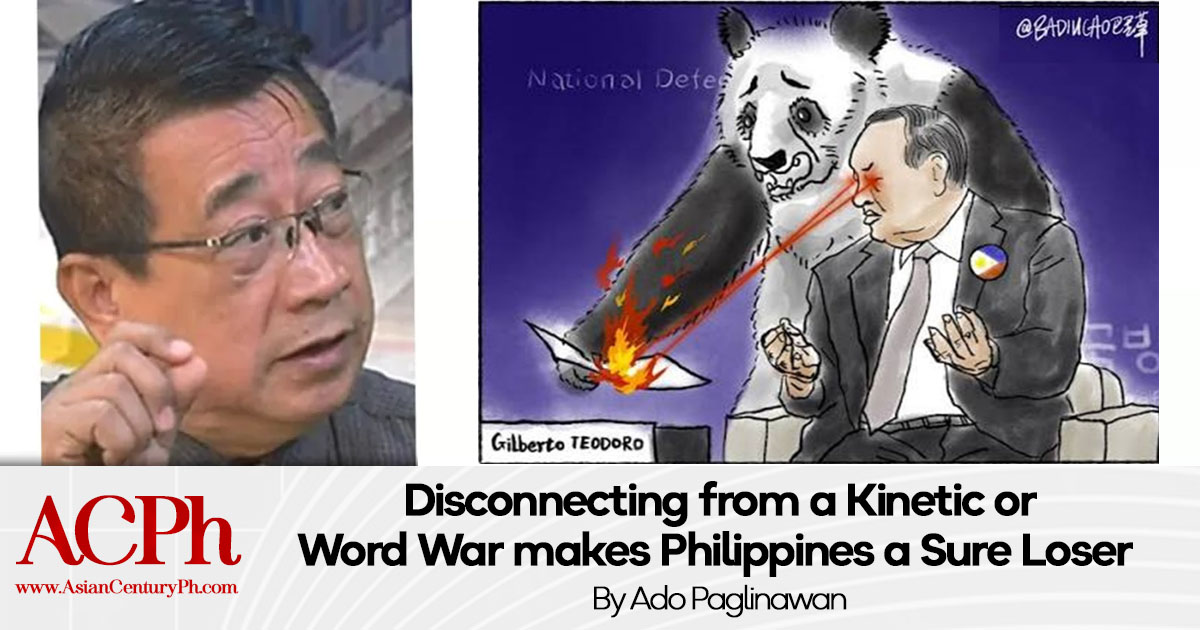
Judging from how Defense Secretary Gibo Teodoro coached Senator Sherwin Gatchalian during the Senate plenary hearing for the 2026 budget, we have moved into clown alley – “hidden, strange places often with mysterious origins or unsettling undertones, blending humor with horror.”
International law and relations expert Melissa Loja said when asked by Senator Rodante Marcoleta as to how far would the bounds of the defense budget cover, “Teodoro does not know where and what West Philippine Sea is, saying the limits of the WPS is 200 nautical mile limit of the Philippine exclusive economic zone.”
Loja pointed out that Pagasa “Island” and some other features claimed by the Philippine are outside such 200 nm EEZ. “So does this mean the proposed defense budget does not cover Pagasa, et al?” She got so flabbergasted by the ignorance of the defense department that she wrote to Inquirer.net “Where in the World is the West Philippine Sea?”
The interpellations by the senators covered key areas of the department’s mandates, including internal security, territorial defense, disaster response and risk reduction, international security cooperation, and the ongoing modernization of the Armed Forces of the Philippines. The proposed budget will fund its programs and its bureaus, the entire AFP including the government arsenal, the National Defense College of the Philippines, the Office of Civil Defense, the Philippines Veterans Affairs and their respective attached units.
Mutual Defense Treaty useless
Marcoleta’s turn started by asking if after 74 years, have we achieved what Article II of the PH-US Mutual Defense Treaty provided for? “In order more effectively to achieve the objective of this Treaty, Parties separately and jointly by self-help and mutual aid will maintain and develop their individual and collective capacity to resist armed attack.”
Gatchalian avoided answering the question with a simple yes or no. Of course, we are not capable of resisting an armed attack by a foreign force because none of our defense alliances has enabled us to be able to have such capacity. To which Marcoleta said, “If we continue to hide behind perennially behind the US, Japan and Australia, we are sacrificing our sovereignty and strategic autonomy.”
The atmosphere started charging with tension as the lawmaker methodically questioned the very foundation of the country’s current security strategy, beginning with the controversial Enhanced Defense Cooperation Agreement (EDCA) and the presence of foreign military assets on Philippine soil, particularly the mid-range missile systems that have drawn the ire of neighboring superpowers.
Marcoleta’s argued that instead of serving as a deterrent, these alliances are effectively painting the country as a target turning the archipelago into a magnet for foreign aggression in a conflict that may not even be of its own making. The senator pressed the defense officials on whether the Philippines has communicated any clear “red lines” to its allies regarding the use of these military sites. He demanded to know if there were guarantees that Philippine territory would not be used for offensive operations unrelated to national defense.
The response from the defense establishment was met with skepticism, as Marcoleta pointed out the lack of explicit consent mechanisms in the current agreements compared to those of other nations like Poland or Australia. He highlighted that other countries require specific approval for every type of equipment prepositioned on their land, whereas the Philippines appears to have granted a “blank check” that compromises its sovereignty and strategic autonomy.
Adding fuel to the fire, the Senate hearing also touched upon the murky waters of budget allocations for territorial defense as Marcoleta needled the DND’s definition of the “West Philippine Sea,” challenging them to provide precise coordinates and maps where billions of pesos in public funds are supposedly being spent.
He raised the alarm over the possibility of “ghost missions” and “ghost budgets” if the government cannot even accurately define the maritime zones it claims to protect. The Senator pointed out glaring inconsistencies between different laws and administrative orders, arguing that this confusion weakens the country’s legal standing and opens the door for corruption.
Marcoleta called attention to why the government is so aggressive towards one claimant country while maintaining “open communication lines” with others who also occupy features in the disputed waters, suggesting a double standard that defies logic.
Sovereignty vs sovereign right
Finally, the minority senator why the executive department is introducing a conundrum between territorial sovereignty and sovereign rights, a distinction that Gatchalian do not know. Marcoleta correctly pinpointed that sovereign rights are merely “functional jurisdiction over areas that are not territories” because Gatchalian insisted that China has kept on pushing us out of what to him was our rightful domain.
I admonish our foreign affairs, defense and coast guard officials to Google it. “Territorial sovereignty is the principle that a state has exclusive and supreme authority over its defined geographic territory, including the land, airspace, and waters, and is free from external interference. This authority includes the right to govern, make and enforce laws, control borders, and manage its own resources without outside intrusion. It is a fundamental concept in international law that underpins the independence and sovereignty of nations.”
(Google) “Sovereign rights are specific, limited authorities a nation holds over its exclusive economic zone or EEZ (up to 200 nautical miles from its coast) for managing natural resources like fish, oil, and gas. This differs from full sovereignty, which is the supreme authority over a state’s territorial waters and land. While a state has sovereign rights to exploit and conserve resources in its EEZ, other nations still retain rights like navigation and overflight in that area.”
Sovereign rights are not absolute. The word “exclusive” defines where it applies. Under the UN Convention on the Laws of the Sea, in case of disputes, coastal states must come to a peaceful agreement among themselves diplomatically, or resort to compulsory arbitration under the International Tribunal for the Laws of the Sea (ITLOS) or voluntary arbitration under the UN Charter.
In the case of the Philippines, we have earned exclusivity 200 nautical miles east of our coastline because there is nobody there to object, hence Benham Rise is indeed Philippine Rise. But west of us, five other parties are disputing our exclusivity – Vietnam, Brunei, Malaysia, Taiwan and China, and unless this is settled amicably, we have to share the resources with them under the provisions of the Chia-Asean 2002 Declaration of Conduct which we have conveniently ignored.
Questions still hang
As the dust settles on this enlightening Senate session, the questions raised by Senator Marcoleta remain largely unanswered. The defense establishment is now under immense pressure to justify its strategies and proving that the billions in taxpayer money are indeed making the country safer, not more vulnerable.
The Department of Foreign Affairs is largely to blame for this misunderstanding for its failure to lead in defining terms and clarifying where Congress must synchronize our conflicting laws in order to put our act together, especially in harmonizing our laws with UNCLOS. We have brought China to an arbitration and when they refused to join invoking an independent state’s right to consent, we unilaterally impose on them an Arbitration Ruling which we in practice ourselves violate, as in Marcoleta’s citation of Paragraph 574 rejecting any archipelagic delimitation in and around a Kalayaan Island Group.
Our coast guard and our Armed Forces must be sensitive to this because if they are to offer their lives and limbs, they must be assured that they are not lost at sea, because someone in Malacañang lost his compass. The public must not be left to wonder if the government is truly serving the national interest or merely navigating a treacherous game of survival where the ordinary citizen becomes nothing more than collateral damage.

White paper
So, Melissa Loja asks Where in the world is the West Philippine Sea? “Atin Ito!” has now become a badge of patriotism, but where exactly is this sea, and what exactly are our children and grandchildren supposed to die for defending it?
The international scholar based in Copenhagen continued on, “When Defense Secretary Gilbert Teodoro was asked this question, he said that the outer edge of the WPS is the 200-nautical-mile limit of the Philippine exclusive economic zone (EEZ) measured from the archipelagic baselines. He said the WPS consists of nine main islands, (later eleven) and Sen. Sherwin Gatchalian echoed him.
“Yet, Kalayaan Municipality (Pagasa Island), Northeast Cay (Parola Island), Itu Aba (Ligao Island,) Fiery Cross Reef (Kagitingan Island), Cuarteron Reef, and several other features that are occupied and/or claimed by the Philippines are situated outside our EEZ. Does the DND mean that these features are not part of the WPS? They are not ‘atin’ (ours)?”
Lojas strikes a paradox, “Conversely, Amboyna Cay, a high-tide elevation or legal rock that generates its own territorial sea (TS), is found inside the Philippine EEZ. Yet, unbeknownst to most Filipinos, we do not claim Amboyna Cay. That, at least, is what Annex 97 of the Philippine Memorial in the South China Sea (SCS) Arbitration seems to state: the Cay is a feature occupied by Malaysia but claimed by Vietnam and China only. The Philippines did not appear as its claimant in its own list of SCS features. On what basis, then, should the WPS encompass the Cay and its territorial sea (TS)?
She adds another question, “If the WPS consists of only nine main islands, as Secretary Teodoro said, what has become of the other Philippine-claimed features? Annex 97 identified 10 SCS features that are occupied by the Philippines, 19 features occupied by Vietnam, and nine features occupied by China are also claimed by the Philippines.”
AO29 vs RA 12084
Loja traces the confusion as stemming from the disconnect of Administrative Order No. 29 (2012) and Republic Act No. 12064, or the Philippine Maritime Zones Act (PMZA)(2024).
In her explanation, under AO 29, the WPS is defined as the “maritime areas on the western side of the Philippine archipelago … [including] Luzon Sea as well as the waters around, within, and adjacent to the [KIG] and Bajo De Masinloc, also known as Scarborough Shoal.” The phrase “waters around, within, and adjacent to the Kalayaan Island Group (KIG)” echoes Presidential Decree (PD) 1596 (1978). Section 1 of PD 1596 defined the KIG as the “area within the following boundaries…including the seabed, subsoil, continental margin, and air space.” In effect, the KIG is an offshore archipelago.
Unfortunately, the SCS Arbitral Tribunal held under paragraph 574 of the Arbitral Award that not only China but “even the Philippines could not declare archipelagic baselines surrounding the Spratly Islands.” Section 1 of Presidential Decree No. 1596, constituting the KIG as an offshore archipelago, cannot coexist with paragraph 574 of the Merit Award.
Thus, a third of the KIG is located outside the Philippine EEZ. Thus, under AO 29, the WPS’ outer edge would be the westernmost boundaries of the KIG, well beyond our EEZ.
Are we being consistent here? Or are we convoluting the issue?
(In the senate budget hearing, Teodoro kept on prodding Gatchalian to disregard Republic Act 12064 or the PMZA and draw attention to Republic Act 9522, which is our baselines law, and not being lawyer, Marcoleta graciously corrected him saying that 12064 is the relevant jurisprudence because it is a latter law that has superseded 9522.)
Addressing the incompatibility between the Arbitral Award and PD 1596, Section 18 of the Philippine Maritime Zones Act declared that it amended Section 1 of PD 1596. Indeed, under Section 5 of the PMZA, the KIG is no longer archipelagic but now consists of rocks with only a territorial sea of 12 nautical miles around each rock.
Ghost territories
What has therefore become the limit of the WPS?
Section 2 of the PMZA redefined the WPS as to now mean the “maritime zones of the Philippines on the western side of the Philippine archipelago and … the maritime features of the [KIG].”
Yet, to repeat, the limit of the WPS cannot be the outer edge of the Philippine EEZ, as this would exclude Kalayaan Municipality/Pagasa Island and other rocks that are outside this maritime zone.
She emphasized, “Making the “maritime features of the Kalayaan Island Group” the limit of the WPS will lead to even more absurdities. Pagasa and other rocks that are outside our EEZ are separated from each other and from the rest of the KIG by high seas.
“No state can appropriate the high seas as territory. Thus, to make these scattered rocks and their territorial seas the limit of the WPS is to depict a disintegrated and disconnected body of water, in violation of every rule on geographic and hydrographic nomenclature.”
This is whenever Commodore Jay Tarriela of the Philippine Coast Guard and his companion in the Taiwan discussions of China’s hybrid warfare, Rear Admiral Roy Trinidad, announces presence of Philippine government vessels outside of our 12 nautical miles territorial sea, I just pass it on as yet another incident of mariners losing their bearings due to the lack of internationally-accepted maps.
This is why I can only empathize with Senator Marcoleta when he says that the National Mapping and Resource Information Authority cannot even produce an official map of the Philippines formally including a West Philippine Sea because it has not been authorized by the United Nations because it is unacceptable to the International Hydrographic Association.
Simply, the West Philippine Sea is ghost territory.
Has our president committed our troops and our people to a war that is not of our own making.
We will continue to stumble in our diplomacy if we keep on mistaking international law with the United States’ rules-based order.
A change of leadership is long overdue.
To be continued.
MARCOLETA DEMOLISHES THE MUTUAL DEFENSE TREATY AND THE WEST PHILIPPINE SEA

Adolfo Quizon Paglinawan
is former diplomat who served as press attaché and spokesman of the Philippine Embassy in Washington DC and the Philippines’ Permanent Mission to the United Nations in New York from April 1986 to 1993. Presently, he is vice-president for internal affairs of the Asian Century Philippines Institute, a geopolitical analyst, author of books, columnist, a print and broadcast journalist, and a hobby-organic-farmer.
His best sellers, A Problem for Every Solution (2015), a characterization of factors affecting Philippine-China relations, and No Vaccine for a Virus called Racism (2020) a survey of international news attempting to tracing its origins, earned for him an international laureate in the Awards for the Promotion of Philippine-China Understanding in 2021. His third book, The Poverty of Power is now available – a historiography of controversial issues of spanning 36 years leading to the Demise of the Edsa Revolution and the Forthcoming Rise of a Philippine Phoenix.
Today he is anchor for many YouTube Channels, namely Ang Maestro Lectures @Katipunan Channel (Saturdays), Unfinished Revolution (Sundays) and Opinyon Online (Wednesdays) with Ka Mentong Laurel, and Ipa-Rush Kay Paras with former Secretary Jacinto Paras (Tuesdays and Thursdays). His personal vlog is @AdoPaglinawan.

This promo includes free delivery by JRS to anywhere in the Philippines.
Email: contact@asiancenturyph.com
Facebook: https://www.facebook.com/asiancenturyph/
Twitter: https://twitter.com/AsianCenturyPH
Substack:
Also read:





Leave a Reply