

Part Five: Where Brawner sees war, China sees diplomacy
I seldom read the Philippine Daily Inquirer but my Deepseek picked up an article corresponding to keywords and constructions I fed the AI app to capture.
The keywords were “Brawner’s boner”.
Last Good Friday, Jake Maderazo came out with a fish story of AFP Chief of Staff Romeo Brawner’s recent faux pas rallying his northern troops to prepare for China’s invasion of Taiwan.
Maderazo tried a gingerly twist to the scenario: “In the ever-evolving landscape of geopolitics and national security, there are times when words, sometimes innocent, sometimes misunderstood, take on a life of their own.”
As an example, the columnist applied the cosmetics: “His message was clear: readiness is the bedrock of the AFP.”
I cannot agree. “Always be prepared” is the bedrock of the Boy Scouts. The bedrock of the Armed Forces of the Philippines is protecting people, securing the State.
Brawner is no Boy Scout. Worse he is not a civilian, he cannot make public policy. Must I even cite the pertinent constitutional provision for him, enshrined in Article II, Section 3, which states that civilian authority is always supreme over the military.
Maderazo tried harder: “But while the message was one of strength and assurance, not everyone received it as such. The word ‘preparedness’ is sometimes misinterpreted as a sign of impending crisis.”
This is worse than a paid advertisement. If Brawner’s message was clear, why was it misinterpreted? If the message was one of assurance, why were the readers misled and alarmed? If an impending crisis were distant, why is there a need to prepare more than usual?
This is where the masturbation begins: “This is a common pitfall. It’s easy to confuse readiness for apprehension, preparation for panic. But Brawner’s statement was not a warning. It wasn’t a harbinger of something terrible about to happen.”
It is not a common pitfall. On the contrary, it uncommon.
It should be remembered that his supervisor, Gibo Teodoro, testified to Senator Imee Marcos’ committee that the military is not a law enforcement agency, but may only be called to extend assistance, whenever appropriate or necessary. In short it has no first-instant business in repatriation of citizens.
If Brawner, however, is doing this on his own time, then he should shred his uniform because as long as he is wearing that cloth, he is Marcos’ pitbull and all his actions are assumed to have the approval of his commander-in-chief. If Brawner warmongers and sows the fear factor, the deduction is it is Marcos war-mongering and sowing the fear factor.
What was crystal clear was Brawner’s specificity – he accurately announced that 250,000 overseas workers were to be evacuated in the event of a China invasion of Taiwan.
The hypothesis “in the event of a China’s invasion of Taiwan” cannot absolve the chief of staff because he commanded his soldiers not just to prepare, but called them to arms, saying: “As members of the Armed Forces of the Philippines, we should have that mentality that we are already at war,” and emphasizing the “next big conflict” the soldiers will face “will not be against our own people.”
Worse, he did not only step over the duty of the Manila Economic and Cultural Office in Taiwan and the line responsibility of the Department of Migrant Workers, he usurped the powers and functions of the Department of Foreign Affairs.
No less than Executive Secretary Lucas Bersamin ran out of vocabulary, as Malacanang awkwardly borrowed the overused “all-government approach”, and issued a day after on April 2 – “The context of General Brawner’s statement should not cause alarm among Filipinos.”
The issue could have rested already. But two weeks after, on April 14 at Camp Capinpin in Tanay, Rizal, he showed recalcitrance repeating his warmongering to the 2nd Infantry, this time “to prepare to secure” Metro Manila, “the seat of government”.
As once could be a mistake but twice is definitely a boner, I can only surmise this time Bersamin decided to stay under the radar giving instead “general boner” merely a ring to stop his bullshit.
Now they threw the bone to this columnist hoping he could bury it somewhere. Instead, he waxed a bow-wow rejoinder, “It was a simple reminder that the AFP’s primary duty is to protect the Filipino people, especially the capital, where the pulse of our government, economy, and democracy beats.”
“Democracy?” Even for a canine, that’s too far a pitch to fetch.
Asked to help Brawner, Bersamin and Marcos, I think he have just succeeded in adding gasoline to the fire.

Unsolicited advice
My hope, is that this doesn’t get laundered further through Joe Bush Dryer and Cleaner in old Plaza Sta. Cruz, a brand that became famous in the 1920s as “dyobos”, because that shop closed down in the late 60s.
I might as well inform you that “boner” has two slang meanings: first a sexual erection, and second a stupid, foolish and careless mistake. It’s considered informal and potentially offensive, especially in professional contexts but here, I suppose you deserve the frankness.
This erection, that has failed to launch, must stop. Brawner is retiring anyway, so just like old soldiers, simply let him fade away.
The next thing I wish to advice you is when things go south like this, cosmetics no longer becomes effective. Just tell your client this children’s nursery rhyme that goes something like this: “Humpty Dumpty sat on a wall. Humpty Dumpty had a great fall. All the king’s horses and all the king’s men, couldn’t put Humpty Dumpty together again.”
One does not have to be a graduate of the Philippine Military Academy to know that in the event of an invasion of Taiwan by China, China will first obliterate all American fleet in the Pacific Ocean and the South China Seas, together with all US prepositioning in Guam, and of course the Philippines.
Sometime in 2021, the US Air Force released its “agile combat employment” or ACE strategems to replace what the late Philippine Army General Victor Corpus exposed earlier as the original intentions of the US Navy to position nuclear submarines in the deep recesses of the Manila Trench capable of launching strikes from the vulnerable southeast coast of China.
In his book “America’s Dim Mak Points” has brought attention to the fact that the US has lost its footings over time, as China had already built artificial islands in the South China Seas which are actually military fortifications capable of launching naval warships and warplanes, and equipped with anti-ship and anti-submarine missiles, thus neutralizing US naval strength in the area.

The US still insists on its ACE doctrine by arming its nine or so bases under the Enhanced Defense Cooperation Agreement, with F22 Raptors and F35 Lightnings, Typhon Missile System and drone swarms.
The downside is that all EDCA bases will be levelled to the ground by Dong Feng 17 hypersonic missiles within one minute of launch from Chinese submarines around our archipelago, or within 3 minutes of launch from any of China’s artificial islands.
No less than the US Naval Institute has exposed ACE’s weakness, suggesting that even if the US fighter jets manage to take off from bases sprawled all over the Indo-Pacific, a return trip to an aircraft carrier or land base may not even be possible. This means all flights are only as good as one-way trips, as swarms of drones, hypersonics and ballistics are sent by their targeted country to where they took off.
It has no bearing, whatsoever, on the preparedness, or unpreparedness, of the Armed Forces of the Philippines.
EDCA itself does not even oblige the United States to disclose to Philippine authorities what they place in those sites. Worse, the Mutual Defense Treaty cannot be activated except in the event of an external attack.
Romancing World War II heroics belongs to history.
Captain Jesus Villamor was credited with downing the first Japanese aircraft as he led a squadron of six P-26 planes against a much larger force of Japanese zeroes as they bombed US installations in the Philippines on December 8, 1941, a few hours after the attack on Pearl Harbor.
That was when reaction time were still in the hours. Today it could a matter within 60 seconds.
The debate that never died is all about the question – Would the Japanese spared the Philippine Islands if the gringos were not here?
But today, what I am sure is that a preemptive attack by China in a Brawner-scenario, suggests that our 250,000 OFWs are safer in Taiwan than repatriated to the Philippines. China will never punish their own kind. Or did you not know that Taiwanese are also Chinese?
Parking the Typhon Missile System in Laoag was a childish display of a president using it as a phallic symbol for what his pea-brain considers “deterrence”.
Regardless of whether we can buy missiles to launch from it, it is still a threat because Chinese have warned that Tomahawks, even if subsonic, are a threat not just to them but to the region.
We have seen them in action in destroying Iraq. Japan has bought 400 of them with deliveries starting this year. A recent pact with Japan can see some of them being shipped instead to the Philippines.
As of this writing, the Hawaii-based 3rd Marine Littoral Regiment announced said an unspecified number of the NMESIS launchers, or Navy-Marine Expeditionary Ship Interdiction System, will be airlifted to “multiple islands” in Batanes, located about 150 kilometers from Taiwan’s southernmost tip.
In a flash, 5 million Ilocanos, and now Ivatans, can be annihilated in matters of minutes, with China invoking the principle of preemptive attack under Article 51 of the UN Charter, which addresses the inherent right of self-defense.
While it allows for self-defense when an “armed attack occurs,” it’s also interpreted to include the right to anticipatory self-defense under customary international law when an attack is imminent and inevitable.
Portals for diplomacy
The upside is China has no intentions of using force against Taiwan if not necessary, that is if no third parties intervene. China’s agenda of reunification is peaceful and can be achieved politically.
Last December 2024, the Oxford Global Society conducted a dialogue between George Yeo and its professors on Understanding China’s Outlook and US-China Relations.
The annotator of Rise of Asia said his perspective is something you don’t hear every day. His speech will change the way you see the China-Taiwan conflict, as he broke all the issues down with eye-opening insights on how Taiwan fits into the bigger US-China rivalry.

In an extemporaneous message that lasted 54 minutes, Yeo asserted, “The US has come to a conclusion that even it’s a conventional war, there is no chance at winning. In fact, there’s a good chance that they may lose, because China now has hypersonic missiles from the mainland which can travel 3,000 kilometers to hit US aircraft carriers (not to mention its ballistic capability).
“This means the aircraft carriers have to stay away and cannot intervene in Taiwan.”
Yeo observed that China wants a peaceful unification and believes that time is on its side as it gets stronger. On the other hand, he sees Taiwan independence as a dangerous illusion.
Yeo said “Twenty years from now, forty years from now, what would China be, what would Taiwan be? It is better for Taiwan to negotiate with the mainland earlier than later because the longer you wait, the weaker your relative negotiation position.”
Yeo noted that the Taiwan issue is “the core of core issues” of China-US relations and the historical injustice around it makes it “emotional” for the Chinese.
For China, it is the last chapter of its civil war, and the US strategy is to keep Taiwan separate from China mainland forever to contain China.
In short, it is a red line.
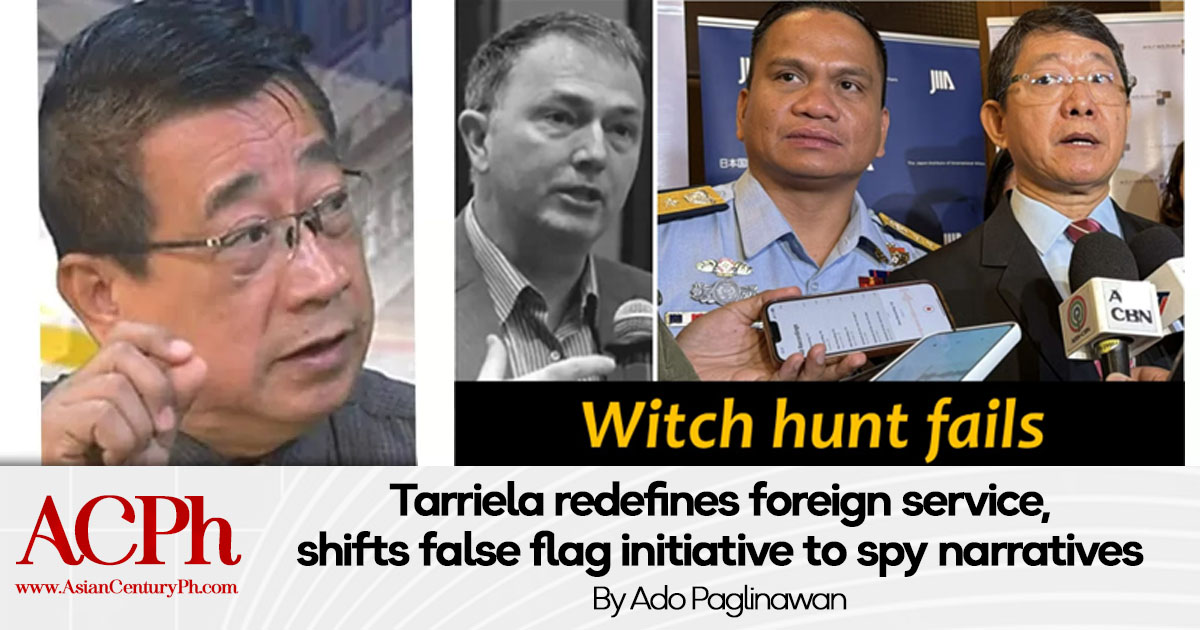
No amount of Brawner’s warmongering and Jay Tarriela’s patrolling the high seas can poke the dragon any further, unless they want a hot war which cannot be won.
The only way we can draw the economic benefits from our so-called exclusive economic zone west of the Philippines is not by bribing Google to include the West Philippine Sea in their maps. It is evident in the communique we signed with China when we opened diplomatic relations with them fifty years ago – resolve differences through bilateral negotiations seeking common ground beyond that red line.
The trouble with the Philippines is that our red or bottom line is the canine devotion most of our leaders have to the United States.
Pax Americana is over. The Asian Century has arrived.
To be continued. Next issue – Taiwan reunification in the light of the 1992 Consensus and the Xi-Ma conversation.

Adolfo Quizon Paglinawan
is former diplomat who served as press attaché and spokesman of the Philippine Embassy in Washington DC and the Philippines’ Permanent Mission to the United Nations in New York from April 1986 to 1993. Presently, he is vice-president for international affairs of the Asian Century Philippines Institute, a geopolitical analyst, author of books, columnist, a print and broadcast journalist, and a hobby-organic-farmer.
His best sellers, A Problem for Every Solution (2015), a characterization of factors affecting Philippine-China relations, and No Vaccine for a Virus called Racism (2020) a survey of international news attempting to tracing its origins, earned for him an international laureate in the Awards for the Promotion of Philippine-China Understanding in 2021. His third book, The Poverty of Power is now available – a historiography of controversial issues of spanning 36 years leading to the Demise of the Edsa Revolution and the Forthcoming Rise of a Philippine Phoenix.
Today he is anchor for many YouTube Channels, namely Ang Maestro Lectures @Katipunan Channel (Saturdays), Unfinished Revolution (Sundays) and Opinyon Online (Wednesdays) with Ka Mentong Laurel, and Ipa-Rush Kay Paras with former Secretary Jacinto Paras (Tuesdays and Thursdays). His personal vlog is @AdoPaglinawan.

Email: contact@asiancenturyph.com
Facebook: https://www.facebook.com/asiancenturyph/
Twitter: https://twitter.com/AsianCenturyPH
Substack:
Also read:




Leave a Reply to dorinarojasCancel reply