

Part 1: An old order gives way to a new one, reshaping global geopolitics
Professor Jiang Xueqin, a Beijing-based historian and educator made a series of bold predictions six months before the November 2024 US elections that Donald Trump will win the presidential elections.
Particularly, he foresaw that Trump as president will escalate in the Middle East a full-scale war with Iran where ultimately the United States will face an ignominious defeat.
Fast forward in a recent interview with Breaking Points, an independent, social media-based news commentary show hosted by Krystal Ball and Saagar Enjeti, the professor doubled down on his view that the US is walking into a trap it cannot escape, specifying “The reality is that right now, it’s a war of attrition between the United States and Iran.”
He said that the Iranians have been preparing 20 years for this conflict. And now they have a pretty good strategy of how to weaken and ultimately destroy the American empire.
Jiang explained that instead of fighting the Americans and the Israelis aircraft for aircraft, missile for missile, the Iranians are waging war against the entire global economy by striking the countries belonging to the Gulf Cooperation Council, many of whom have hosted US bases, by going after critical energy infrastructure and blocking all traffic moves.
The Iranians understands clearly well that the Gulf states are the linchpin of the American economy. They will go after the water desalination plants that are lifeblood of these nations, because they don’t have fresh water supply. They are threatening the very existence of Saudi Arabia, UAE, Qatar and Bahrain.
Jiang said “They sell petrodollars, and then they recycle the petrodollars back into the American economy through the investments in the stock market. Right now, we know that the entire American economy is propped up by AI investments in data centers. And a lot of that comes from the Gulf states.”
So, if the Gulf states are no longer able to sell oil, and they will no longer able to finance AI, sending AI bubble in the United States to burst. And with it, bursts as well the entire American economy, which he adds “is really a financial Ponzi scheme.”

New Nostradamus’ videos have sparked a massive buzz online as a lecture delivered by a Beijing-based historian Jiang Xueqin who made multiple geopolitical forecasts, has begun to play out in real time.
In May 2024, Jiang Xueqin, as part of his “Predictive History” series on YouTube, dissected the convergence of interests among three key actors—Iran, Israel, and Donald Trump—who, despite different motivations, all benefit from a US invasion.
He argued in his lecture that a new Trump administration would be pushed toward war with Iran due to political pressure from a powerful Israel lobby, Saudi Arabian interests, and America’s reliance on global hegemony for financial gains, reports Newsweek.
A lecture that was initially meant for academic purposes has gone viral on social media, amid escalating tensions between Iran and Israel and the growing involvement of U.S. troops in the regional conflict. He warned that if Donald Trump returns to the White House, it could lead to a US military invasion of Iran, a move he described as ‘a catastrophic mistake’.
Obsolete warrior
Jiang continued, “The United States is racing to accomplish its Iran mission before munitions run out but its military is not designed to fight a 21st century war.”
He reminds listeners that “the military industrial complex came to being after World War II, designed to fight the Cold War which was really about muscle flexing, built around an entire military strategy that relies on very sophisticated technology that cost a lot of money to build.”
Jiang said this is what the American air defense system has evolved into – “and that’s why we’re seeing this asymmetry in this war, where you have these million-dollar missiles trying to take out these $50,000 drones, which it’s not sustainable in the long term.”
The professor added that the US, cannot win this war without putting boots on the ground. At the heart of Jiang’s argument is the unforgiving geography of Iran. The country’s mountainous terrain, he explained, would turn any invading force into ‘hostages, not soldiers’.
He said conquering and holding Iran, with its vast size and population, would demand 3 to 4 million soldiers—far beyond the current US military’s capabilities, especially given declining recruitment and reliance on outsourced manufacturing for equipment. US troops would struggle to mass effectively, protect supply lines, or retreat if needed.
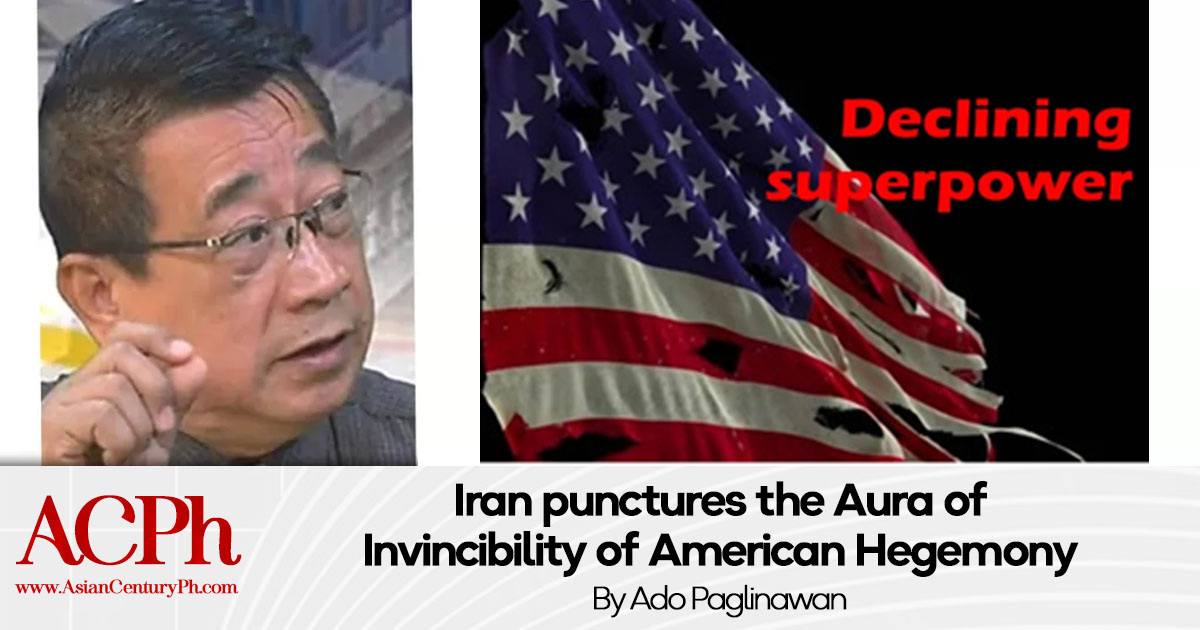
Jiang emphasizes Iran’s two decades of preparation, framing the conflict as a holy war against the ‘Great Satan’. What Iran is actually doing is puncturing of the aura of invincibility that sustained American hegemony for the past 20 years.
“Through proxy battles and exercises, such as a simulated 12-day war in June (2025), Iran has honed its long-term strategies against clipped US and Israeli tactics. Its network of allies—Hezbollah, Hamas, Shia militias, and the Houthis—allows for asymmetric warfare that disrupts without direct confrontation.”
What particularly resonated in me was Jiang’s cross-referencing parallels in history and the hubris of empires. He begins by comparing the forthcoming US debacle to the Athenian invasion of Sicily in 415 BCE, where overconfidence led to total annihilation. He draws similarities to Vietnam, where terrain and local resistance bled American forces dry. He echoes of Hitler’s invasion of the Soviet Union which he tagged as “initial easy wins breeding fatal arrogance.”
If US forces become trapped, Jiang warns, Trump might escalate to nuclear threats against Tehran. However, Russia could intervene by declaring a nuclear red line, positioning Putin as a global savior and further isolating the US.
If Jiang’s crystal ball holds, the fallout would reshape global dynamics. A US defeat could end the petrodollar era, accelerate economic collapse at home, and usher in a multipolar world where powers like China and Russia gain prominence.
Understanding the petro-dollar dynamics tucked under the US-Iran war.
Israel, on the other hand, could end up vulnerable in a rebalanced Middle East.
Jiang’s insights, rooted in a dispassionate analysis of incentives and history, serve as a cautionary tale that empires fall not from weakness alone, but from the hubris that blinds them to unwinnable wars.

American idiot’s perfidy
Scott Ritter, an American former United States Marine Corps intelligence officer and United Nations Special Commission weapons inspector who served in Iraq from 1991 to 1998, corroborates Jiang’s predictions but weighs in heavily from a different but related angle.
“This is a regime change conflict that the United States and Israel lost when they fired the first six missiles into Tehran, striking the residence of Ali Khamenei and killing the supreme leader of Iran, the second most important man in the Shia faith in the entire world after Grand Ayatollah Sistani in Najaf, Iraq.
It is to be noted that when Donald Trump, announced Operation Epic Fury to the American people, said that his pummeling of Iran was designed to suppress , terminate, decapitate the regime, and create the opportunity for the Iranian people to rise up and take matters into their own hands.
Today, the Iranian people are rising up and taking matters into their own hands. The streets are filled not with crowds shouting death to Khamenei, but crowds extolling the newest martyr, a man who gave his life in the service of his country, in service of his faith.
Ritter emphasizes. “We being the United States and its controlling masters in Tel Aviv, have lost this war. The regime will not be changed. And the Iranians will resist long after the United States and Israel have depleted and spent their forces, run out of ammunition and will be compelled to sue for peace.”
Describing Trump, he was heartless, “I prefer to use the term developed by the American punk rock group Green Day. He’s an idiot. He’s an American idiot. One of the dumbest people that have walked the face of the earth.
“A man who makes no effort to learn anything about what he’s about to do. A man whose intellect is as shallow as, you know, the dust on my desktop. You know, he is a man who postures as an American patriot, but he’s an Israeli stooge.”
Ritter said Trump has been briefed by his intelligence services that there is no nuclear weapons program in Iran. He added that this president was briefed by his generals and admirals that the US lack the ability to finish the mission he wants to accomplish.
But he continued. this is a man who instead listened to Benjamin Netanyahu to launch this war of aggression. “If we ever bring him to trial, the fact that it was done under perfidy, meaning once again, the United States lied to Iran and the world, leading people to believe that there was a potential of a negotiated settlement.
A new name: Ali Larijani
Smart Report Network confirms this in a bizarre manner.
It says if we are looking at the situation in the Middle East right now, what you are seeing is not a president managing a war. What you are seeing is a president losing control of one.
Trump is now publicly telling the American people to prepare for a lot of death because far from what he thought would be as easy as his Venezuelan experience, the war could last four to five weeks.
Meanwhile, it said an American F-15 Strike Eagle has crashed over Kuwait due to friendly fire. Iranian ballistic missiles are penetrating Israel’s Iron Dome. U.S. embassies across the region are under siege. Pro-Iranian militias have destroyed an American ammunition factory at Erbil in the Iraqi Kurdistan region
Dow futures dropped 500 points overnight, while crude oil spiked more than 7 percent, past $72 a barrel.
This does not look like a mission progressing toward victory. It looks like the architecture of a catastrophe assembling itself in real time.

Iran’s clerical body, the Assembly of Experts, has elected Mojtaba Khamenei, the son of the late Ali Khamenei, as the Islamic Republic’s new Supreme Leader, according to his informed sources who spoke to Iran International on condition of anonymity.
The social media outfit that prides itself as a cinematic intelligence desk for the real world, reveals that a deal was reportedly within reach before the US and Israel attacked Iran.
The mediator from Oman had already indicated a framework was in place. But instead of closing onto an agreement, the Trump launched an invasion and has now been claiming the people they are bombing are having productive discussions. Is this negotiation, or is this psychosis dressed up as megaphone diplomacy that now demands Iran’s unconditional surrender?
Before the first bomb was dropped, Ali Larijani, the secretary of Iran’s National Security Council and was its chief negotiator in talks with the United States, appeared just three weeks before the invasion and said Iran’s negotiations were exclusively with the United States but Israel had inserted itself into the process with the intent of sabotaging those negotiations.
He said Israel’s strategy was to destabilize the region and that regional leaders should be aware. He named Qatar, Saudi Arabia and Turkey as targets of Israeli maneuvering. Larijani issued a warning of a roadmap of what was about to go wrong. But nobody in Washington listened, or the people who listened were overruled by people who wanted this war.
Now, Larijani has resurfaced, not as a negotiator, but as a wartime voice. And his message is unambiguous.
Trump now claims productive discussions with Iranian top leadership, that Iran’s chief negotiator just publicly called a delusional fantasy. His message was clear as daylight: Iran will not negotiate.
He said Trump plunged the region into chaos with his delusional fantasies and has turned his self-made ‘America first’ slogan into ‘Israel first’ sacrificing American soldiers for Israel’s power-hungry ambitions.
His closing was ominous.
“The armed forces of Iran did not initiate this aggression. The Iranian nation is defending itself. That is not the language of a government in productive discussions. That is the language of a government that has decided the time for talking is over.”
Trump told America he was negotiating. Larijani told the world he was lying. And the gap between those two realities is now filled with missile strikes and body bags.
Strategic geopolitical shift
While American service members are dying in the Middle East, a geopolitical transport is happening in Asia.
The New York Times reported that the Trump administration is officially delaying $13 billion in congressionally approved sale to Taiwan because Trump wants to ensure a smooth summit with Xi Jinping in April.
US military resources are also being diverted away from the Pacific. Xi Jinping told Donald Trump he could no longer sell weapons to Taiwan, could not let Taiwan’s president use U.S. airspace, could not support Taiwan’s defense.
Trump complied, every single time, banning Taiwan’s president from U.S. airspace en route to Central America last year.
Every major adversary worldwide has taken his measure and found him manageable is the same man who tells us he is the toughest president in American history.
China protects Iran and Russia watches with satisfaction while the United States burns munitions, credibility and lives in a war that is making every strategic competitor stronger.
The outlook in Ukraine is even dreadful for Europe and NATO.
As of early 2026, the United States has been implementing a significant shift in its military stockpile focus, diverting resources—particularly high-end air defense systems and missiles—from Ukraine to the Middle East.
TRT Afrika confirms that according to President Volodymyr Zelensky has expressed concerns about Russia benefiting from rising oil prices, the proceeds from which are a key source of funding for its war effort.
The Ukranian president also said the US has asked Ukraine to help defend Gulf allies against Iranian drones. Asked about this statement, US President Donald Trump expressed: “I’ll take any assistance from any country.”
Zelensky suggested, in particular, that Ukraine would be willing to swap its interceptor drones for more US Patriot air defenses to protect against Russian ballistic missiles on condition that its own defense was not weakened on top of diplomatic gains for Kyiv.
Zelensky has acknowledged speaking to counterparts across the Gulf – in the United Arab Emirates, Qatar, Bahrain, Jordan and Kuwait – and is promising what he calls ‘concrete steps’ to help them defend their military bases and civilian infrastructure from Iranian attack.
But this may be too little too late.
Gulf states, including Saudi Arabia, the UAE, Qatar, and Kuwait, are already considering withdrawing from U.S. investments and reframing security contracts amid rising financial strains and risks, economic fallout from reduced energy and tourism income, and increased vulnerability to Iranian retaliation.

Will Trump disclose the actual number of body bags being repatriated? The Islamic Revolutionary Guard Corp estimates anywhere between 100 to 650 troops killed in Iranian missile and drone attacks all over the Middle East.
Conclusion
There are two models of power on display right now.
Iran, whatever you think of its government, has responded to the assassination of its Supreme Leader with institutional continuity, coordinated military retaliation across multiple theaters, activation of proxy networks from Iraq to Lebanon to Yemen, and a public messaging strategy that is disciplined and consistent.
Larijani’s statement was not ranting. It was precise, targeted, and designed to split American public opinion from American policy.
Over at Trump side, his defense secretary insists this will not become protracted while the casualty count climbs daily. The president himself, a five-time draft dodger who faked bone spurs to avoid service, stands at a podium and tells the nation that more Americans will die and that is just the way it is.
Incongruently, US Senator from South Carolina Lindsey Graham is on television calling for simultaneous war with Cuba and an assault on Hezbollah, screaming about finishing off bastards while American families bury their children.
One side has built redundancy into every layer of its command structure. The other side built a messaging strategy around a man who posts in social media about the White House Correspondents’ Dinner while his soldiers are killed.
That disproportionateness is not survivable over a few more weeks of American body bags.
Next part: EDCA bases in the Philippines under siege

Adolfo Quizon Paglinawan
is former diplomat who served as press attaché and spokesman of the Philippine Embassy in Washington DC and the Philippines’ Permanent Mission to the United Nations in New York from April 1986 to 1993. Presently, he is vice-president for international affairs of the Asian Century Philippines Institute, a geopolitical analyst, author of books, columnist, a print and broadcast journalist, and a hobby-organic-farmer.
His best sellers, A Problem for Every Solution (2015), a characterization of factors affecting Philippine-China relations, and No Vaccine for a Virus called Racism (2020) a survey of international news attempting to tracing its origins, earned for him an international laureate in the Awards for the Promotion of Philippine-China Understanding in 2021. His third book, The Poverty of Power is now available – a historiography of controversial issues of spanning 36 years leading to the Demise of the Edsa Revolution and the Forthcoming Rise of a Philippine Phoenix.
Today he is anchor for many YouTube Channels, namely Ang Maestro Lectures @Katipunan Channel (Saturdays), Unfinished Revolution (Sundays) and Opinyon Online (Wednesdays) with Ka Mentong Laurel, and Ipa-Rush Kay Paras with former Secretary Jacinto Paras (Tuesdays and Thursdays). His personal vlog is @AdoPaglinawan.

Email: contact@asiancenturyph.com
Facebook: https://www.facebook.com/asiancenturyph/
Twitter: https://twitter.com/AsianCenturyPH
Substack:
Also read:




Leave a Reply